Portuguese
  Spanish


Elon Musk’s SpaceX Starship Rocket Successfully Lands For The First Time, Marking A Monumental Advance In The Space Race
SpaceX, the company led by Elon Musk, has just made a significant leap in rocket technology with the successful landing of the Starship, without explosions, on its fourth attempt. This achievement puts the company ahead of its competitors, marking an important step towards developing the first fully reusable rocket in history, according to IGN Brazil.
Achievements of Elon Musk’s Starship Launch Test
Reliability of Raptor Engines
The combustion chamber of the Raptor engine achieves pressures higher than any other rocket engine, using metalox (methane and liquid oxygen) for clean combustion. Despite failures in previous launches, the recent attempt showed that the rocket’s performance was not affected even with one of the Raptor engines of the Super Heavy stage failing.
Structural Integrity of Starship
Built with stainless steel, the Starship demonstrated robust structural integrity, even after crossing the atmosphere at over 20,000 km/h and losing parts of its thermal shield. The rocket managed to ignite its engines and simulate a landing in the Indian Ocean.
-
Netherlands Reports First Child Euthanasia Case Since Rule Expansion for Minors

-
Brazilian Innovator Survives Homemade Submarine Dive in Paraty Despite Hatch Leak and False Oxygen Alarm

-
China Develops Custom 140-Ton Electric Mining Truck with 770 kWh Swappable Battery, Deploys 290 Units in Xinjiang’s Largest Zinc Mine
-
Meta to Launch Arena, a New Prediction App Targeting 3.56 Billion Users, Competing with Polymarket and Kalshi




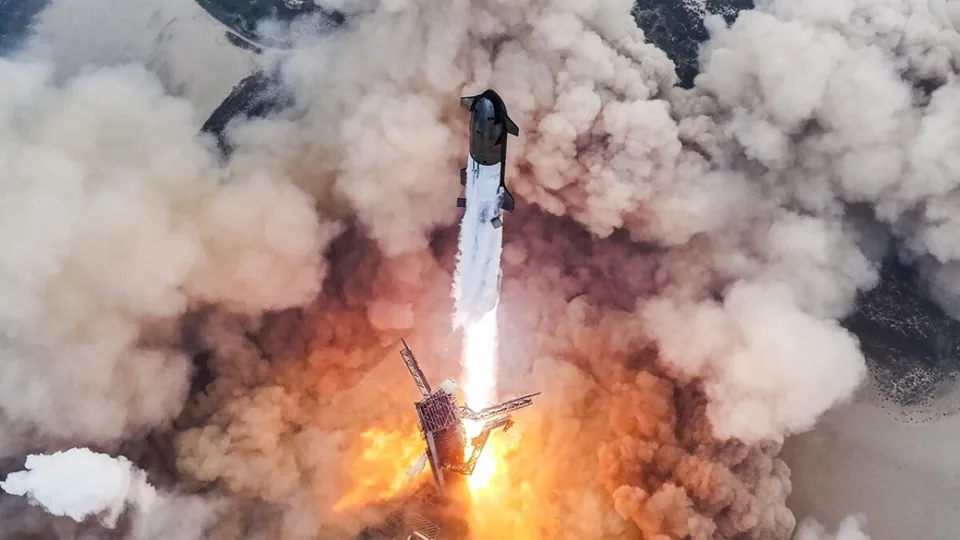
Improvement of the Launch Platform
After the destruction of the platform on the first flight, SpaceX implemented a flame deflector with high-pressure water jets and new ground reinforcements. The improvements allowed refueling the Starship with propellant and oxidizer in just 45 minutes.
Super Heavy Landing Capability
The Super Heavy booster, at 70 meters tall, successfully reignited its engines and landed for the first time. Stage separation was ensured by the ejection of a hot separation ring, allowing for a simulated landing in the Gulf of Mexico.
Entering Orbit and Returning
The Starship crossed the edge of space on its second flight and reached orbit on the third. On the fourth flight, it returned from space without disintegrating, using additional rotation control thrusters and a thermal shield made of ceramic tiles.
SpaceX Light Years Ahead of Competition
These advances place SpaceX light years ahead of competitors still using disposable rockets. Companies like Blue Origin, with the New Glenn, and some Chinese projects are working on reusable rockets, but none have reached the scale and ambition of the Starship.
The Starship, designed to be fully and quickly reusable, aims to launch 100 tons into space and return for another flight on the same day. The Super Heavy could potentially fly three times a day, while the Starship once per day.
Next Steps for Elon Musk’s SpaceX
To bring this revolutionary project to fruition, Elon Musk’s SpaceX still needs to complete a few crucial steps:
- Capture the Super Heavy in real-time by the launch tower “Mechazilla.”
- Ensure that the vessel can re-enter the entire atmosphere.
- Make the reuse of the spacecraft viable and efficient.
SpaceX continues to lead innovation in space exploration, transforming the future of space travel and leaving its competitors in the prehistory of launches.