Portuguese
  Spanish


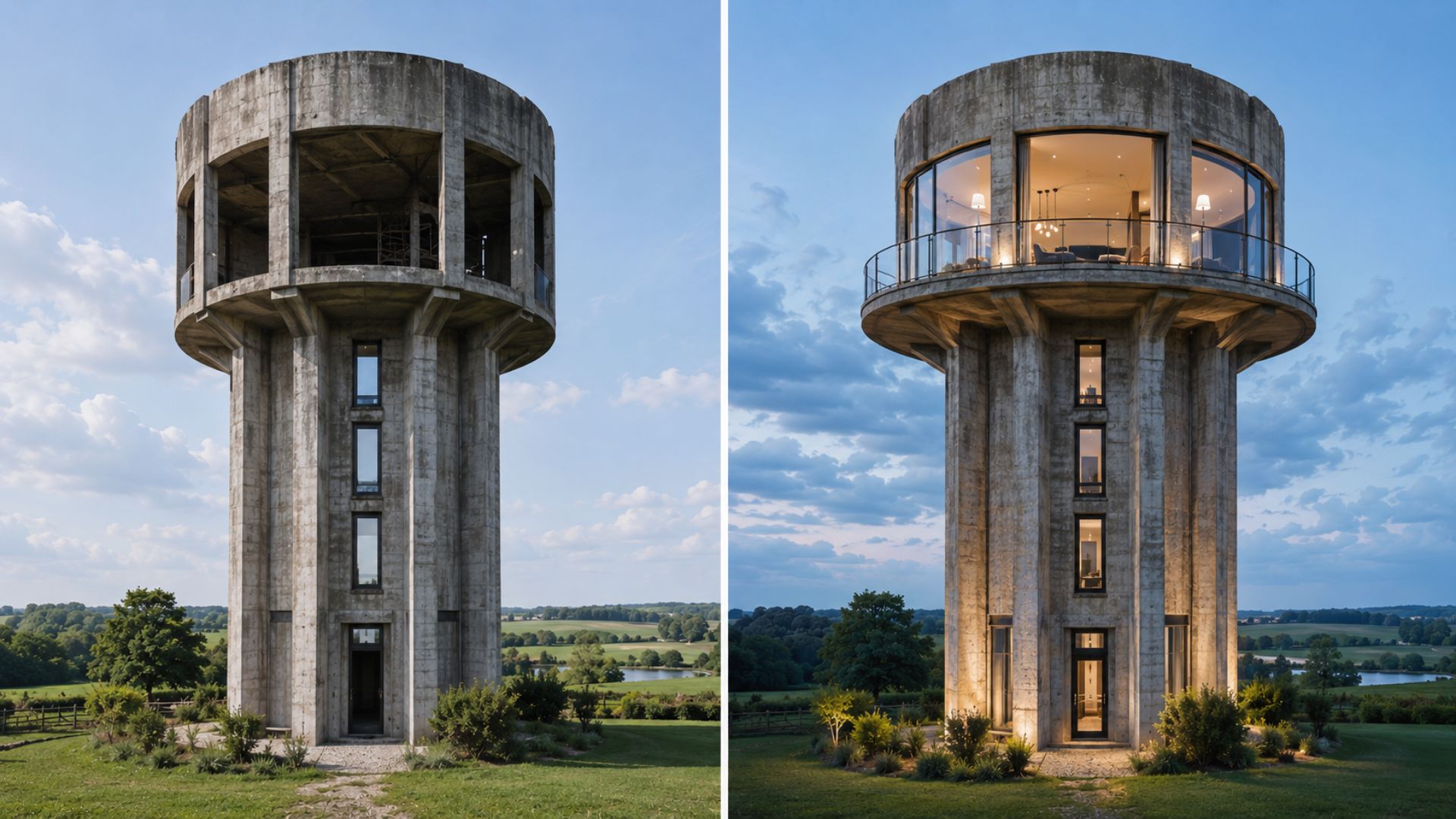

Matt and Ali Grey bought the Tonwell Tower, a brutalist concrete water tower from 1964, in England, and spent 4 years on the renovation. The former 23-meter water tank turned into a four-bedroom house, with a living room and kitchen at the top and a view that reaches London.
Some people look at an abandoned concrete tower and see just an ugly hulk. Matt and Ali Grey looked at one and saw their dream home. The couple bought an old brutalist water tower 23 meters high, built in 1964, and spent four years transforming the old reservoir into a four-bedroom home. At the top, where the water tank that supplied the region once stood, there is now a living room and a kitchen with a breathtaking view.
The story was told by the site New Atlas in February 2025. The structure is called Tonwell Tower, located in Hertfordshire county, England, and is one of those cases where the most unlikely construction becomes a home. From the top of the old water tank, the panoramic view can reach the silhouette of London on clear days, rewarding each one of the four years of hard work the couple faced.
From 1964 water tower to house: the unlikely structure
The Tonwell Tower was designed by architect Edmund Percey and erected in 1964 to supply water, with constant pressure, to the villages of Tonwell and Sacombe Park. It was a reinforced concrete water tower, in the brutalist style, capable of holding about 50,000 gallons, nearly 230,000 liters, at the top of its 23 meters.
-
Wood-Look Aluminum Emerges as a High-Tech Alternative for Facades and Gates, Offering Sophisticated Aesthetics and Low Maintenance

-
U.S. City Builds Tiny Home Village on Water Company Land to House 136 Homeless People: Inside the Social Housing Units

-
Woman Turns Shipping Container into Home, Embraces Rural Life to Cut Monthly Expenses to Just Over $330
-
France Revamps 530 Social Housing Units with Large Balconies and Glass Facades Without Demolishing Existing Buildings


Brutalism, here, is not an insult, it’s a style. Brutalist architecture relies on raw concrete, exposed, without disguises, and was fashionable in public works of the 1950s and 1960s. A brutalist water tower is, by nature, heavy, austere, and imposing, the opposite of what one imagines as the coziness of a home. Transforming this into a home required vision and courage.
And this specific water tower had the extra ingredient: height. At 23 meters, the structure offered something that no amount of money easily buys on flat land, a 360-degree view over the English countryside. It was precisely this hidden potential in the concrete that made the couple bet on the water tank, seeing a home where most saw just a forgotten monument.
4 years of work: 4,800 kg of glass and 7.5 tons of plaster
Transforming a water tank into a house is not a weekend renovation. Matt Grey, an industrial designer, undertook the project as a self-build, alongside his wife Ali and their children, and it took four years to complete. It was a labor-intensive project, with the family getting hands-on from start to finish, from planning to finishing touches.
The numbers of the project give an idea of the effort. To illuminate and insulate the concrete tower, the couple installed about 4,800 kg of glass, in 40 triple-glazed windows opened in the solid walls, in addition to 7.5 tons of plaster and 1.8 km of metal framework. Each window, weighing over 120 kg, had to be fitted into openings cut in the raw concrete, a task that combines engineering precision and the stubbornness of those who don’t give up.
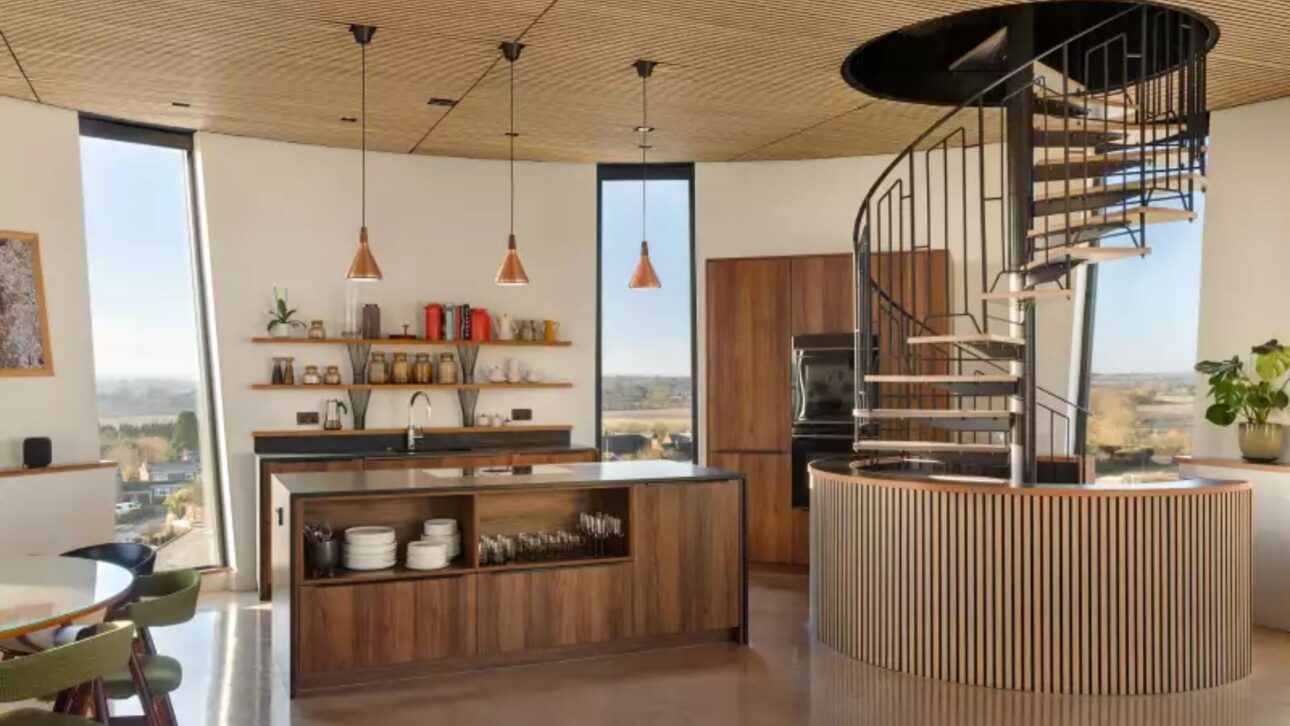
The result distributes the house over several levels within the old water tank. There are about 160 square meters spread over five floors, plus the terrace, totaling four bedrooms and four bathrooms. Going up and down there becomes a daily exercise, with spiral staircases and over a hundred steps connecting the floors of the water tower, from base to top.
The top reservoir that became living room and kitchen
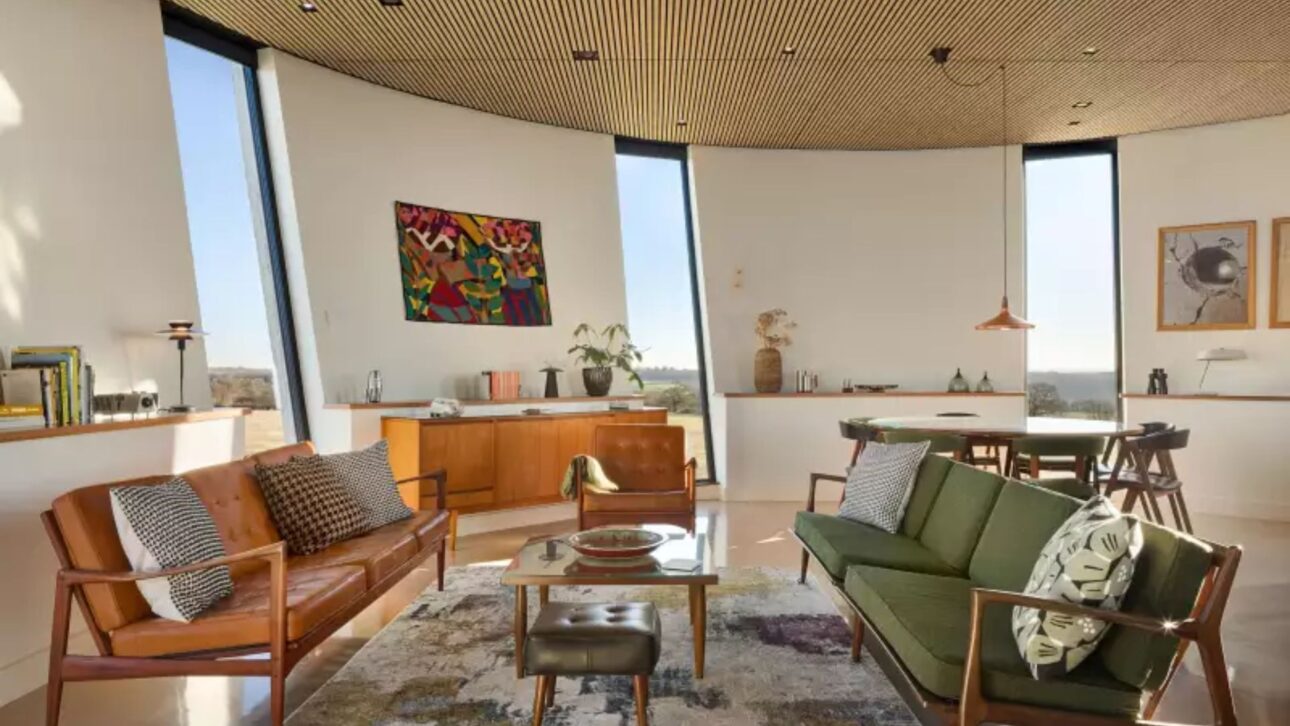
The old water tank, which was once full of water, became a spacious social area of about 60 square meters, round and open. Where there was once a water reserve, there is now a living room, dining room, and a complete kitchen, with a black granite and walnut wood countertop.
The choice to place the living area at the top is no accident. That’s where the best light and the best view are, so it makes perfect sense to live and entertain guests at the highest point of the water tank. Cooking and dining 23 meters high, surrounded by glass, is the experience that defines the house, and turns an ordinary meal into a landscape spectacle.
This intelligent utilization is what separates a good conversion from a mere adaptation. The circular format of the old reservoir, which could have been a problem, became a charm, with the environment flowing around without walls to hinder. The water tank dictated the design of the house, instead of being disguised, and this honesty with the original structure is part of the charm.
View that Reaches London: the Prize from Above
If there is a reason that justifies so much work, it is called the view. From the top of the tower, the window frames a 360-degree landscape that stretches for miles over the fields of Hertfordshire. On clear days, the view reaches the London skyline, the capital that is about 30 minutes away by train.
This proximity to London changes the property’s game. It is not an isolated retreat in the middle of nowhere, but rather a house with a postcard view a stone’s throw from the largest city in the United Kingdom. Having the tranquility of the countryside and the silhouette of London in the same window is the kind of rare combination that common towers on flat terrain would never offer.
The rooftop terrace completes the experience. After climbing over a hundred steps, the resident is greeted by a private lookout over the entire region. The view that reaches London ceased to be a skyscraper privilege and became the backyard of an old water tank, daringly repurposed.
Preserved Brutalism: Exposed Concrete with Modern Comfort
A clever detail of the renovation was not erasing the building’s identity. On the outside, the Tonwell Tower remains proudly brutalist, with raw concrete exposed, without makeup to hide what it always was. The house does not pretend to be something else, it embraces its water tower appearance, and that is precisely what makes it unique.
Inside, the game is about balance. The walls were insulated to prevent moisture and heat loss, but sections of the central concrete shaft were left exposed inside the rooms, as reminders of the industrial past. The raw concrete coexists with wood, fabrics, and warm colors, softening the brutalist coldness without betraying it.
The house also gained technology to be comfortable year-round. Efficient heating systems and modern insulation ensure that living inside a concrete water tower is not synonymous with cold or discomfort. It’s the 1960s brutalism reconciled with 21st-century comfort, proving that austere structure and cozy home can coexist.
From Water Tank to Airbnb: What the Case Teaches
The story did not stop with the family’s move. The Tonwell Tower also became a destination, rented as a seasonal accommodation, after attracting the attention of funds that reward unusual constructions. The old water tank, which nobody wanted, is now sought after by those looking for a different stay.
The case teaches a lesson that goes beyond architecture. Unlikely and abandoned structures, from water towers to old sheds, carry a potential that only those with vision can see. Reusing what already exists, instead of demolishing, is sustainable, economical, and full of personality, as long as there is patience for the years of work this usually requires.
Of course, it’s not for everyone. Buying a brutalist water tower and funding four years of renovation requires plenty of money, time, and willingness. But the result, a four-bedroom house with a view that reaches London, shows that it’s worth dreaming big with what seems like scrap, and the Tonwell Tower is living proof of that.
In the end, the story of Matt and Ali Grey is about seeing beauty where others see old concrete. They took a 23-meter brutalist water tank from 1964 and transformed it, in four years, into a four-bedroom house with a top-floor room and a view that reaches London. It’s the kind of boldness that redefines what can become a home. Few people would have the courage, and perhaps that’s why the result is so impressive.
And you, would you have the courage to live in an old water tower, climbing over a hundred steps every day in exchange for a view that reaches London, or do you prefer the comfort of a regular house at street level? Share in the comments if you would take on this water tank as a home.