Portuguese
  Spanish


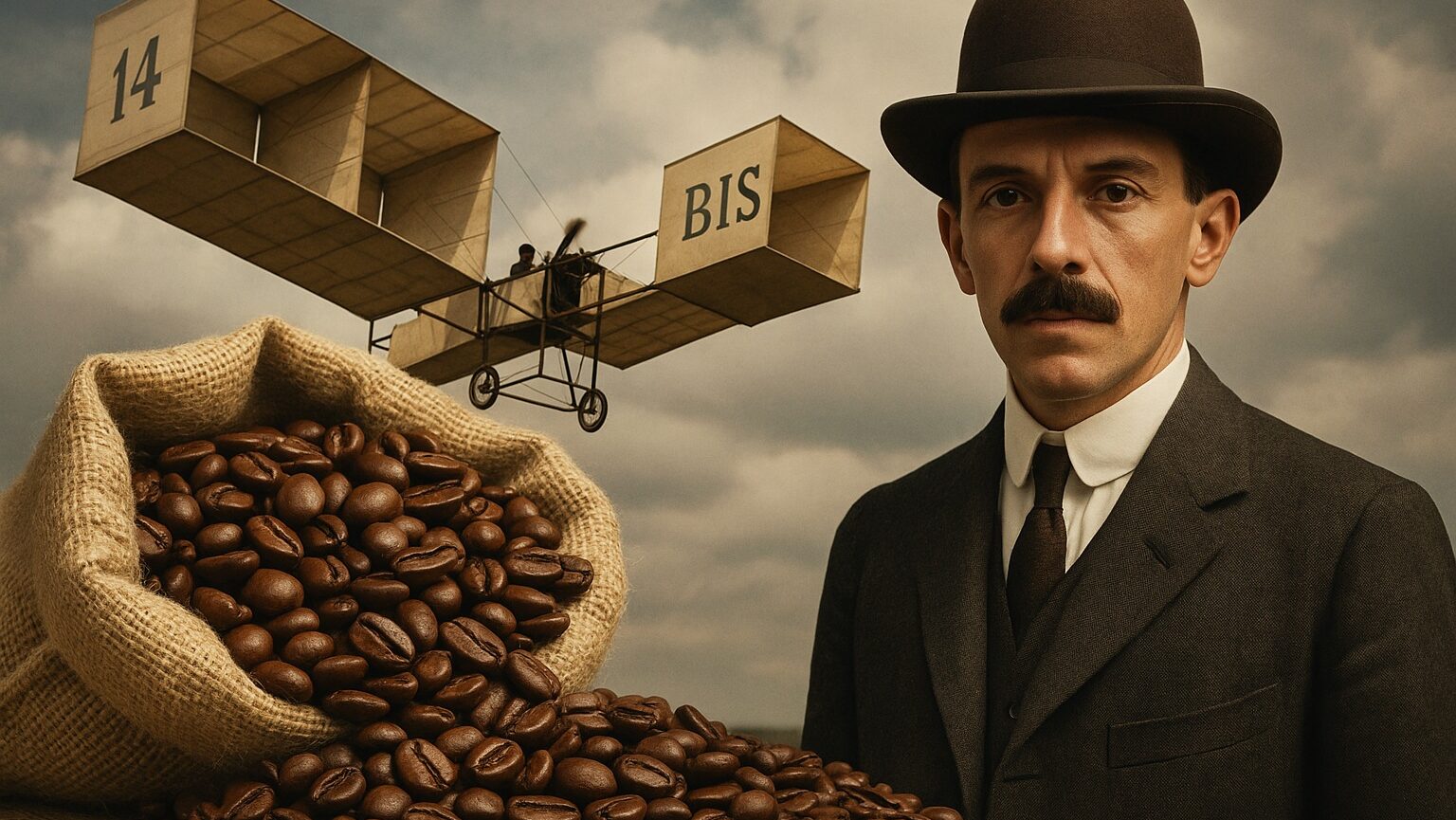

Coffee Funded Inventions of Santos-Dumont, Supported Experiments in France, and Made the Flight of the 14-BIS Possible, a Milestone that Changed World Aviation
When we think of Alberto Santos-Dumont, images of his inventions, airships, and the iconic 14-BIS immediately come to mind. Known and admired around the world, the Brazilian earned a place in the “Book of Steel” of the Pantheon of Fatherland and Freedom, an honor reserved for figures who changed history. His trajectory was only possible thanks to a detail often forgotten: coffee.
The Coffee That Funded Innovation
Henrique Dumont, the aviator’s father, was one of the largest coffee barons of the Brazilian Empire. His Arindeuva farm, located in the interior of São Paulo, became a reference in modernity.
Considered the largest and most advanced in Latin America, it was equipped with cutting-edge technology for its time.
-
16-Year-Old from Brazil’s Sertão Wins Young Scientist Award for AI Predicting Rainfall with 94.5% Accuracy to Aid Farmers

-
Netherlands Reports First Child Euthanasia Case Since Rule Expansion for Minors

-
Brazilian Innovator Survives Homemade Submarine Dive in Paraty Despite Hatch Leak and False Oxygen Alarm
-
China Develops Custom 140-Ton Electric Mining Truck with 770 kWh Swappable Battery, Deploys 290 Units in Xinjiang’s Largest Zinc Mine



Among the innovations, Henrique built a 96-kilometer railway within the property. Small locomotives transported the beans to the processing area, ensuring speed and efficiency.
This infrastructure not only modernized production but also generated a fortune that would become crucial for his son’s future.
When the family moved to France, Alberto inherited an amount equivalent to over 3 million current dollars.
Therefore, it was with this capital that he financed experiments, prototypes, and achievements that would forever change world aviation.
Childhood Among Machines and Coffee Plantations
Called Albertinho by family members, Santos-Dumont did not show interest in coffee cultivation.
His fascination lay with the machines imported from Europe by his father. Readings of Jules Verne further fueled his imagination.
At the farm, Alberto took his first steps as an inventor. He played with mechanisms and created small technical solutions. In an interview published in 1914, he summarized this phase with enthusiasm:
“My greatest joy was to occupy myself with my father’s mechanical installations. That was my department, which made me very proud.”
The farm environment, therefore, served as an improvised laboratory. It was there that the young observer trained the creativity he would later apply in his experiments in the sky.
Coffee Always Present
Even after leaving Brazil, coffee continued to mark his routine. In Paris, Santos-Dumont made a point of bringing a thermos of coffee on his flights.
The drink, besides being a habit, was a symbol of childhood and the financial foundation that supported his projects.
Furthermore, each achievement was celebrated with coffee. It was a way to keep the connection with his origins and the wealth that made his daring ventures possible.
Thus, the Brazilian bean became a constant companion on his journey.
From Farm to Sky
The family’s financial support was essential. Henrique Dumont, in letters sent to his son, assured him he should not worry about money. His only duty would be to study and invent.
This trust gave Alberto the freedom to invest in airships and, later, the 14-BIS.
The result was historic. In 1906, in front of witnesses in Paris, Santos-Dumont made the first certified flight of a heavier-than-air airplane.
The feat solidified his global fame and immortalized the Brazilian name as the “Father of Aviation”.
Therefore, there is a direct connection between coffee and technological innovation. The production that sustained the national economy in the 19th century also paved the way for advancements that transformed the planet.
Coffee, Innovation, and Lesson for Today
When boarding any airplane, few remember that part of this achievement was born in the coffee plantations of São Paulo.
Coffee not only drove the economy but also served as fuel for one of the greatest inventors in history.
Moreover, the trajectory shows how strategic investments in the field can generate global impacts.
The Brazilian agribusiness, when allied with innovation, has the capability to transcend borders and influence generations.
Producers, investors, and enthusiasts in the sector find a clear inspiration in this story. The most important thing is to realize that the wealth generated from the soil can drive science and technology.
Just like in the past, the current agribusiness can create solutions for the challenges of the present and the future.
The legacy of Santos-Dumont shows that innovation and agriculture go hand in hand. Coffee, a symbol of Brazil, not only fed millions but also enabled man to conquer the skies.
With information from Compre Rural.