Portuguese
  Spanish


Without a booster rocket, General Hypersonics claims to have used an impact accelerator to take the same system beyond Mach 4 twice in about 90 minutes. Published on June 7, 2026, the demonstration aims for accessible hypersonic tests and high-cadence suborbital missions.
General Hypersonics, a Washington-based company, announced a reusable launch demonstration without a booster rocket that exceeded Mach 4 twice using the same system. The information was published by Interesting Engineering on June 7, 2026, based on a company statement.
According to information published by Interesting Engineering, the test was conducted with an impact accelerator technology capable of propelling payloads through a reusable launch tube. The source states that the platform is developed and tested at the HyperLab, but does not detail the exact location of the facility, while the company targets repeatable suborbital missions.
Reusable system exceeded Mach 4 twice in about 90 minutes
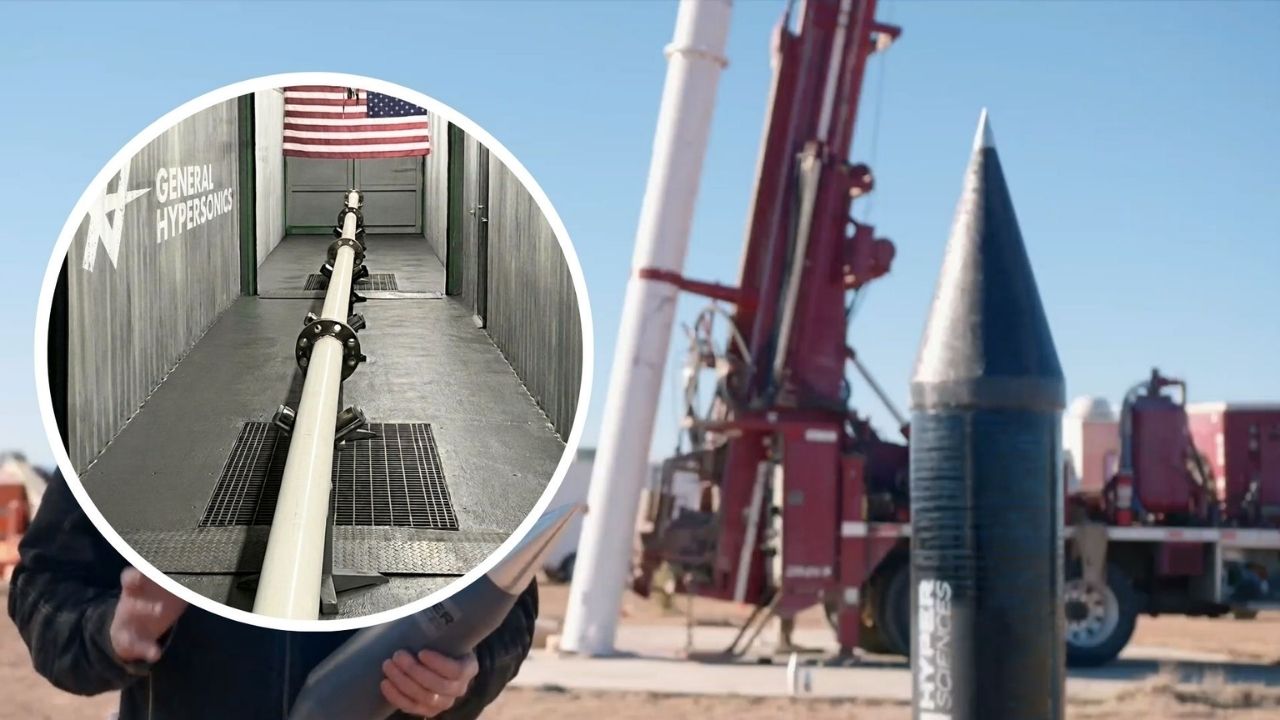
The demonstration drew attention because the same system surpassed Mach 4 in two separate launches, with the second occurring approximately 90 minutes after the first. According to the company, the milestone reinforces the pursuit of more accessible, repeatable, and scalable hypersonic and suborbital operations.
-
Sixth-grader in Miami wins Lemelson Young Inventor Prize for creating water-absorbing concrete using discarded oyster shells and charcoal.

-
Brazilian Researchers Develop Portable, Painless, Radiation-Free Breast Cancer Tracker Using Microwaves, Costing Around $200 and Potentially Replacing $240,000 Mammograms
-
Beer as a Vaccine? Scientist Develops Experimental Method with Live Yeasts, Tests Own Brew, and Publishes Results on Zenodo

-
Brazilian Researchers Develop ‘Rapha’ Device Using Natural Latex and LED Light to Heal Diabetic Foot Ulcers and Prevent 50,000 Annual Amputations


The central point was not just to achieve high speed, but to repeat the launch quickly. Instead of relying on a disposable system, General Hypersonics claims to be developing a platform capable of restarting, recharging, and relaunching multiple times a day.
Mach 4 corresponds to about 5,000 km/h, more than four times the speed of sound. Although hypersonic flight is generally defined starting at Mach 5, the company regards the result as a relevant step for high-speed testing.
The technology should not yet be confused with ready orbital access or a complete replacement of traditional launchers. The presented advancement is linked to testing and development of high-cadence systems, without a first-stage booster rocket.
General Hypersonics bets on impact accelerator
General Hypersonics’ platform uses an impact accelerator to propel payloads within a reusable tube. According to the company, the system is powered by clean combustible gases and dispenses with the use of an initial booster rocket and toxic propellants.
This approach attempts to tackle one of the biggest obstacles of hypersonic testing: cost, complexity, and low flight frequency. Many programs rely on transport aircraft, auxiliary rockets, specialized test areas, and heavier mission planning.
The company’s proposal is to reduce the entry barrier for testing technologies at extreme speeds. If the same equipment can be quickly reloaded, the cycles of trial, error, and improvement can become shorter.
The system was operated manually in both launches, according to the source. General Hypersonics claims that automated loading systems are in development to further improve the response time between shots.
Without rocket, test aims for lower cost and more repetition
The system’s differential lies in the promise of conducting high-speed tests without a disposable rocket. This change is important because each traditional launch may require its own infrastructure, specific fuel, long preparation, and component disposal.
In aerospace and defense sectors, the ability to test more frequently can accelerate development. The higher the flight frequency, the greater the chance to correct failures, validate materials, and refine designs in less time.
Mark Russell, founder and CEO of General Hypersonics, stated that the difference lies in creating a system designed to be launched repeatedly, not for a single mission. The company’s view is that this repetition can pave the way for cheaper tests and faster technological development.
Even so, the statement itself indicates that the platform is evolving. The automation of loading, the expansion of cadence, and the advancement to routine suborbital missions still appear as next steps, not as fully consolidated stages.
Hypersonic tests still depend on expensive infrastructure
The hypersonic sector is known for requiring complex infrastructure. To achieve extreme speeds, traditional programs may use aircraft, booster rockets, test corridors, specialized sensors, and teams dedicated to unique missions.
General Hypersonics aims to differentiate itself by proposing a simpler and reusable path. The use of an impact accelerator could reduce part of this dependency, especially in test phases where repetition is more valuable than a single large-scale mission.
The advancement matters because limited testing is costly and delays learning. In high-speed technologies, materials, control, stability, and thermal resistance need to be evaluated multiple times before reaching more mature applications.
The platform does not eliminate all the challenges of hypersonic flight, but it changes the conversation about cadence. Instead of treating each launch as a rare event, the company wants to bring the process closer to a routine of more frequent trials.
Mach 4 shows extreme speed, but it’s not Mach 5 yet
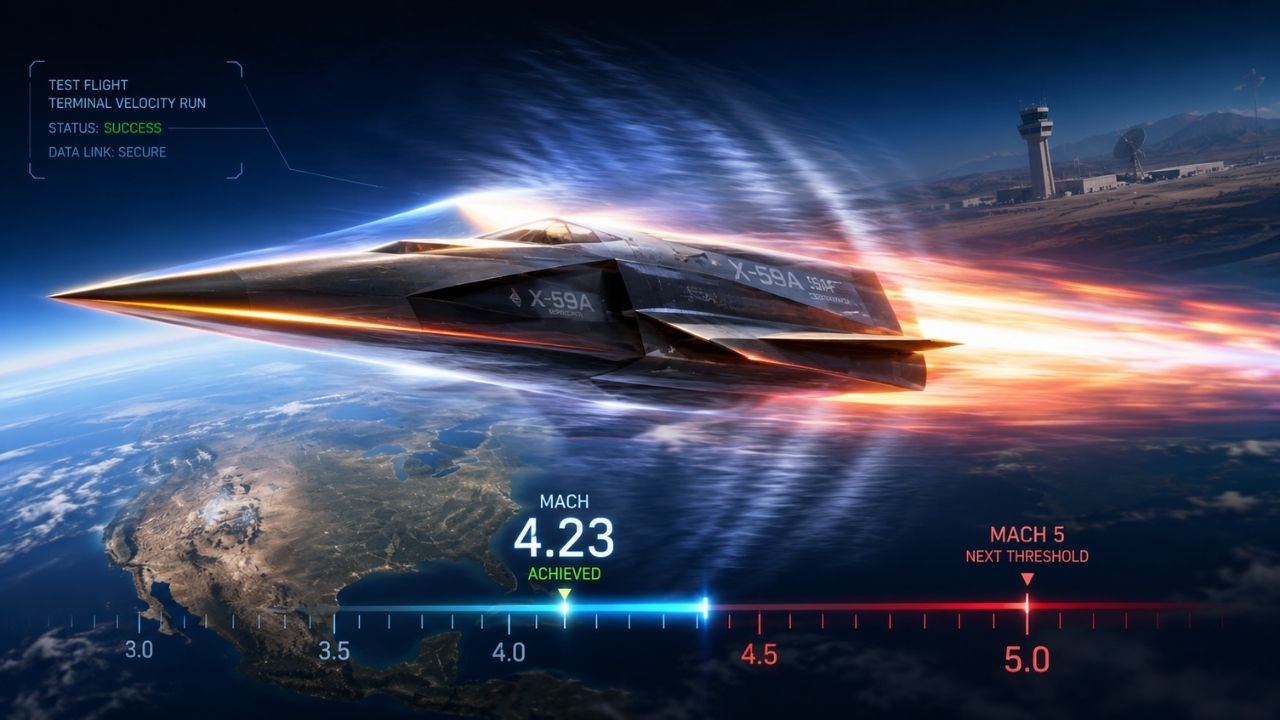
The demonstration surpassed Mach 4, an impressive number for any high-speed test. However, the technical reference cited by the source reminds us that hypersonic flight is usually defined as Mach 5 or higher.
This does not diminish the value of the experiment, but it helps to put the result in context. The test is on the frontier of high speed, but still below the limit generally used to classify full hypersonic flight.
The source uses a comparison to illustrate the scale: at Mach 4, a vehicle could theoretically cross the continental United States in less than an hour. This type of speed explains why governments and companies invest in increasingly repeatable test systems.
The challenge is to transform demonstration speeds into controllable, safe, and useful operations. For this, it is not enough to surpass Mach 4 once; it is necessary to repeat, measure, correct, and evolve the system.
Platform can operate in fixed or mobile locations
General Hypersonics states that its platform is designed to quickly recharge, launch frequently, and operate from fixed or mobile locations, on land or at sea. This point broadens the potential interest of the system for different types of operations.
If this flexibility is confirmed in future stages, the technology could serve test programs in varied environments. The possibility of relocating or adapting the platform is relevant for those seeking more agile access to high-speed trials.
The HyperLab, cited as the company’s reusable external launch facility, appears as the development and testing environment for the technology. However, the source does not provide the exact address of the facility nor complete details of the configuration used.
This limitation is important editorially. What can be stated with certainty is that General Hypersonics claims to have conducted the launches at its testing facility; there is not enough data in the provided source to detail coordinates, operational team, or all the technical parameters of the demonstration.
Repeatable suborbital missions are the next goal
General Hypersonics states that it intends to go beyond high-speed tests and advance to routine suborbital missions. This is the most ambitious point of the proposal because it involves transforming a test technology into a platform with broader use.
Suborbital missions do not enter full orbit but reach trajectories above the lower atmosphere before returning. They can serve for experiments, technology validation, scientific studies, and payload tests.
The promise of repeating these missions at a lower cost is what makes the project relevant. If the platform reduces preparation time and relies less on rocket infrastructure, it could pave the way for a more frequent model of suborbital access.
For now, the available information indicates development and testing, not a mature commercial operation. The company plans to increase automation before ramping up the cadence and advancing to recurring suborbital missions.
Sector seeks to reduce cost and accelerate development
The achievement comes at a time when governments and private companies are increasing investments in reusable hypersonic technologies. The search is for methods that reduce cost, increase flight frequency, and allow for faster learning.
In aerospace development, repetition is often decisive. Testing once shows possibility; testing many times shows reliability. It is this difference that General Hypersonics is trying to exploit with its reusable system.
The absence of a disposable rocket booster can also have environmental and operational impacts, especially if it reduces the use of toxic propellants and the need for single-use components. However, the source does not present figures on savings or emissions.
Therefore, the result should be read as a technical milestone declared by the company, not as definitive proof of replacing traditional methods. Public data is still lacking on real cost, scale, safety, payload, and performance in more complex missions.
System without rocket could change the logic of extreme tests
The General Hypersonics test points to a simple yet powerful idea: instead of treating each launch as a rare and expensive event, the company wants to create a reusable routine for ultra-high-speed flights. The fact that it repeated two launches above Mach 4 in about 90 minutes is the center of this narrative.
If the technology advances, the system without a rocket could help reduce the cost of hypersonic tests, accelerate material development, and bring more frequent suborbital missions closer. The big question is whether the model can move from demonstration to consistent operations at scale.
The promise is relevant because extreme speed requires more than power. It requires repetition, control, safety, cost reduction, and infrastructure capable of supporting many test cycles.
And you, do you believe that systems without rockets can open a new phase for hypersonic tests and suborbital missions, or will traditional rockets still remain indispensable for a long time? Leave your opinion in the comments.