






 Portuguese
  Spanish


Without treated water and tired of waiting for the government, residents of the Ha-Matsa villages in Limpopo, South Africa, set up their own water system. With about R$ 3,7 thousand, they connected a mountain spring to the old community taps and brought water to almost 5,000 people.
Faced with the lack of piped water, a community decided to solve the problem on their own. In the Ha-Matsa villages in Limpopo, South Africa, the residents pooled their resources and built a water system that connects a mountain spring to the village taps. The case was reported by the South African site EWN.
The cost of the project was surprisingly low. The residents raised about 12,000 rands, equivalent to approximately R$ 3,7 thousand, with a contribution of about R$ 15 per family. With this money, they bought pipes and drew water directly from the spring.
The result benefits almost 5,000 people. The water system has been operational for about three years and provides water to families who previously depended on precarious sources and the municipal well. But the story also has important limitations, highlighting the size of the challenge. See below how it was all done.
-
Opened in 1980, Shopping Recife was Pernambuco’s first mall and helped transform Boa Viagem into a bustling and sought-after district in southern Recife.

-
Rare Case of Neurocysticercosis in Spain: 60-Year-Old Man’s Suspected Brain Cancer Turns Out to Be Tapeworm Cysts, Avoiding Invasive Cancer Treatments

-
Horse Trailer from 2000 Transformed into Mobile Home with Bed, Kitchen, Bathroom, and Workspace in Upcycling Project
-
Life in the Arctic: Surviving Months of Darkness, Frozen Seas, and Isolation Until the Thaw




How the residents of Ha-Matsa set up the water system
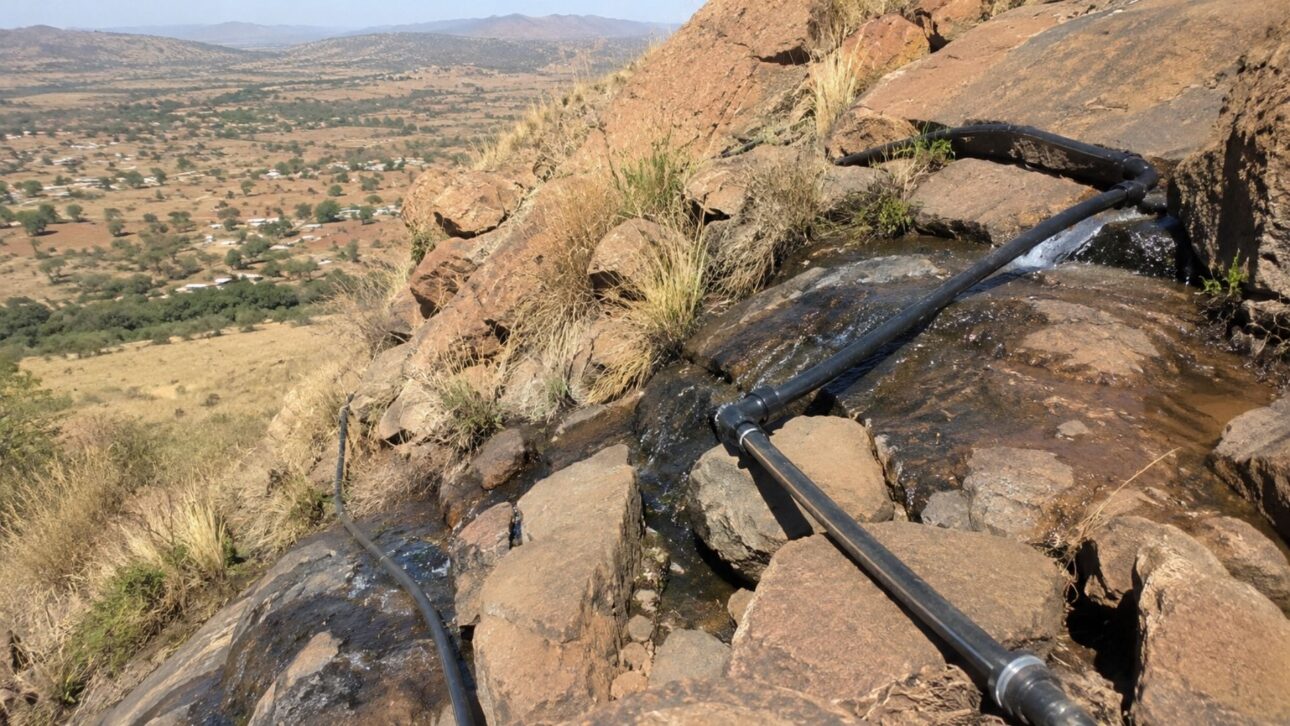
The project was born from a community fundraiser. Tired of waiting for an official solution, the residents of the Ha-Matsa villages, near Louis Trichardt, gathered about 12,000 rands, around R$ 3,7 thousand. Each family contributed a small amount, and the collective sum was enough to purchase the basic materials.
The labor also came from the community itself. According to EWN, local unemployed youths helped install the piping, turning the lack of work into a collective effort. It was this joint effort that took the water system off the drawing board, without relying on contractors or public funds.
The layout took advantage of an existing structure. Instead of creating everything from scratch, the residents connected the new pipes to the old community taps, installed during the apartheid period. Thus, the water from the spring began to reach distribution points that had been abandoned or dry for a long time.
The system is being gradually improved. After operating for the first few years, the network was recently reinforced with larger diameter pipes to improve pressure and carry the water further. It is simple engineering, done by trial and adjustment, but it has changed the routine of the villages.
The case adds to a water crisis affecting all of South Africa. In several provinces, infrastructure failures, drought, and poor management leave communities without regular supply. In Limpopo, one of the hardest-hit regions, episodes like that of Ha-Matsa are frequent.
From the mountain spring to the taps: how it works
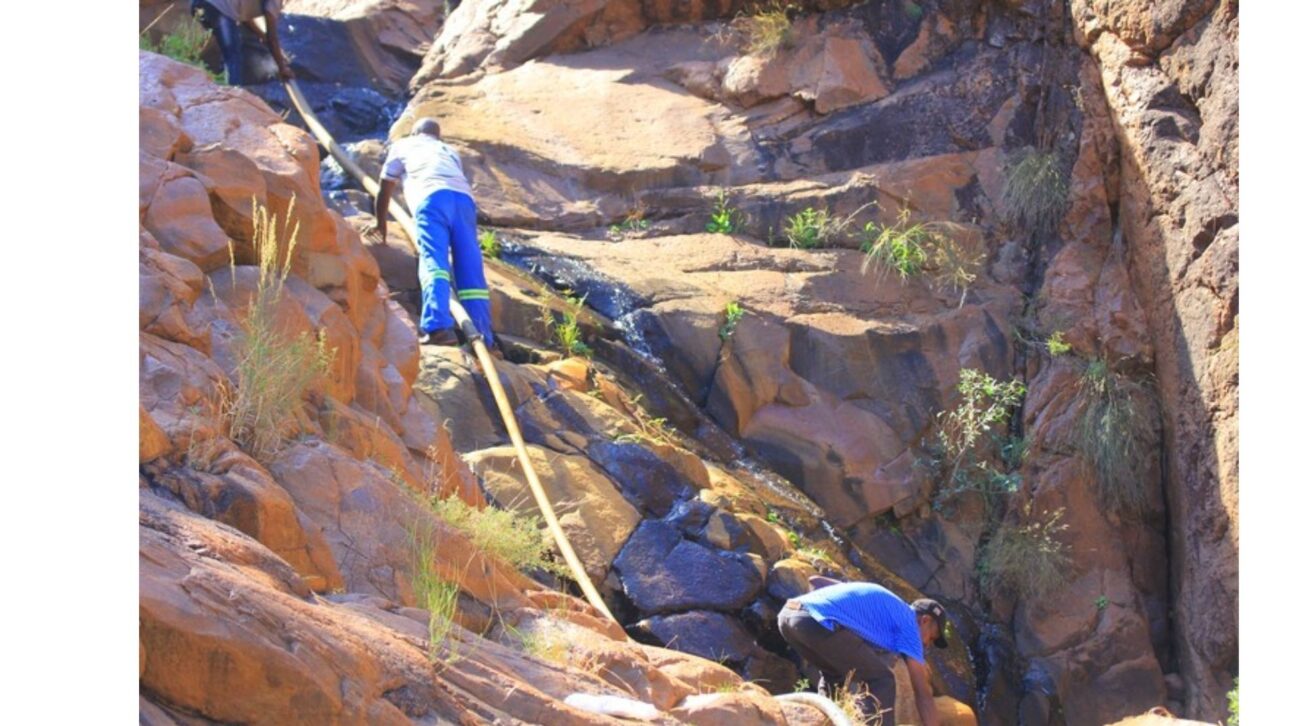
The heart of the project is a spring in the mountain. The water naturally emerges at a higher point of the terrain and, therefore, flows down the pipes by gravity, without needing pumps or electricity. This use of the slope is what makes the water system cheap and easy to operate.
Gravity-fed water systems like this have been used for centuries around the world. When there is a spring at a high point, the terrain’s own slope pushes the water through the pipes to the taps, eliminating the need for pumps. It is simple and inexpensive engineering, ideal for places without reliable electricity, like many rural villages.
The distribution follows the logic of the simplest path. From the spring, the piping runs down the mountain until it reaches the community taps scattered throughout the villages. Since everything works by the force of gravity, there are no electricity bills or expensive equipment to maintain the water flow.
The residents still tried to maintain the water quality. They built a kind of stone and cement wall next to the spring, functioning as a rustic filtration barrier to retain dirt. It’s a homemade attempt to make the water a little safer before it flows through the pipes.
Even so, the system is simple and has weaknesses. Without chemical treatment or adequate protection, the water that reaches the taps is raw, coming directly from the mountain. The arrangement solves the most urgent part, which is having water nearby, but it is far from the standard of a treated supply network.
R$ 3.7 thousand to supply 5,000 people
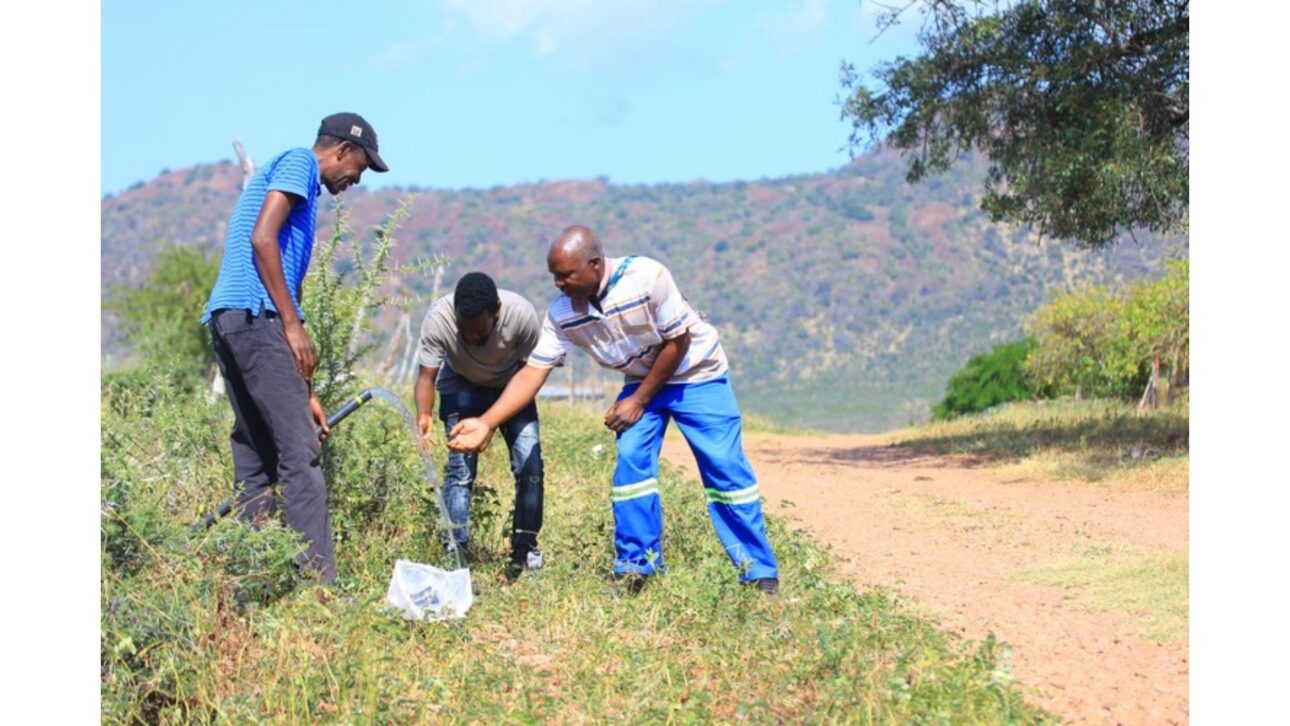
What is most impressive about the case is the relationship between cost and reach. With about R$ 3.7 thousand, the residents managed to bring water to almost 5,000 people, a number that shows the power of a well-directed collective solution. Divided among so many people, the investment per person is minimal.
The cost per family is also revealing. The contribution of about R$ 15 per household fits into most budgets, which helped make the fundraising possible. When many people contribute a little, the result is a project that no single family could afford on their own.
This low cost contrasts with the value of large projects. While the community spent a few thousand reais, official supply works in the region involve hundreds of millions of rands. The difference in scale explains why the homemade water system made the news: it delivers an immediate result for a fraction of the price.
Of course, the comparison has its limits. The residents’ project does not offer treated water or the same reliability as a professional station, but it solves the most immediate problem. For those who didn’t have water near their home, having the tap working already represents a huge transformation in daily life.
The secret, more than the money, was the organization. Bringing families together, defining the contribution, and coordinating the joint effort required trust and community leadership. Without this coordination, no amount would be enough to take the water system off the ground and keep it running for three years.
The problem: the treated water that never arrived
To understand the achievement, it is necessary to know the scarcity of the region. The villages of Ha-Matsa have never had regular access to treated and piped water, relying on natural springs and wells. The spring from the mountain has always been one of the main ways to obtain water, even without any treatment.
The scenario reflects a national problem. Although South Africa has made significant progress in water access since the end of apartheid, millions of people still experience irregular or unsafe supply. In rural areas, the gap between the law and the tap that actually works remains large.
The official supply is scarce and unstable. According to GroundUp, the region has a municipal well that takes almost five days just to fill the reservoir, which gives an idea of how insufficient the water supply is for so many people. Waiting for the public network meant living with scarcity.
Private wells also cannot cope. The case of a resident illustrates the drama well: her 60-meter well dried up after four years, and when she tried to drill another 30 meters, she only found mud. Such stories are repeated in the villages and help explain the urgency for an alternative.
It was this combination of problems that pushed the community to take action. Without treated water, with wells drying up and a failing public supply, the residents understood they needed their own solution. The water system from the spring emerged as the possible answer in the face of such scarcity.
The government project that drags on
While the community acted, a large official project remained stalled. In the region, there is a government water supply project, linked to a water treatment station, budgeted at hundreds of millions of rands. Despite the size of the investment, it accumulates delays and has not yet solved the villages’ problem.
The reasons for the delay accumulate. According to reports, the project faced delays in funding release, problems with material delivery, heavy rains, and even local conflicts, pushing deadlines forward. For the residents, each postponement meant more time without water at the tap.
The community’s frustration is evident in the leaders’ statements. “Our people are risking their health using water shared with animals because requests for help were ignored,” said traditional leader Philemon Matsa, according to GroundUp. The statement sums up the neglect that motivated the homemade project.
It is this contrast that gives strength to the story. On one side, an expensive and stalled project; on the other, a simple, cheap, and functioning water system. The comparison does not mean that the homemade solution is ideal, but it exposes the public power’s failure to guarantee a basic right.
The limitations the system still has
As inspiring as it is, the project is far from perfect. The biggest weakness is the water quality: since it is not treated, there is a risk of contamination, especially because the spring is sometimes shared with animals. The filtration wall helps, but it does not replace proper treatment.
Maintenance is another sensitive point. The pipes purchased are cheap and frequently break, requiring constant repairs. In some cases, the residents have to walk more than three kilometers to fix damaged sections of the pipeline, a never-ending task.
The coordinator himself admits the difficulties. “It’s not easy to maintain because the pipes are of low quality. We are asking for donations to buy more resistant pipes and expand the system,” said Khathutshelo Matsa, community coordinator, to GroundUp. In other words, the water system survives on improvisation.
All this shows that the solution is a patch, not a full stop. The homemade water system takes the community out of emergency, but does not eliminate the need for a treated and reliable public network. The effort of the residents buys time, without permanently solving the historical lack of sanitation.
Why communities end up doing public works on their own
The case of Ha-Matsa is not unique in the world. In many poor or remote regions, residents end up taking on tasks that should be the responsibility of the State, such as opening roads, setting up water networks, or managing sewage. The absence of public services pushes the population towards self-management.
This movement has two sides. On one hand, it shows the strength and creativity of communities, capable of solving problems with very few resources, like the water system connected to the spring. On the other hand, it exposes a serious flaw: people only take such risks because the public authorities are not fulfilling their role.
There are also risks involved in these works. Without professional engineering, homemade projects can have safety, durability, and quality issues, like the untreated water from Ha-Matsa’s taps. Goodwill addresses the urgent, but does not guarantee a lasting and safe solution.
Therefore, experts often see these initiatives as a warning. When many communities need to do the State’s work on their own, the message is that the basic services system is failing. The creativity of the residents deserves applause, but it should not be the only option.
The next challenge is continuity. Community works depend on constant maintenance and people willing to take care of them, which is not always sustainable over time. Therefore, the ideal is for public authorities to take over and improve these systems, instead of leaving the entire burden on the residents.
What this has to do with Brazil
The reality of Ha-Matsa is more familiar to Brazil than it seems. Millions of Brazilians still live without access to treated water and basic sanitation, especially in the semi-arid and rural areas. Just like in South Africa, many people here depend on wells, water trucks, and improvised sources.
The Brazilian numbers help to gauge the problem. About 30 million people in the country still do not have access to treated water, according to sanitation sector surveys, and the majority are in rural areas and outskirts. It is in this vacuum that community solutions similar to those of the residents of Ha-Matsa emerge.
The country also has its tradition of collective solutions. In the Northeast, cistern programs help families capture and store rainwater, and community efforts bring supply to places forgotten by the public authorities. The logic is similar to that of the residents who connected the spring to the taps.
The difference often lies in technology and support. When there is technical guidance and some public resources, water capture improves in quality and safety, avoiding the contamination problems seen in Ha-Matsa. Combining community effort with engineering knowledge usually yields the best results.
Finally, there is a lesson about rights and accountability. Stories like this inspire with creativity, but remind us that clean water is a right, not a favor. In Brazil and in South Africa, the ideal is for the quality water system to arrive through public means, without the population needing to improvise to survive.
And you, would you organize a community effort to bring water to your home?
The story of the villages of Ha-Matsa shows the strength and limits of community action. With about R$ 3,700 and a lot of work, the residents connected a mountain spring to the taps and brought water to nearly 5,000 people in South Africa. An admirable feat, but one that also highlights the absence of public power. Their homemade water system became a symbol of an old struggle for something basic: having clean water coming out of their own tap.
And you, would you participate in a community effort to ensure water in your community? Share in the comments what you think of the solution created by the residents of Ha-Matsa and whether you believe such initiatives should receive technical and financial support to operate safely.


