






 Portuguese
  Spanish


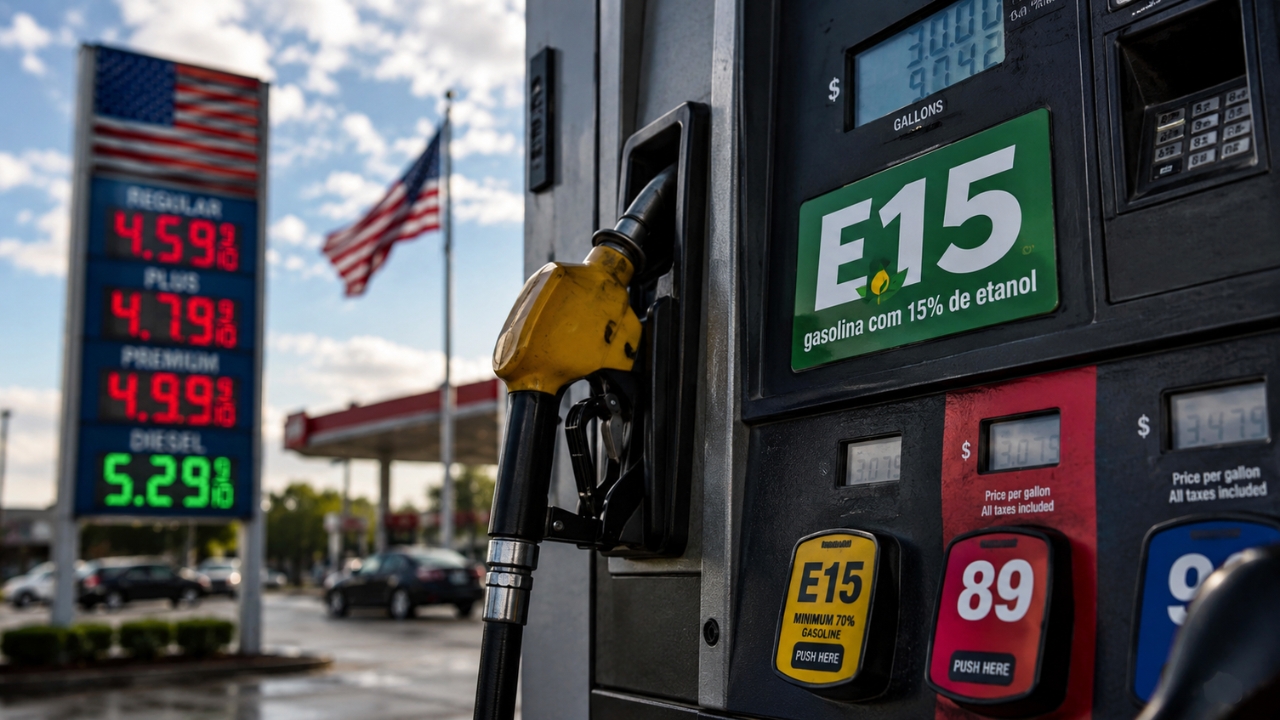

Understand why E15 gasoline has become a bet in the United States and how the Brazilian experience with higher ethanol content helps explain this debate.
The surge in gasoline prices has once again put the United States on alert. Amid prices above $4.50 per gallon, House Republicans approved a measure that could allow the sale of E15 gasoline, a blend with 15% ethanol, year-round.
According to information published by Newsweek, the project was approved by 218 votes to 203 and now faces a more complicated path in the Senate. The proposal aims to ease the burden on drivers before the summer season, when fuel consumption tends to increase.
But there is a detail that draws even more attention for the Brazilian reader: while the US debates the expansion of E15, Brazil already deals with regular gasoline that contains 30% anhydrous ethanol in the blend. In other words, what still causes political dispute there is already routine at gas stations here.
-
Drivers are falling for these scams without realizing: operation reveals closed gas stations, adulterated fuel, and hidden losses when refueling.

-
New Fiat EV, priced at R$ 77,000, will bring a reinterpretation of the 147 and a consumption equivalent to 70 km/l.

-
Petrobras surprises the market by cutting diesel by R$ 0.35 per liter, and the decision may ease the tax impact for drivers and transport companies.
-
Gasoline at R$ 4.99 makes drivers wait more than an hour at Havan gas stations in Santa Catarina, during a “zero tax” promotion with a limit of 15 liters per car and 25,000 liters available across five units of the network.





The American bet to try to curb the rise in gasoline prices
The proposal approved in the US House allows the national sale of Unleaded 88, the commercial name for E15, year-round. This fuel is composed of 85% gasoline and 15% ethanol, a higher proportion than the standard American E10 gasoline.
Currently, E15 faces restrictions in parts of the country during the warmer months due to environmental concerns. The fear is that, in high temperatures, the blend could contribute to the formation of smog, a common pollutant haze in large urban centers.
For supporters of the project, however, the focus is on the price. E15 tends to be cheaper than E10 and could help drivers at a time of strong pressure at the pumps. In some estimates, the difference could reach $0.25 per gallon.

Brazil already lives the reality of gasoline with much more ethanol
In Brazil, the conversation is quite different. Since August 1, 2025, regular gasoline has contained 30% anhydrous ethanol, forming what is called E30. Before that, the percentage usually used was 27%.
This means that Brazilian consumers are already filling up with a blend that has twice the ethanol content being discussed in the United States. While American policy moves to allow 15%, Brazil operates with 30% in regular gasoline.
In the case of premium gasoline, the mandatory percentage is lower: 25% anhydrous ethanol. This difference exists because premium gasoline follows its own specifications, aimed at vehicles that require higher performance and octane.
Ethanol is not new to Brazilian drivers
For Brazilians, ethanol is almost an old acquaintance. Besides being mixed with gasoline, it is also sold separately as hydrated ethanol, widely used in flex cars, which can run on both gasoline and ethanol.
This reality places Brazil in a unique position in the world. The country has one of the largest global experiences with biofuels, mainly because of production from sugarcane, one of the most traditional raw materials in the sector.
While in the USA ethanol is strongly linked to corn, in Brazil sugarcane dominates much of the production chain. This difference is important because it influences cost, productivity, environmental impact, and fuel availability.

A higher mix can lower the price, but it doesn’t work miracles
The great promise of the mix with more ethanol is to reduce dependence on pure gasoline and lessen the pressure on prices. Since ethanol is usually cheaper than petroleum-derived gasoline, increasing its presence can help hold back some of the adjustments.
In Brazil, the move towards E30 was also advocated as a way to strengthen national production, reduce imports, and give more space to renewable fuels. It is an economic, energy, and political bet at the same time.
But there is a point that the consumer needs to understand: ethanol has lower energy density than gasoline. In simple terms, it may yield less per liter. Therefore, a cheaper mix does not always mean automatic savings in all cases.
Why does Brazil accept 30% and the USA discuss 15%?
The difference between the two countries is not just in policy. It also involves the vehicle fleet, gas station infrastructure, environmental legislation, agricultural chain, and history of ethanol use.
In Brazil, engines and the market have adapted over decades to the greater presence of biofuel. Many cars sold in the country are already prepared to handle high percentages of ethanol, especially flex models.
In the United States, the situation is more limited. E15 is only approved for conventional light vehicles from the model year 2001 onwards and for flex-fuel vehicles. Motorcycles, heavy engines, and equipment like chainsaws and lawnmowers should not use this type of fuel.
The detail that may surprise at the pumps
Although E15 is presented in the US as a cheaper solution, it is still far from being universal. The fuel appears in just over 3,000 stations and is available in 31 states, according to the data cited in the original text.
In Brazil, on the other hand, the consumer does not choose whether they want regular gasoline with anhydrous ethanol: the mixture is already ready at the pump. When someone fills up with regular gasoline, they are getting a composition that necessarily includes a large portion of ethanol.
This difference makes the American debate curious for the Brazilian public. What in the US is sold as a possible novelty to ease prices, in Brazil has been a central part of fuel policy for many years.
The fuel war is just beginning
The approval of the proposal in the US House does not yet mean that E15 will be immediately released across the country. The text needs to pass the Senate, where it will face resistance and will need 60 votes to advance.
Meanwhile, expensive gasoline continues to pressure families, businesses, and governments. The search for alternatives like ethanol shows that fuel has ceased to be just an economic issue and has become a strategic one.
For the Brazilian reader, the comparison is inevitable: the US discusses whether to accept 15% ethanol, while Brazil already fills up with 30% in regular gasoline. In a world of unstable oil and explosive prices, this difference reveals how the mixture at the pump can transform into a political, economic, and environmental weapon.


