Portuguese
  Spanish


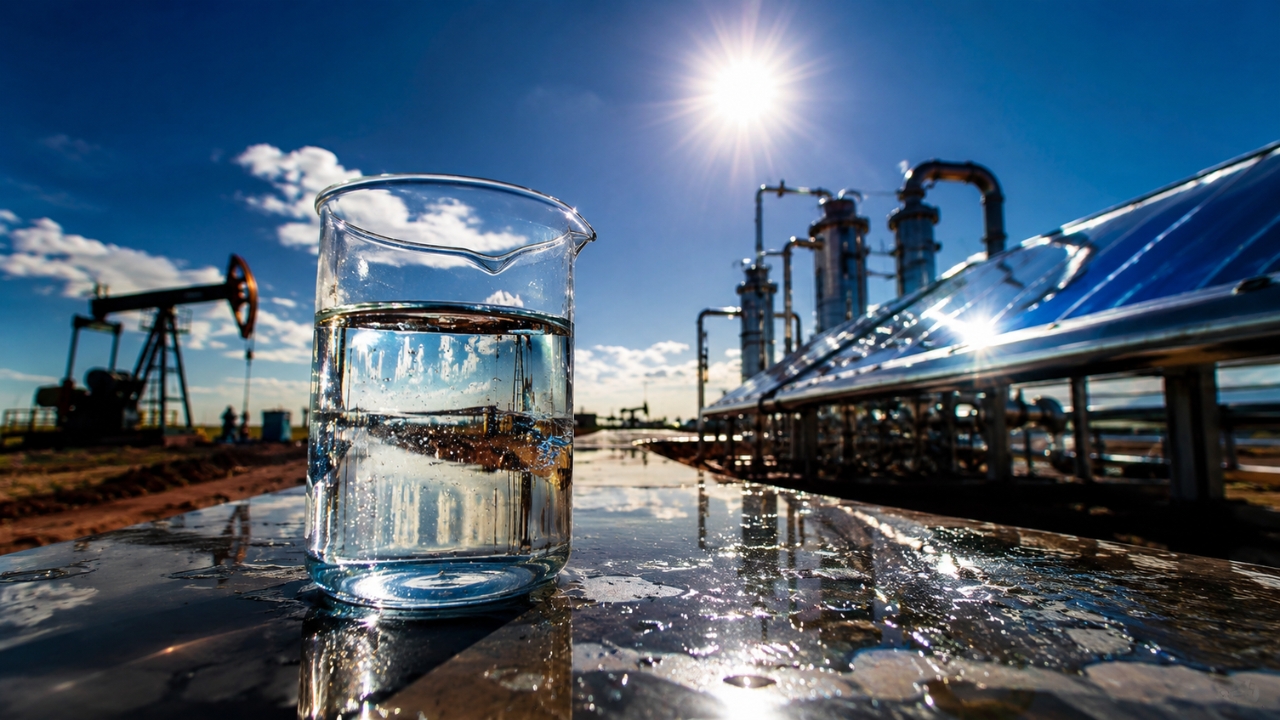


Experimental installation in the USA treats extremely salty water from oil fields and shows how solar energy can help reduce underground disposal.
An experimental installation in the heart of the United States oil industry may be opening a new front for one of the sector’s biggest problems: the fate of the extremely salty water that comes out with the oil. Instead of simply sending this waste to disposal wells, the technology uses solar energy to purify water so saline that it is several times more concentrated than seawater.
The project was put into operation by Sunvapor in partnership with the Southeast New Mexico College, which announced the initiative as the first solar desalination facility in the USA located at a commercial salty water disposal well. According to the statement released by the institution, the unit can treat produced water with about 130,000 ppm of total dissolved solids and generate a distillate with less than 400 ppm.
The number is striking because seawater usually has about 35,000 ppm of dissolved salts. In other words, the system is dealing with much more aggressive water, typical of oil regions where extraction generates huge volumes of liquid waste. The test takes place in the Permian Basin, one of the most important oil and gas areas in the United States.
-
Longest Solar Eclipse of the Century Will Turn Day to Night for Over 6 Minutes, Allowing Star Gazing; Won’t Recur for 156 Years

-
Brazilian Researcher Develops Protein Supplement from Tilapia Waste, Combining Innovation and Sustainability with Economic Potential

-
Women in São Paulo Unknowingly Tracked by Coin-Sized Tags Hidden in Cars and Belongings, Raising Stalking Concerns
-
Near a $750 million AI data center in Brazil, a resident’s well runs dry, leaving her unable to afford the $25,000 needed for repairs.


The hidden problem behind oil wells
When an oil well produces oil, it can also bring along large quantities of produced water, a mixture with salt, minerals, and other compounds present in underground formations. In many operations, this water is directed to disposal wells, where it is injected back into the subsoil.
This method is common, but it is not simple. In some regions, the increase in salty water injection has been associated with environmental, operational, and even geological concerns. The sector seeks alternatives because the volume of produced water can be enormous, and disposing of it indefinitely requires infrastructure, licensing, energy, and constant monitoring.
This is where desalination comes in as a potential game-changer. If part of this water can be treated, the waste ceases to be just a liability and has the potential for use in industrial, agricultural applications, or new processes, as long as it meets the required environmental and regulatory standards.
The technology that swaps electricity for solar steam

The most striking aspect of the solution is the use of solar energy to generate heat. Instead of relying solely on electricity in a highly intensive process, the system bets on steam as a thermal energy source to separate water from salts.
Sunvapor works with low-carbon industrial plants and has developed an approach specifically aimed at processes that require heat. In practice, the idea is to use solar energy to reduce operational costs and emissions associated with hypersaline water treatment.
This detail is crucial. Desalinating seawater is already expensive in many scenarios. Desalinating oil water, with much higher salinity, is even more challenging. Therefore, transforming solar heat into steam to power the process can be an important differentiator if the technology can scale.
From 130,000 ppm to less than 400 ppm
The technical leap is what makes the project so impressive. The water treated in the pilot has about 130,000 parts per million of total dissolved solids, an extremely high concentration. After the process, the distillate is below 400 ppm, a drastic reduction in salt load.
This does not automatically mean that the water can be drunk or used freely. For any reuse, it would still be necessary to evaluate other chemical components, local regulations, and safety standards. But the result shows that the most difficult step, removing a massive salt load, can be done with the support of solar energy.
The project also has an educational dimension. Southeast New Mexico College is using the facility to train professionals in sustainable water treatment, preparing the workforce for an industry that may grow precisely in regions where oil, water, and renewable energy intersect.
Why this matters for the oil sector

The oil industry is under pressure to reduce environmental impacts without stopping production. In this context, a technology capable of reducing the volume sent to disposal wells could change the operational logic in mature basins.
If the treatment proves economically viable, companies could reuse part of the water in industrial processes, reduce logistical costs, and decrease reliance on underground disposal. For areas with water scarcity, such as parts of New Mexico and Texas, any possibility of recovering water gains strategic importance.
The project is still a pilot, but it targets a gigantic problem. Produced water is one of the largest waste streams in the oil and gas industry. The more oil is extracted, the greater the need to deal with saline liquids, especially in fields where the water ratio increases over time.
A new race for the water hidden in oil
The most interesting thing is that the solution does not try to sell a distant futuristic promise. It is installed in a real operation, connected to a commercial disposal well. This brings the technology closer to the field and allows testing of performance, maintenance, cost, and water quality under conditions closer to industrial reality.
There are still obstacles. The treatment of produced water can involve compounds beyond salt, and each basin has its own characteristics. The challenge will be to prove that the technology works reliably, economically, and safely in different types of water and on a larger scale.
Even so, the symbolism is strong: instead of just burying saline water underground, a solar plant tries to transform it into a resource. If successful, the oil sector could gain a new tool to tackle two problems at once: liquid waste from extraction and increasing pressure for water in arid regions.