






 Portuguese
  Spanish



80 Trillion Watts: British Startup Launches Most Powerful Cannon in the World to Demonstrate Nuclear Fusion Process
First Light Fusion, a British startup, has taken an impressive step in the field of clean energy by firing the most powerful cannon in the world, aiming to achieve nuclear fusion.
When it comes to clean energy, one of humanity’s greatest dreams is to achieve nuclear fusion, the same reaction that occurs in the heart of stars and that could provide a virtually limitless and carbon-free energy source. It sounds like science fiction, but a British startup called First Light Fusion is making significant progress on this journey in a surprising way.
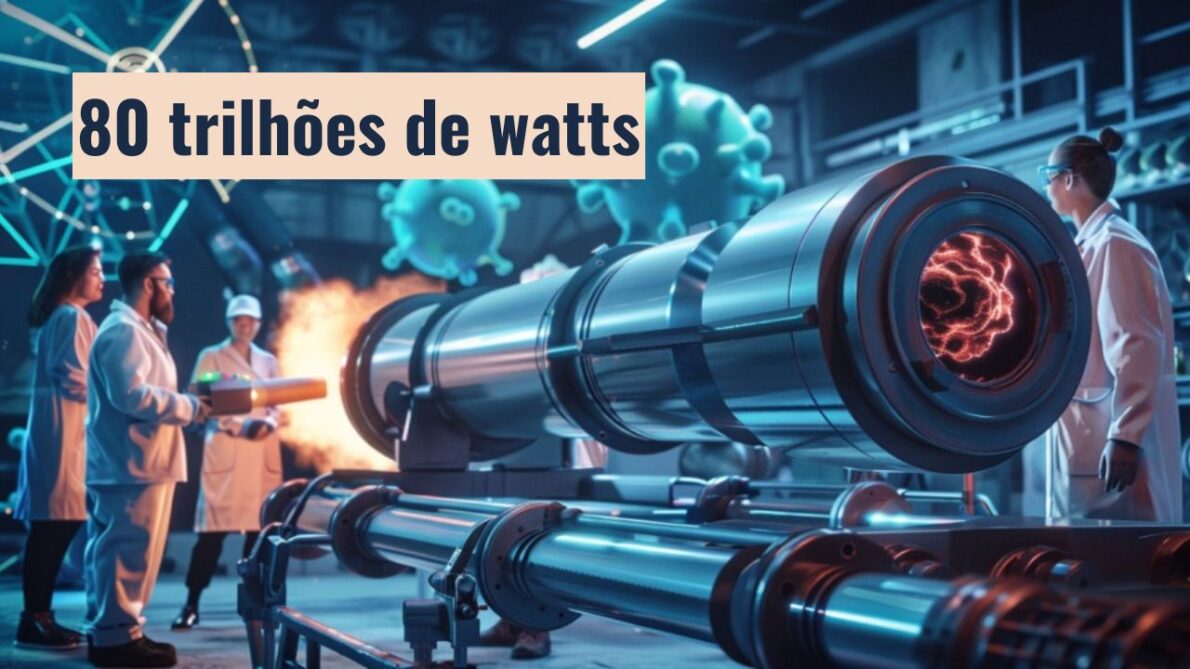
The First Light Fusion recently fired an electromagnetic pulse machine capable of generating 80 trillion watts of power, making it the most powerful cannon in the world. To put it into perspective, this level of power is something difficult to imagine, but it is what the company believes is necessary to achieve nuclear fusion in a cheaper and more accessible way. The cannon fired a tungsten projectile at an extraordinary speed, intending to create the extreme conditions necessary for fusion.
-
Ceará brings together 7 giants and R$ 66 billion to transform Pecém into the largest green hydrogen hub in Brazil, with final decisions expected by the end of 2026.

-
Angra 3 becomes Brazil’s R$ 24 billion dilemma: finishing the 66% complete plant costs almost the same as abandoning it, right in the race for energy in the AI era.
-
Scientists Convert Factory Waste Heat into Hydrogen Using Perovskite Catalyst at Significantly Lower Temperatures

-
Airbus and MTU Launch Joint Venture to Advance Hydrogen-Powered Electric Aircraft Engines, Paving the Way for a New Era of Low-Emission Commercial Aviation


The Pursuit of the Peak of Clean Energy
Nuclear fusion is not a new idea, but rather a concept that has been the holy grail of energy science for decades. The idea is simple in theory: you take two hydrogen atoms, smash them together until they fuse into helium, and this fusion releases an enormous amount of energy. That’s what happens in stars, and the hope is that one day we can reproduce this here on Earth to generate clean and virtually unlimited energy. But, in practice, the story is quite different.
Most traditional methods for achieving nuclear fusion involve the use of extremely powerful lasers or intense magnetic fields, but these methods have proven to be costly and complex. First Light Fusion is trying a different approach, called inertial confinement. Instead of lasers, they use a tungsten projectile that, when fired at high speed against a deuterium capsule (a hydrogen isotope), creates the pressure and temperature needed to initiate fusion.
The Z Machine and Record Pressure
Before developing its own cannon, First Light Fusion had already been the first private company to use the Z Machine at the Sandia National Laboratory in the United States, which previously held the pressure record for this type of experiment. Now, with its new amplification technology, the startup has managed to achieve a pressure of 1.85 terapascal, breaking the previous record of 1.5 terapascal. For those unfamiliar, these pressures are truly unimaginable – we’re talking about extreme conditions that, on Earth, only occur in experiments like these.
Challenges and the Future of Nuclear Fusion
Despite the progress, nuclear fusion still faces many challenges. For First Light Fusion’s method to be commercially viable, they would need to launch a projectile every 30 seconds, maintaining a continuous fusion reaction over time. This is something that, for now, is far from reality.
But with each advancement, science is getting a little closer to making nuclear fusion a clean and accessible energy source. If First Light Fusion or another company can overcome these challenges, the impact on how the world generates and consumes energy would be revolutionary. Until then, we continue to closely follow this journey towards the star that could illuminate our future sustainably.
Leave your comment and share your opinion on this innovation in the quest for nuclear fusion and clean energy! Are we closer to an energy revolution?


