Portuguese
  Spanish


Researchers from the Max Planck Institute, the University of Göttingen, and the Côte d’Azur University tested replicas of the MOMA instrument, which will be used on the Rosalind Franklin rover to analyze organic molecules on Mars. The method separates mirror image versions of compounds like pristane and phytane, possible biosignatures preserved for long periods
Mars returns to the center of the search for ancient life with a test focused on signals capable of spanning billions of years. European researchers evaluated a method that will be used by the Rosalind Franklin rover, from the European Space Agency, starting in 2030.
The red planet may have been warm, wet, and protected by a denser atmosphere. This scenario could have created favorable conditions for simple microbial life. The challenge is to find evidence, as organic molecules in Martian rocks do not confirm life.
The search for biosignatures on Mars
The study focused on two hydrocarbons: pristane and phytane. These molecules are associated with living organisms on Earth and are also present in petroleum. Because they are stable, they are seen as possible biosignatures that can be preserved under suitable conditions.
-
A nearly 70-year-old Chinese inventor has registered 90 patents and created a device that stores water in the roots, helping seedlings survive drought while trying to transform the arid slopes of the Loess Plateau into green areas without relying on heavy irrigation.

-
Researchers want to change the way of producing rare earth magnets, reducing purification steps and making better use of the elements found in Swedish deposits.
-
5.5 tons pulled from the seabed: a ‘living carpet’ of invasive coral was suffocating the Baía de Todos-os-Santos until the Brazilian Navy descended with divers, steel brushes, and acid salt to carry out the largest eradication operation of the species ever conducted in the country.

-
A Brazilian project dumped 5,500 concrete blocks and 2 barges into the ocean to block trawling in Paraná, and 25 years later what seemed like a risky intervention turned into an underwater nursery, a diving spot, and a refuge for endangered species.


Guillaume Leseigneur, a scientist at MPS and the principal author of the study, stated that if life ever existed on Mars, molecules like pristane and phytane could have survived until today.
The usefulness of these molecules is not just in their presence. The central point is to discover how they appear. Pristane and phytane are chiral compounds, with two forms that are mirror images, like left and right hands.
What chirality can reveal
Chirality is considered a valuable tool in the search for past extraterrestrial life, according to Uwe Meierhenrich, co-author of the study and researcher at the Côte d’Azur University.
Living organisms tend to produce almost exclusively one of the mirror image versions of a chiral molecule. In systems formed without biological participation, the expectation is to find both forms in approximately equal quantities.
This difference makes the analysis relevant. It is not enough to detect organic compounds on Mars. It is necessary to verify if there is a chemical imbalance compatible with living processes or if the observed pattern points to non-biological reactions.
How the Rosalind Franklin Rover Enters This Investigation
The Rosalind Franklin rover is set to search for these signals with the Mars Organic Molecule Analyzer, known as MOMA. The instrument was developed under the leadership of MPS and combines a gas chromatograph, mass spectrometer, ovens, and laser.
The process begins with heating rock samples in ovens to release volatile compounds. Then, the gases pass through specially coated capillary tubes and are analyzed.
Since the mirror forms of the same molecule interact differently with these coatings, they move at different speeds. This behavior allows the separation of enantiomers and the comparison of their proportions.
To test the method’s capability, the team used identical replicas of MOMA’s capillary tubes. For the first time, they managed to separate the chiral forms of pristane and phytane, extremely inert molecules.
Fatma Yesil Sahan, co-author and member of the MOMA team at MPS, stated that this chiral separation requires high instrumental sensitivity and measurement precision, capabilities demonstrated by the equipment.
Murchison Meteorite Brought a Surprise
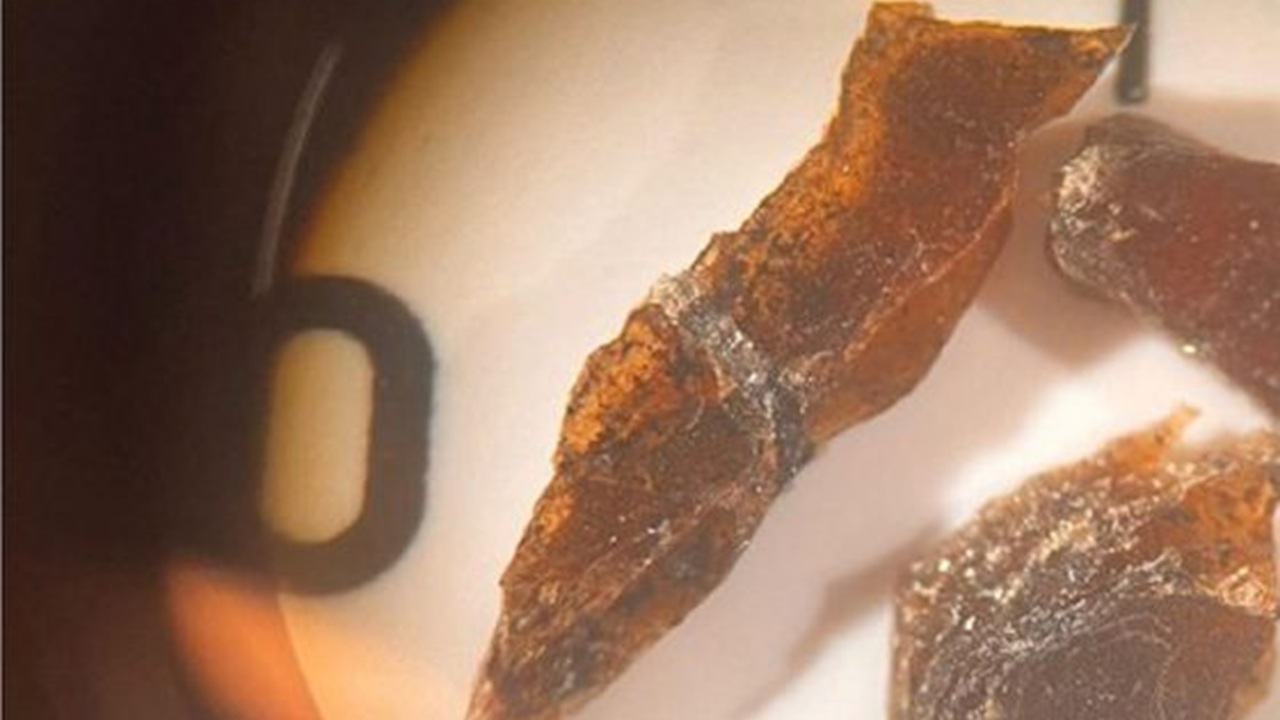
Since there were no Martian rocks available, researchers turned to the Murchison meteorite, which fell in Australia in 1969. The object is known for containing a mix of organic compounds.
Part of this material was present since the meteorite’s formation. Another part may have been incorporated after the fall, due to terrestrial biological contamination. Initially, it was suspected that pristane and phytane belonged to this category.
The analysis indicated something different. The meteorite showed equal amounts of the mirror versions of pristane and phytane. This pattern does not correspond to the biological material that could have contaminated the object at the crash site.
The proposed explanation is that contamination occurred during passage through Earth’s atmosphere. During this journey, the meteorite would have absorbed aerosols generated by the combustion of fossil fuels.
Comparisons with pristane and phytane present in oil shales reinforced this interpretation. These sedimentary rocks have petroleum precursors preserved for millions of years at depth.
Manuel Reinhardt, from the University of Göttingen, explained that petroleum forms in these rocks over millions of years, at great depths, under heat and pressure.
Over time, these conditions eliminate the natural imbalance between the forms of the molecules, leaving equal proportions, as observed in Murchison.
Preparation for a More Certain Answer
The test does not prove that life existed on Mars, but it shows that MOMA can separate very subtle chemical signals. This capability will be essential when Rosalind Franklin analyzes Martian samples.
The global focus on Mars
The search for biosignatures on Mars depends on instruments capable of distinguishing very similar signals. Organic molecules can arise through biological or non-biological pathways, so the analysis needs to go beyond simple detection.
Chirality helps in this regard because it compares the proportion between mirror forms of the same compound. When this proportion appears unbalanced, it may indicate a different process than that expected in common chemical reactions. Therefore, tests with equipment like the one that will follow on Rosalind Franklin are important before the direct analysis of Martian samples.
With information from Max Planck Institute for Solar System Research.