






 Portuguese
  Spanish


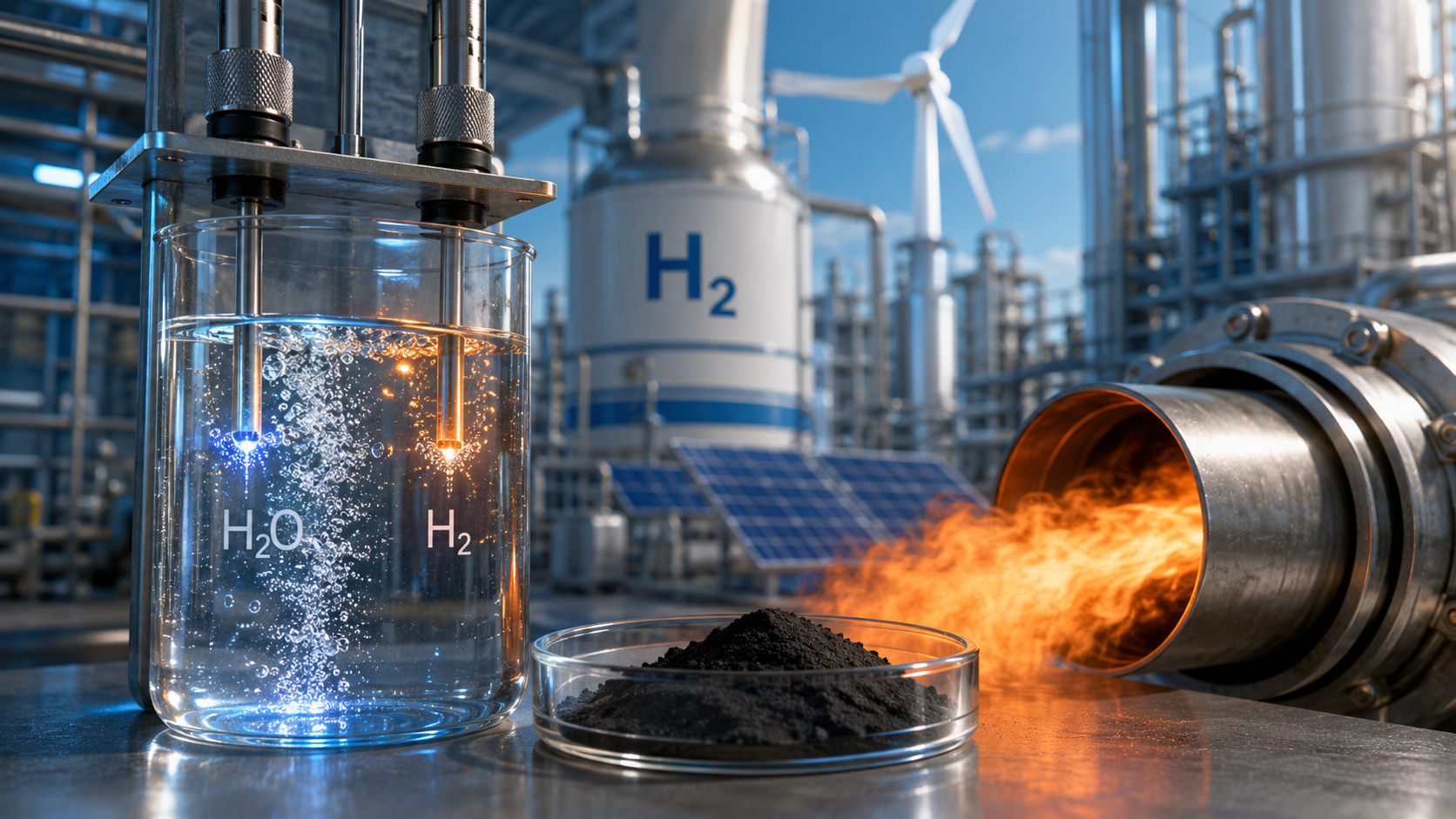

Clean hydrogen, industrial waste heat and perovskite catalyst place University of Birmingham study at the center of the new race for clean energy.
The University of Birmingham, in the United Kingdom, announced a breakthrough that could impact one of the most strategic areas of the energy transition: the production of clean hydrogen. Researchers at the institution demonstrated a method of thermochemical water splitting with a perovskite catalyst capable of generating hydrogen at much lower temperatures than those required by traditional systems.
The most relevant point of the discovery is the potential use of industrial waste heat. Since the process now operates at a much lower thermal range, the team claims it can utilize the discarded heat from sectors such as steel, cement, glass, and chemicals, paving the way to produce hydrogen near the industrial sources themselves, without relying on the same level of extreme heat that has limited the technology until now.
Clean hydrogen still faces the problem of originating from polluting processes
Hydrogen is often regarded as an important component of the energy future because, at the point of use, it can generate only water and heat or power fuel cells for electricity production. This profile helps explain why it frequently appears at the center of decarbonization strategies.
-
Airbus and MTU Launch Joint Venture to Advance Hydrogen-Powered Electric Aircraft Engines, Paving the Way for a New Era of Low-Emission Commercial Aviation

-
In a Place Many Doubt Solar Power Works, 360 Panels Operate in the Arctic, Harnessing Reflected Snowlight to Reduce Diesel Use at an Isolated Station
-
Island in Brazil Innovates by Installing 184 Solar Panels on Urban Lagoon to Generate Clean Energy
-
Japanese Island of 417 Residents to Test Living Half the Year Solely on Solar Power, Reducing Dependence on Diesel Brought by Ship



The problem is the origin. According to the University of Birmingham, about 95% of current hydrogen production still depends on fossil fuels, mainly through established industry routes that remain associated with carbon emissions. This contradiction is one of the reasons why the search for truly clean and economically viable methods has become so important.
Thermochemical water splitting encountered extreme temperatures
The route studied by the team is thermochemical water splitting, a process in which a catalyst helps separate the molecule into hydrogen and oxygen. The historical problem with this approach has always been the level of temperature required for the cycle to function efficiently.


According to the university, conventional thermochemical systems typically perform the water-splitting step between 700 °C and 1000 °C. The regeneration of the catalyst, necessary to reuse the material in new cycles, often requires even higher temperatures, in the range of 1300 °C to 1500 °C.
This is where the research led by Yulong Ding from the university’s School of Chemical Engineering presented its main differential. According to the institution, the new catalyst reduced this level by about 500 °C, opening up an operational window much more compatible with industrial heat sources that are currently wasted.
Perovskite catalyst brought hydrogen production to the range of 150 °C to 500 °C
The material tested by the researchers is a perovskite catalyst, a class of crystalline compound widely studied in energy and catalysis technologies. According to the research release, this material was able to produce substantial amounts of hydrogen in a range of 150 °C to 500 °C.
The regeneration of the catalyst also dropped to a lower range, between 700 °C and 1000 °C. In practical terms, this means that the cycle still requires high heat, but no longer depends on the extreme temperatures that made the route even more difficult and expensive compared to other options.
The publication of the work in the International Journal of Hydrogen Energy reinforces the technical significance of the result. The article was published on May 1, 2026 with the title Remarkable thermochemical water-splitting on Ba2Ca0.66Nb1.34-xFexO6-δ perovskites at medium temperatures for hydrogen production.
Waste heat from factories can become input for producing clean fuel
The most important practical consequence of the study is outside the laboratory. According to the University of Birmingham, the new temperature range allows for the envisioning of hydrogen production alongside industrial plants that already generate large volumes of waste heat, especially in core sectors like steel, cement, glass, and chemicals.
Instead of letting this heat escape through chimneys or dissipate into the environment, the proposal is to reuse it as thermal input for a hydrogen production process. This can reduce energy waste and create a more decentralized model, where the fuel is generated close to where it will be used.
The team also highlights a relevant logistical advantage. If hydrogen is produced and consumed locally, some of the storage and transport bottlenecks can be reduced, which helps to circumvent one of the most discussed weaknesses of the hydrogen chain.
Preliminary study indicates potentially lower cost than green and blue hydrogen
In addition to the thermal gain, the university released a preliminary cost competitiveness analysis. According to this initial study, water splitting with the new catalyst could deliver hydrogen at a lower cost than green hydrogen, produced by electrolysis, and blue hydrogen, produced from methane with carbon capture.
The formulation used by the team itself calls for caution. The result is described as preliminary and depends on specific conditions, with a stronger advantage in regions where renewable electricity is cheaper. This means that the advancement is promising, but it does not yet equate to a proven cost in continuous industrial operation.
Research has already advanced to patent and search for industrial partners
The University of Birmingham reported that it is already working to commercialize the technology in the United Kingdom and Europe. According to the institutional release replicated by ScienceDaily, the university’s entrepreneurship area has submitted a patent application covering the use of BNCF catalysts in low-temperature water splitting.
The institution also stated that it is seeking partners to develop the technology towards industrial application. This step does not mean that the solution is already widespread on a commercial scale, but it shows that the discovery has moved from the strictly academic field to the phase of intellectual protection and market prospecting.
Discovery tackles one of the most difficult bottlenecks of industrial decarbonization
A large part of the clean energy debate focuses on electricity generation, but heavy industry remains dependent on large-scale process heat.
It is precisely at this point that the new research gains relevance, as it attempts to link clean hydrogen, waste heat recovery, and industrial decarbonization in a single technological route.
If laboratory results are confirmed in real industrial environments, the technology could offer an alternative to reduce dependence on fossil fuels in processes that are still difficult to electrify today.
The study does not solve the challenge of clean hydrogen on its own, but it addresses a central technical obstacle: the extreme heat that has always made the thermochemical splitting of water more difficult to achieve.


