






 Portuguese
  Spanish


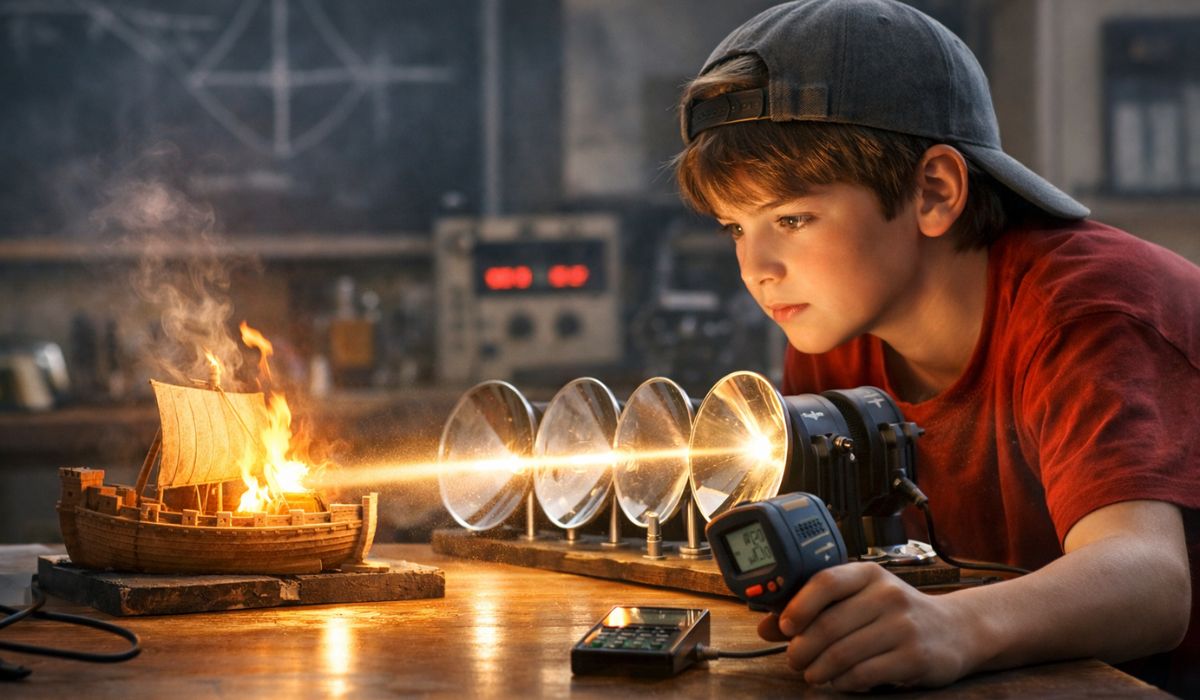


School Experiment In Canada Revives Historical Debate About Archimedes’ Supposed “Death Ray” By Testing The Concentration Of Light Through Mirrors And Its Measurable Thermal Effects In The Lab.
A school experiment conducted in Canada has reignited a debate surrounding one of the most well-known stories from antiquity: the so-called “death ray” attributed to Archimedes.
The project was developed by Brenden Sener, a student from London, in the province of Ontario, and aimed to test, in a controlled environment, whether the concentration of light through mirrors can significantly raise the temperature of a target.
Reports published at the time indicated that the student was 12 or 13 years old, depending on when his work was made public.
-
China Develops Custom 140-Ton Electric Mining Truck with 770 kWh Swappable Battery, Deploys 290 Units in Xinjiang’s Largest Zinc Mine

-
Meta to Launch Arena, a New Prediction App Targeting 3.56 Billion Users, Competing with Polymarket and Kalshi

-
Scientist Challenges Famous Human Evolution Theory, Argues Homo Sapiens Evolved Gradually Over Thousands of Years
-
15-Year-Old American Builds Ocean Generator with PVC Pipe and 3D-Printed Propeller for $12, Wins National Prize, Presents at White House, and Makes Forbes 30 Under 30 List




The study was presented at science fairs and later described in an article in the Canada Science Fair Journal, where the author details the methodology, measurements, and results obtained in the laboratory.
The initiative does not prove that Archimedes used a similar device during the siege of Syracuse in the 3rd century BC.
The experiment is limited to analyzing the physical principle involved: the reflection and concentration of luminous energy at a specific point, with measurable thermal variation recorded.
Historical Origin of Archimedes’ Death Ray
Ancient accounts attribute to Archimedes the creation of a system of mirrors that was used to concentrate sunlight against enemy ships during the Roman siege of Syracuse in 212 BC.
According to these narratives, the reflected energy would have heated wooden parts of ships until igniting them.
However, there is no detailed technical description preserved from the time nor direct archaeological evidence of the supposed artifact.
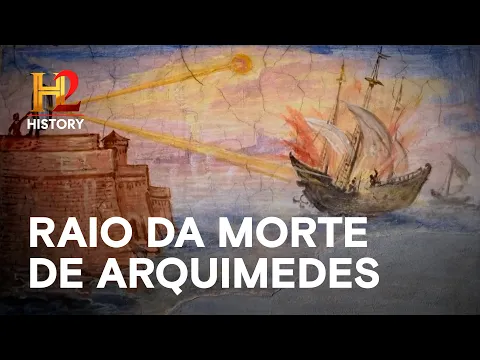

The story is known through later records, which led part of the academic community, over the centuries, to treat the episode with skepticism.
In the 17th century, philosopher René Descartes questioned the plausibility of the weapon described in the accounts.
Other scholars also pointed to the absence of material evidence and the practical difficulties of execution as factors that undermine the historical narrative.
Still, the hypothesis continued to be discussed in studies of the history of science and technology, especially because the optical principle involved — concentrating light through mirrors — is physically demonstrable.
Experiment With Concave Mirrors And Temperature Measurement
In the article published in the Canada Science Fair Journal, Sener describes the setup of a system with a heating lamp and four concave mirrors positioned to reflect light at a single fixed point.
The aim was to measure the temperature variation at the target as the number of mirrors increased.
For this, he used 50 W and 100 W lamps, as well as an infrared thermometer to record the measurements.
The readings were taken in triplicate, aiming to reduce variations and allow for comparison between the tested scenarios.
According to the data presented in the article, there was a progressive increase in temperature as new mirrors were added to the arrangement.
Heating was also shown to be more intense when the light source’s power increased from 50 W to 100 W.
The tables published in the study indicate that, in the scenario with the highest power and four mirrors, the recorded temperature exceeded 50 °C, starting from a baseline close to 21 °C.
The goal of the work was not to provoke combustion, but rather to observe the relationship between the number of reflectors and localized heating.
Modern Tests And Practical Limits Of The “Death Ray”
The debate about the so-called “death ray” is not limited to school projects.
In 2005, a team associated with MIT participated in experiments linked to the television program MythBusters to evaluate the feasibility of the hypothesis on a larger scale.
Institutional records from MIT itself report difficulties in maintaining precise alignment of the mirrors when the target was in motion.
In certain tests, smoke was generated and the surface targeted darkened after a few minutes of concentrated exposure to light.
CBS News coverage of the experiments indicated that, at greater distances, the effect was limited to singed material, without sustained flame.
In tests conducted at a closer distance, an initial flame was recorded that did not persist for a long time.
The executive producer of MythBusters stated at the time that the results indicated low practical viability of the system as a weapon under real conditions.
Experts often highlight that factors such as wind, solar angle variation, reflector instability, and the movement of ships can significantly compromise the performance of the setup in a combat scenario.
Between Physical Plausibility And Historical Use
The results presented by Sener indicate that the concentration of light through concave mirrors increases the temperature of a focal point in a measurable way in a controlled environment.
This data confirms the functioning of the basic optical principle involved in the historical narrative.
On the other hand, the existence of the physical effect does not equate to proof of military use in antiquity.
The application in a war context would depend on variables that were not reproduced in either the school experiment or the widely publicized modern tests.
Researchers in the field of the history of science often distinguish in this debate the theoretical viability of the phenomenon from its practical large-scale implementation.
The absence of technical documentation contemporary to the siege of Syracuse keeps the episode in the realm of historical hypotheses.
By transforming an ancient narrative into a measurable experiment, initiatives like Sener’s help delineate what can be observed in the lab and what remains undocumented.






Estamos a falar do mesmo raio da morte que foi tentado por profissionais no Mythbusbers a uns anos (largos!!!) atrás, em escala real se não me engano. E foi comprovado falso?!
Ele tentou , mas não conseguiu fazer o raio da morte.
Dá pra ver que é ia