Portuguese
  Spanish


Detected by IceCube, the particle IC 210922A led astronomers to Shadow Blaster, a compact galaxy hidden by dust and marked by intense star formation
For a particle capable of traversing planets, stars, and cosmic clouds, the Antarctic ice finally revealed a clue.
On September 22, 2021, the IceCube Neutrino Observatory recorded the event IC 210922A in the frozen depths of the South Pole.
The trajectory of the particle led scientists to a possible source located about 11 billion light-years from Earth.
-
Researchers Identify Factor Influencing Dementia Risk Beyond Age and Genetics

-
Iranian Engineers Develop Solar-Powered Mobile Water Purification System for Isolated Regions, Offering Sustainable Solution for Water-Scarce Communities
-
Pedal-Powered Washing Machine Made from Bicycle Parts Cleans Clothes in Three Minutes Without Electricity, Leaves Them 80% Dry.

-
Sixth-grader in Miami wins Lemelson Young Inventor Prize for creating water-absorbing concrete using discarded oyster shells and charcoal.




Researchers point to the galaxy JCMT0402−0424, nicknamed Shadow Blaster, as the main candidate.
A massive concentration of dust around the object prevents optical telescopes from seeing the galaxy clearly.
How IceCube found the neutrino in Antarctica
Scientists call the neutrino a “ghost particle” because it passes through matter almost without interacting with it.
This characteristic allows the particle to escape from extremely dense regions, even when dust clouds block the light.
IceCube uses thousands of sensors installed under the Antarctic ice.
These devices identify small light signals when a particle rarely interacts with the frozen material.
The team responsible for the observatory classified the event as IC 210922A.
The main data from the investigation include:
- Date of detection: September 22, 2021;
- Responsible observatory: IceCube, in Antarctica;
- Recorded particle: high-energy neutrino;
- Candidate galaxy: JCMT0402−0424;
- Estimated distance: 11 billion light-years;
- Galaxy nickname: Shadow Blaster.
The galaxy hidden by a huge layer of dust
The Shadow Blaster almost disappears in optical images because a thick layer of cosmic dust envelops the entire region.
Even so, the galaxy emits radiation in submillimeter wavelengths.
Specialized instruments captured this hidden glow and revealed the presence of the object.
The galaxy existed during the so-called cosmic noon, a period marked by one of the greatest peaks of star formation in the Universe.
Initially, researchers analyzed whether a supermassive black hole could explain the large amount of energy.
The observations, however, did not show convincing signs of an active galactic nucleus.
The data therefore favors the hypothesis of a region dominated by intense star formation.

The telescopes that helped locate the Shadow Blaster
The IceCube recorded the original signal, but other observatories helped trace its possible origin.
The James Clerk Maxwell Telescope and the Submillimeter Array located a bright source within the region indicated by the neutrino.
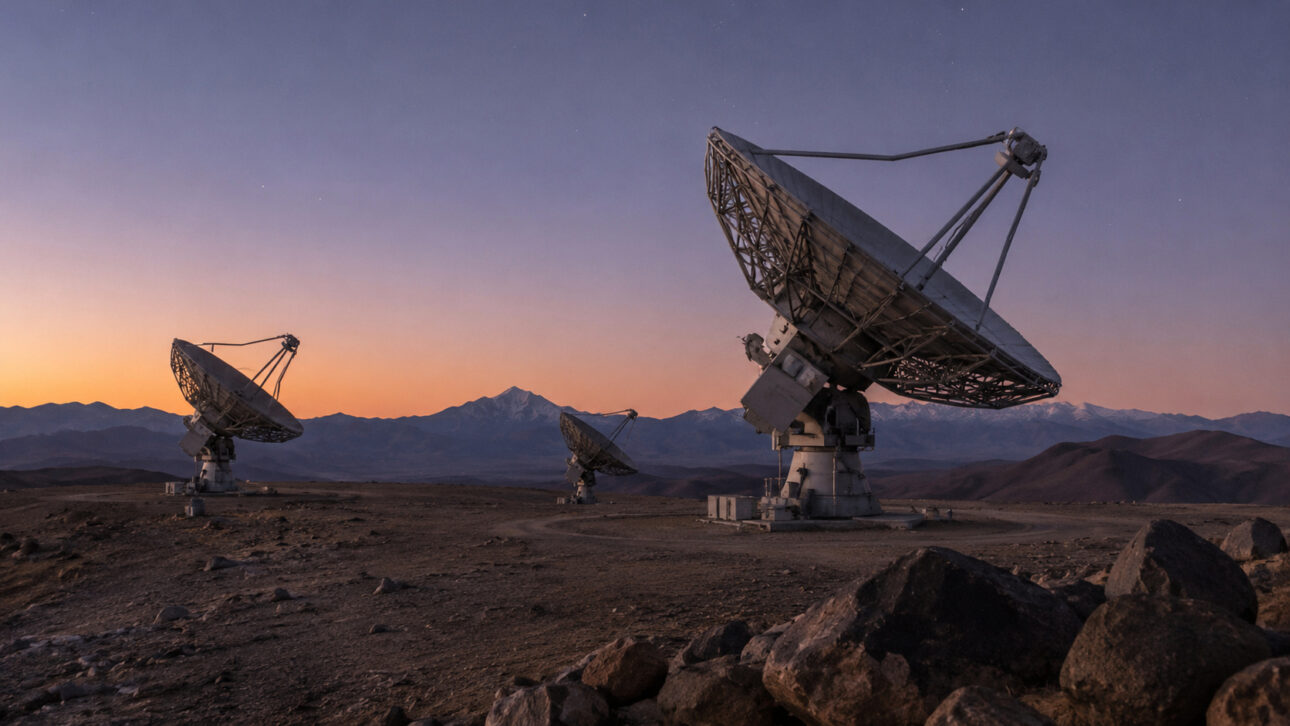
Subsequently, ALMA, installed in Chile, produced more detailed images of the galaxy.
A galaxy positioned in front magnified the radiation of the Shadow Blaster through a gravitational lens.
This phenomenon acted as a natural magnifying glass and increased the visibility of the distant object.
Gemini North also provided data for the analysis of the celestial field related to the neutrino.
What Nature Astronomy presented in June 2026
On June 17, 2026, the scientific journal Nature Astronomy published the results of the investigation.
The study classified the Shadow Blaster as the most plausible electromagnetic candidate in the region associated with IC 210922A.
The researchers, however, have not yet definitively proven the origin of the neutrino.
The discovery strengthens the so-called multi-messenger astronomy, which combines particles, waves, and different ranges of radiation.
With this approach, scientists can investigate hidden galaxies without relying solely on visible light.
Nature Astronomy, the ALMA Observatory, the NSF NOIRLab, IceCube, and the National Astronomical Observatory of Japan released the information.
The discovery shows how an extremely difficult-to-capture particle can reveal hidden regions of the distant Universe.
And you, do you believe that neutrinos could help scientists locate other invisible galaxies? Share your opinion in the comments.