






 Portuguese
  Spanish
  4 min of reading
  0 comments


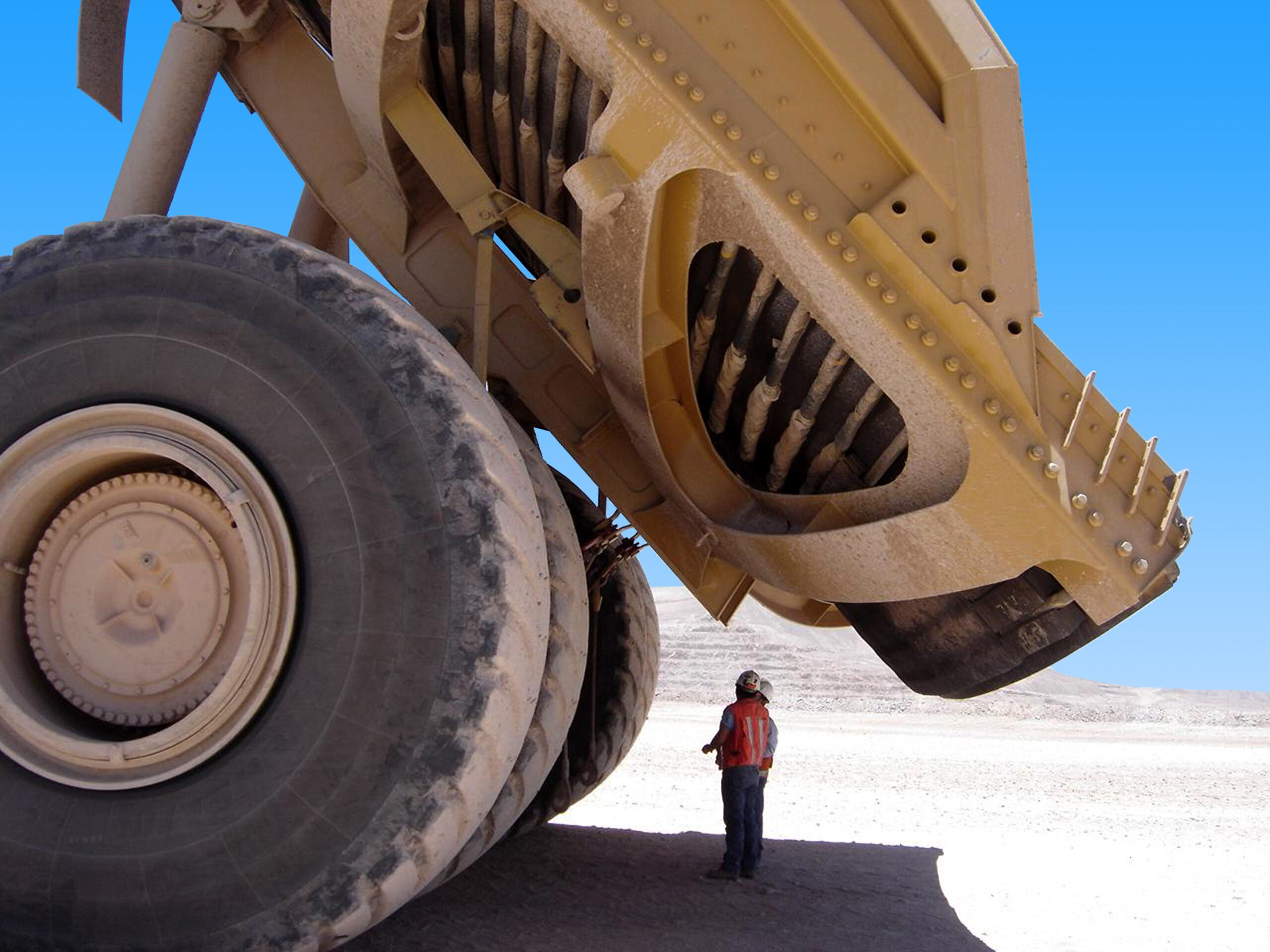
Autonomous mining trucks, house-sized giants that operate without anyone in the cabin, have already moved more than 8.6 billion tons of rock and ore in mines around the world, and the manufacturer behind them ensures that all this mountain was transported without a single recorded injury.
The number comes from the command system that pilots the largest fleet of autonomous mining trucks on the planet, operated by one of the American heavy machinery giants. Today, there are hundreds of these vehicles working in dozens of mines spread across three continents, all guided by software, radars, and satellite, without a driver inside. And what is most impressive is not just the amount moved, but the fact that it was achieved without any accident with casualties.
8.6 billion tons, more than a thousand pyramids
It’s hard to grasp the size of this number, so a comparison is worthwhile. The Great Pyramid of Giza weighs about 5.9 million tons. The 8.6 billion tons already moved by these trucks are equivalent to transporting more than 1,400 Great Pyramids entirely from one place to another. And each vehicle is colossal: the largest mining trucks carry almost 400 tons per trip, with tires taller than an adult person.
Inside, the autonomous trucks manage with a combination of high-precision GPS, radars, laser sensors, and a central control that communicates with each vehicle in real-time. They see obstacles, avoid each other, and stop on their own if someone or something crosses in front, all without a steering wheel turning. The technology began to be tested in the last decade and has been scaling mine by mine, and is already preparing to reach smaller models and medium-sized operations. In practice, an entire mine can operate in the dark because the machine doesn’t need to see like we do.
-
The “Chinese invasion” has arrived: BYD already dominates almost 45% of the electric buses registered in Brazil in May 2026, while 80% of the entire electric fleet in the country is concentrated in São Paulo with 1,300 vehicles.

-
From toy to track machine: Koenigsegg Sadair’s Spear made with over 327,000 Lego pieces reaches 111 km/h and surpasses the former Bugatti Chiron record.

-
Deep-sea marine animal can go more than 5 years without eating, combining physical adaptations and genetic mechanisms to survive in environments with extreme food scarcity; meet the Bathynomus.

-
Science wants to know what football does to you: study gathers smartwatch data to understand the real impact of World Cup emotions on the human body


The artificial intelligence that no one sees working
We spend the day talking about artificial intelligence that writes text and draws images, but it is in this type of heavy industrial application that automation has already become a silent routine. These trucks work at dawn, in dust storms, without lunch breaks and without fatigue at the end of the shift. It’s not the first time heavy industry has removed humans from the most dangerous place: robots already operate oil rigs without anyone on the platform, and the logic is the same, machine where the risk is too high for people.

Why mines replaced the driver with the machine
The calculation that convinces mining companies is straightforward. An autonomous truck doesn’t sleep, doesn’t take lunch breaks, doesn’t change shifts, and doesn’t take vacations, so it runs nearly 24 hours a day, every day. Industry estimates speak of productivity gains of 15% to 30% per vehicle, combined with smoother braking and acceleration that save fuel and tires. In equipment that costs millions of dollars and has tires worth hundreds of thousands of reais each, this reduced wear turns into a mountain of money at the end of the year.
Not surprisingly, the giants of the sector have jumped headfirst into this race. In the Pilbara region of Australia, giant mining companies operate some of the largest autonomous fleets on the planet to extract iron ore, and the technology has already spread to copper mines in Chile and coal mines in North America. Two manufacturers, one American and one Japanese, compete point by point for control of these unmanned mines, and the tug-of-war between them only accelerates the pace of orders. Whoever dominates the driverless truck dominates the cost per ton.
What remains for the driver
Here comes the part that affects us. Driving one of these trucks in a mine is a hard, dangerous, and isolated job, in places like the deepest mine in the world, in South Africa, where heat and risk are constant. Removing humans from there saves lives, and the fleet’s zero-injury record is proof of that. But this same advancement erases an entire profession, and the social cost of those who lose their jobs rarely makes it into the press release.
The industry likes to say that no one is left behind, that the driver becomes a remote operator in an air-conditioned room, monitoring dozens of trucks on screens instead of facing the dust. In part, it’s true; there are new positions for technicians, fleet data analysts, and those who supervise the system. The problem is the math. A central with a few operators controls what used to require hundreds of drivers, so the numbers don’t match one-to-one. For every new and qualified position that appears, several old driving jobs disappear, often in towns that were born and live around the mine.
I confess it’s a mixed feeling. I’m relieved to imagine fewer people risking their lives on a mine ramp at 50 degrees, and at the same time, I think about the thousands of drivers that this software quietly replaces. The artificial intelligence that moves mountains arrived first and deeper than the one that writes poems, yet no one posted a picture of it working.
When the machine does the dangerous work better and without getting hurt, what do we do with those who lived off that steering wheel?


-

1 person reacted to this.