






 Portuguese
  Spanish


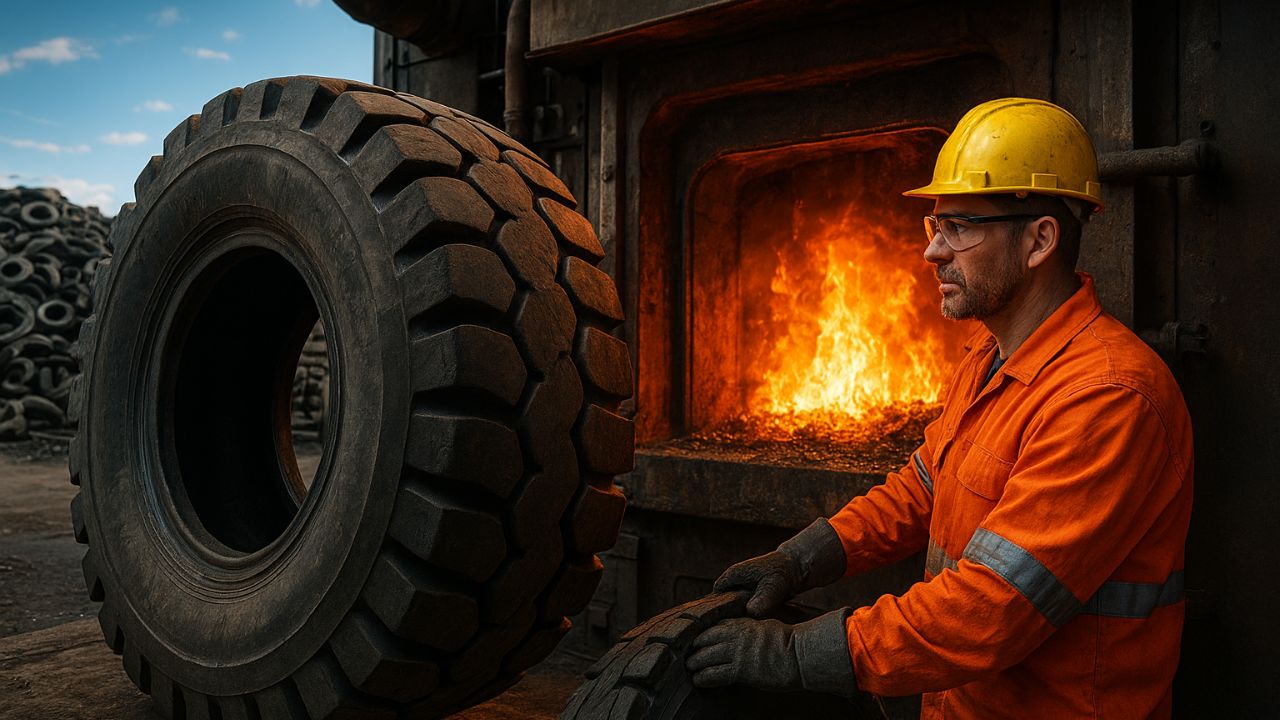


Driven by Law, Rubber Giants Recycling Generates Millions by Transforming Tons of Industrial Scrap into Energy and Infrastructure in Brazil.
Brazil faces a colossal challenge: what to do with the rubber giants, the mining tires that can weigh tons and take 600 years to decompose. What was once a million-dollar environmental liability, accumulating public health risks and contaminating the soil, has become the engine of a profitable industry. This transformation was catalyzed by a strict legislation, which forced the creation of a sophisticated value chain to properly dispose of this scrap.
Today, these unusable tires are the raw material for two main routes: the production of Tire Derived Fuel (TDF) for the cement industry and the manufacture of rubber-asphalt for roadways. Data from Reciclanip, a managing entity created by the National Association of Tire Industry (ANIP), indicates that the country discards about 450 thousand tons of tires annually. It is a monumental volume that, instead of polluting, is now fueling industrial ovens and building more durable roads.
The Environmental Liability That Became Law
The size of the challenge is difficult to visualize. A single OTR (Off-The-Road) tire from a mining truck can measure four meters in diameter and weigh four tons. When improperly disposed of in landfills or open air, these materials become ideal breeding grounds for disease vectors, like Aedes aegypti, in addition to contaminating the soil with chemical leachate. For decades, the accumulation of this material formed a “giant environmental liability.”
-
Mother Leaves Stable Job to Support Gamer Son’s Dream, Sees Channel Surpass 10 Million Subscribers, Now Helps Run a Million-Dollar Online Empire: The Story of Angie Baker

-
72-Year-Old Retired Chinese Engineer Builds Personal Cable Car for $1,200 to Avoid Climbing Stairs, Uses It for 5 Years Before Ordered to Dismantle

-
Neymar’s 14-year-old son, Davi Lucca, launches 3D dinosaur brand “Amigo Dino,” gaining attention on social media for his entrepreneurial spirit.
-
Improper Outlets Can Cause Fires and Damage Devices: How to Identify the Correct 10A or 20A Model for Each Appliance




The turning point was regulatory. The CONAMA Resolution No. 416/2009 established the Reverse Logistics Policy, becoming the foundation of this entire industry. The regulation requires manufacturers and importers of tires to collect and properly dispose of unusable products. As many mining companies import their giant tires directly, they legally assume the role of importer and, consequently, the full responsibility for final disposal, creating an immediate and stable demand for recycling services.
Route 1: Energizing the Cement Industry
The most established route for the rubber giants is their transformation into Tire Derived Fuel (TDF). In the process, the tires are shredded into “chips” of rubber, which are then used as fuel in cement factory kilns. These kilns, which operate at extreme temperatures of up to 2,000°C, ensure the complete thermal destruction of waste without generating ash, as the inorganic components are chemically incorporated into the clinker (the raw material for cement).
This is a perfect industrial symbiosis. For the cement industry, TDF is a source of energy with high calorific value, often exceeding that of coal and comparable to fuel oil, but at a significantly lower cost. This reduces operational costs and, crucially, lowers the carbon footprint by replacing traditional fossil fuels. For the recycling industry, cement plants represent a large-volume customer with constant demand, ensuring the flow of production and the economic viability of the operation.
Route 2: The Asphalt That Transforms Roads

The second valuation route transforms scrap into cutting-edge infrastructure. Rubber powder, obtained by finely grinding the tires, is mixed with asphalt binder (CAP) to create “rubber-asphalt.” The technology results in a pavement with superior performance: studies indicate an increase of about 40% in durability, greater resistance to cracks and potholes, and even better grip and reduced noise, enhancing safety on highways.
Although the initial cost is about 30% higher than conventional asphalt, the savings prove themselves in the long run, with less need for maintenance. The main success story comes from Minas Gerais. Data from the Department of Highways of Minas Gerais (DER-MG) shows that the state has become the largest public consumer of this technology in the country. Driven by road recovery programs, the use of the material rose from 1,107 tons in 2020 to 40,115 tons in 2024, an impressive increase of over 2,400%.
The Minas Gerais model illustrates how a public procurement policy can single-handedly create a robust market for a recycled product. By ensuring large-scale demand, the state government facilitated investment by recycling and paving companies in the technology. This decision transformed an infrastructure investment into a direct environmental remediation tool, responsible for the removal of over 1.6 million tires from the environment just in this program.
How Much Is an Unusable Tire Worth?
The recycling industry of the rubber giants has proven to be a resilient business by not depending on a single source of revenue. The model relies on three pillars: first, the “gate fees”, paid by mining companies and importers for the recycler to accept the waste, ensuring compliance with CONAMA law. Second, the sale of processed rubber products, whether TDF for cement companies or powder for asphalt.
The third pillar is the sale of recycled steel. Heavy vehicle tires can contain up to 25% of high-quality steel in their composition, which is extracted during the shredding process via magnetic separators. This material is sold directly to steel mills, closing the material cycle. This diversification protects the business: even if the price of a commodity (like steel) falls, revenues from service fees (guaranteed by law) and TDF sales keep the operation profitable.
The trajectory of OTR tires in Brazil is a clear example of circular economy in practice. What was a complex and dangerous environmental liability has been transformed, by the force of effective regulation and industrial innovation, into a revenue center. The industry of the rubber giants not only cleans the environment but also generates energy, builds better roads, and drives a million-dollar economic chain.
Do you agree with this change? Do you think it impacts the market? Leave your opinion in the comments; we want to hear from those living this in practice.


Muito bom.
logística reversa, deve ser uma preocupação constante no reaproveitamento dos materiais.