






 Portuguese
  Spanish
  6 min of reading
  0 comments


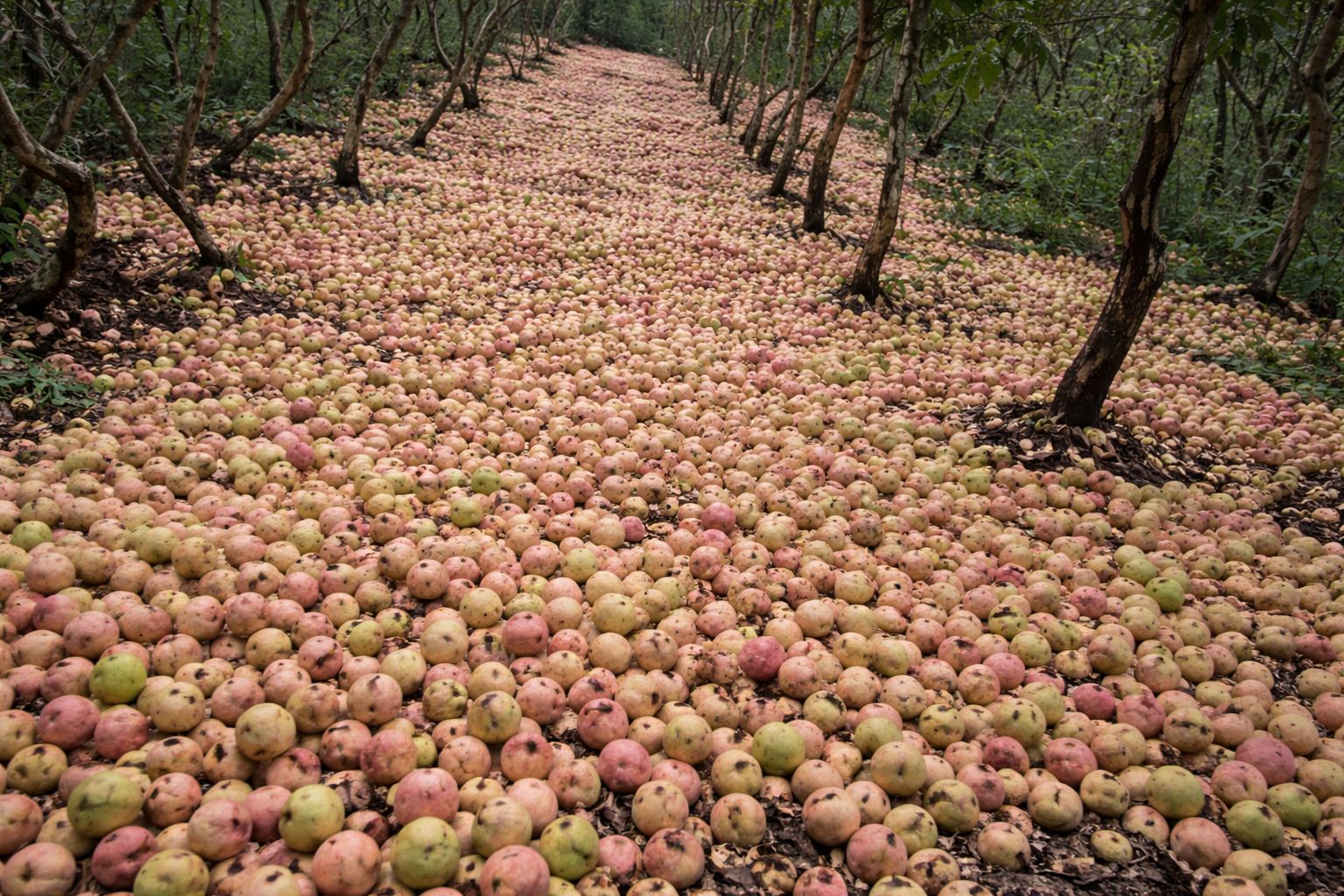
Guava producers in Rio Grande do Sul face a devastating scenario: with one of the largest harvests in recent years, buying companies have become overloaded and have started to restrict or suspend the acquisition of the fruit. Without the structure to store, producers like Simone Back and Sidnei Rauber from Feliz (RS) are discarding tons of guava while consumers pay high prices in the market.
Producers of guava in the interior of Rio Grande do Sul are throwing away tons of fruit they cultivated for months because they simply have no one to sell to. The scenario is paradoxical: the guava harvest is one of the best in recent years in the region, but buying companies have become overloaded with the volume and have started to restrict or even suspend the acquisition of the fruit. Without adequate structure to store and market all the guava production, many producers have been left with no options, and disposal has become the only choice, generating direct losses for families who depend on the fruit as their main source of income. Production costs remain, but without sales, the margin is zero.
The problem became visible after posts on social media by producer Simone Back and her husband, Sidnei Rauber, from the community of Arroio Feliz in Feliz (RS). The couple reported that the situation is the result of a series of difficulties that began in 2024, when floods hit the region and caused significant losses in guava crops, with landslides and a reduction in the number of plants. In 2025, the harvest was considered average, and producers are still facing delays in payments for previous sales. Now, with high production throughout the region, the excess supply has caused buying companies to freeze, and the guava that should be turned into juice, jam, or pulp is rotting on the ground.
Why companies stopped buying guava from Gaúcho producers
The explanation is a combination of localized excess supply and limited processing capacity. When all producers in a region harvest guava at the same time and in volumes above average, the industries that process the fruit reach their absorption limit and cannot receive, store, and process everything that is offered. Pulp, juice, and jam factories operate with fixed processing capacity, and when the supply of guava exceeds this capacity, someone gets left out.
-
In Matopiba, soybeans have replaced rice and beans, and traditional Cerrado communities that used to grow their own food now have to buy it, while pesticides from neighboring farms reach the springs.

-
Foreign tree planted to combat drought invades more than 1 million hectares of the Caatinga, encroaches on riparian forests, and turns an old solution for the semi-arid region into a silent threat to biodiversity.

-
Invasive weed that withstands extreme heat advances with climate change, threatens crops on several continents, and raises a global alert about a silent plant capable of dominating soils, suffocating native species, and reshaping entire ecosystems.
-
While other coffees escape the American tariff hike, Brazilian instant coffee is excluded, raising an alert in the sector and may become up to 37.5% more expensive in the United States.


The problem is exacerbated by the lack of refrigerated storage infrastructure in the producing region. The guava is a perishable fruit that ripens quickly after harvest and cannot wait weeks on the farm until the industry has space to receive it. Without accessible cold storage and without alternative outlets such as direct-to-consumer markets or export, guava producers are at the mercy of a limited number of buyers who dictate when, how much, and at what price they will buy.
The paradox between guava waste and the price paid by the consumer

According to information released by the portal Canal Rural, the most difficult situation to accept for those who produce guava is knowing that, while tons of the fruit rot on the farms, the end consumer pays more and more for it at the supermarket. The retail price of guava has not fallen even with the bumper crop in the producing region, because the chain of intermediaries between the producer and the shelf absorbs margins that are not reflected in the field. The producer cannot sell due to a lack of buyers, but the consumer pays dearly because retail operates with prices that consider transportation costs, refrigeration, wholesaler margin, and retailer margin.
This mismatch is structural and affects guava producers throughout Brazil. Those who plant have no negotiating power over the price and depend on a few buyers who can simply stop buying when it suits them. The producer who invested in seedlings, fertilizers, pesticides, labor, and irrigation throughout the guava cycle has no way to recoup these costs when the fruit is not sold. The result is zero margin for those who produced and maintained profit for those who market.
The floods of 2024 that worsened the situation for guava producers
The current scenario did not arise out of nowhere. In 2024, devastating floods hit Rio Grande do Sul and caused significant losses in the region’s guava crops, with landslides destroying productive areas and reducing the number of plants on many properties. Producers who survived the floods invested in replanting and recovering damaged areas, hoping that the next harvest would compensate for the losses.
The irony is cruel. The 2025 harvest came with quality and volume higher than expected, but instead of representing the financial recovery that guava producers needed, the good harvest created an oversupply that the buying companies could not absorb. Producers who lost everything in the floods and went into debt to start over now see the guava that should have paid off the debts being discarded on the ground. Delays in payments for previous sales worsen the financial scenario and leave many families in desperate situations.
What is needed for guava producers not to have to discard the fruit
The solution involves infrastructure, market diversification, and public policy. Community cold storage or cooperatives that allow guava to be stored for longer would give producers the ability to wait until industries have space to receive the fruit, avoiding the immediate disposal that occurs when harvesting and processing capacity do not coincide.
Diversifying sales channels is also essential. Guava producers who depend on one or two buying companies are vulnerable to exactly the type of situation that happened in Rio Grande do Sul: if these companies stop buying, all production is left without a destination. Farmers’ markets, direct sales to consumers, government food acquisition programs, and partnerships with restaurants and bakeries are alternatives that dilute risk and ensure that guava reaches those who want to buy it instead of rotting in the field.
The human impact of guava disposal in Rio Grande do Sul
Behind the tons of discarded guava are entire families who live off the fruit. Simone Back and Sidnei Rauber, who published videos on social media showing the waste, represent hundreds of producers from the Arroio Feliz community and the Feliz region who face the same situation without media visibility. For these families, guava is not just an agricultural product: it is the source of income that pays bills, supports children, and keeps the property running.
Discarding guava in the middle of the harvest is a waste that should outrage just as much as the hunger that persists in the same country. While producers throw fruit away due to lack of buyers, food banks and social programs face a shortage of donations, in a disconnect between supply and demand that technology, logistics, and political will could resolve. The guava that rots on the ground in Rio Grande do Sul is the most concrete proof that producing food in Brazil is still an act of courage that is not always rewarded.
Guava producers in RS discard tons of fruit because companies stopped buying. Do you think the government should intervene? Who is responsible for this waste? Leave your opinion in the comments.


Be the first to react!