






 Portuguese
  Spanish
  5 min of reading
  0 comments


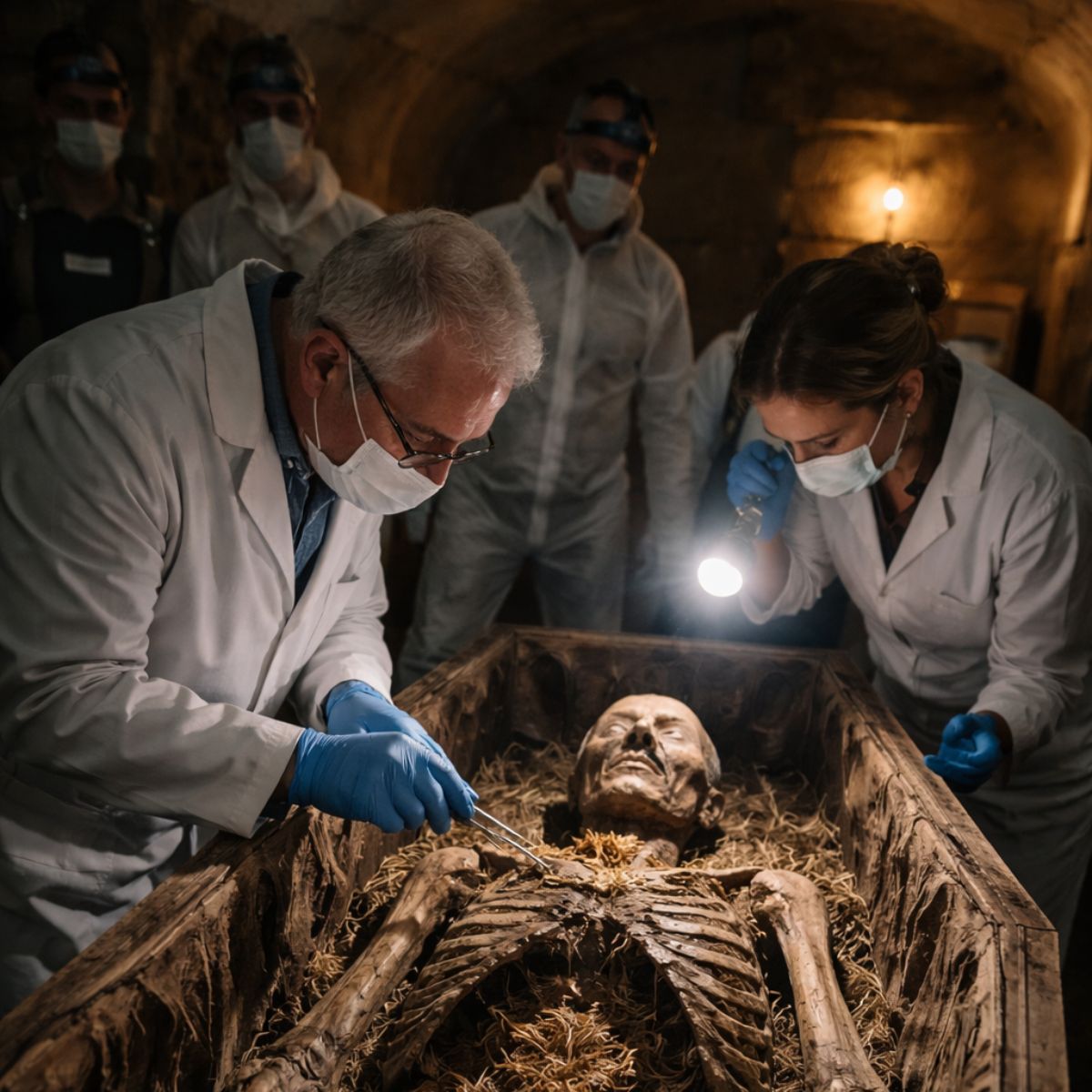
Study in Frontiers in Medicine revealed that an 18th-century mummy in an Austrian crypt was subjected to embalming without incision, with materials inserted rectally, a technique never documented, and that the man died of tuberculosis at 37 according to analyses from the University of Munich.
A mummy known as the “dry air chaplain” had rested for centuries in a church crypt in the Austrian locality of Blasenstein, surrounded by legends attributing healing powers to it, until a leak in the structure in 2025 allowed researchers to finally examine the body with modern tools. Andreas Nerlich, a professor at the University of Munich, led the team that conducted tomography, chemical analyses, and radiocarbon dating, and the results published in Frontiers in Medicine revealed three simultaneous findings: the likely identity of the man, his cause of death from tuberculosis, and a method of embalming that no other historical or scientific record has ever documented. The mummy, in remarkable condition of preservation, likely belongs to Franz Xaver Sidler von Rosenegg, a local vicar who died in 1746 at the age of 37.
What made this case unique in Austria and the world is the way the body was preserved. The tomographies showed that the internal cavities of the mummy were filled with wood chips, flax and hemp fibers, and traces of a zinc-based compound, materials that absorbed moisture and prevented the proliferation of bacteria over three centuries. The disturbing detail: the body has no cuts on the surface. The team concluded that all the material was introduced through a natural opening, probably rectally, an embalming technique that Nerlich classified as the only recorded case in the history of science.
The identity of the man hidden inside the mummy

Radiocarbon dating indicated that the death occurred between 1734 and 1780, and the age range indicated was between 35 and 45 years. These data coincide with the historical records of Franz Xaver Sidler von Rosenegg, a vicar who served in rural Austria and died in 1746. The convergence between chronology, age, and geographical context strengthens the association, although definitive confirmation requires complementary evidence.
-
Federal Police involved in the case to identify the person responsible for hacking the Civil Defense system, which sent ten false alerts, frightened residents of different capitals, and turned messages about real risks into notifications with “misanthropy” and even alien attacks.

-
Extreme drought causes ghost village to reappear at the bottom of the reservoir that supplies Athens, revealing houses, a school, and ruins swallowed since the 1980s as the lake shrinks and exposes the water crisis threatening the capital of Greece.

-
An entire village lay asleep at the bottom of a lake for 3,000 years: divers suction sediments in Italy and reveal more than 600 wooden stakes, bronze tools, and traces of a Bronze Age settlement hidden underwater.
-
They call it the “Shopee house” and even cardboard, but the R$ 20,000 house is a certified Wood Frame from Alea, financed by Minha Casa Minha Vida: understand if it’s worth more than masonry.



The isotopic analysis revealed dietary habits consistent with those of a parish clergyman: a diet centered on grains and meat. However, the data suggest that the man preserved in the mummy may have undergone food restriction in the final months of life, possibly as a consequence of the deprivations imposed by the War of the Austrian Succession, a conflict that devastated the region during the 1740s and affected the supply of rural communities throughout Austria.
The tuberculosis that killed the clergyman and the rosary that confused scientists
An X-ray examination conducted in the early 2000s had detected a foreign object inside the mummy, fueling for two decades the theory that the vicar may have been poisoned. The new study completely ruled out this hypothesis: the object was a perforated spherical bead, a piece of a rosary that became lodged in the body during the preservation procedure. With no indication of toxic substances, researchers redirected the investigation to natural causes.
The conclusion, detailed in Frontiers in Medicine, points to acute pulmonary hemorrhage caused by advanced-stage tuberculosis. The disease was among the leading causes of death in 18th century Europe, and the mummy shows internal signs consistent with chronic lung infection. Tuberculosis would have weakened the clergyman over the years leading up to the fatal hemorrhagic episode, a scenario compatible with both the age profile and sanitary conditions of rural Austria during that period.
The embalming that has never been seen before in any mummy in the world

The most striking revelation of the study in Frontiers in Medicine is the technique used to preserve the body. The scans identified that the cavities of the abdomen and pelvis were completely filled with wood fragments, plant fibers from flax and hemp, and residues of a zinc compound with antimicrobial properties. This combination acted as a liquid absorption system and a barrier against bacterial decomposition, explaining why the mummy retained skin and tissues intact for three centuries.
The unprecedented aspect is that no cuts were made on the surface of the body. In Egyptian mummification, embalmers would open the abdomen with blades to remove organs and insert preserving substances, a procedure that left evident marks. In the Austrian mummy, the skin is intact throughout. Nerlich’s team concluded that the only possible route for the insertion of the materials was the natural opening of the rectum, an embalming procedure that has never appeared in any other case cataloged by science. The professor confirmed that this is an unparalleled record in the literature.
What this mummy reveals about death and preservation in 18th century Austria
The study broadens the understanding of how European communities outside major centers treated their dead. In rural 18th century Austria, sophisticated conservation techniques were typically reserved for the aristocracy and high clergy, making the embalming of a parish vicar an exceptional fact. Someone deemed that man’s body worthy of preservation and invested time and resources in a complex procedure, even with limited means.
The mummy of the “air-dried chaplain” remains in the Blasenstein crypt, now carrying a story that science has documented in detail. The man who was likely named Sidler, who ate grains and meat, who fell ill with tuberculosis and died at 37 in war-torn Austria, underwent an embalming that no one before him received and that Frontiers in Medicine has just presented to the world as an absolutely unprecedented case. Three hundred years later, the mummy continues to surprise anyone who approaches its story.
And you, did you imagine that a European mummy could hold such a strange secret? Do you think the embalmer knew what he was doing or improvised with the resources he had? Leave your opinion in the comments.





Be the first to react!