Portuguese
  Spanish


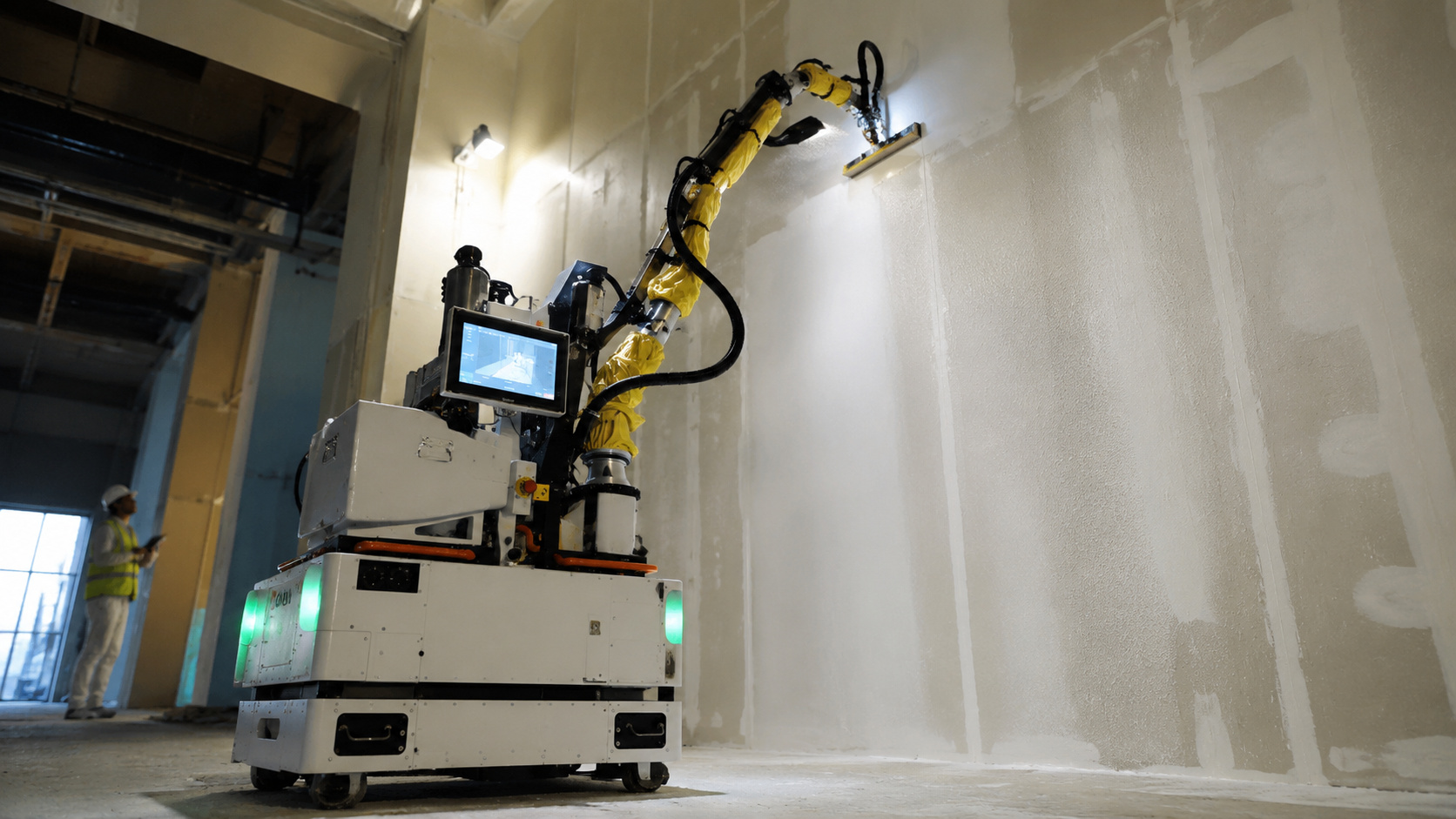


AI-powered painting robot uses 3D scanning to work on high walls and ceilings, reduces human effort in finishing, and brings automation to large projects in the United States with operation without complex preparation
The autonomous AI robot for painting and finishing has already covered the approximate equivalent of over 92,000 square meters in Europe, and now targets large projects in the United States.
The technology works on services that typically require a lot of physical effort, such as painting high walls, sanding surfaces, and finishing ceilings. Instead of relying on manual markings or a complex digital structure, the robot uses 3D scanning to understand the environment and perform the work.
The information was released by Okibo, a robotics company for construction sites. The proposal introduces artificial intelligence into a stage known for being repetitive, tiring, and very common in large-scale constructions.
-
A Brazilian street cleaner built a machine to recycle PET bottles in the hinterlands of Paraíba, transforming the trash he swept from the streets into threads, brooms, and equipment sold even outside Brazil, and began earning about R$ 7,500 per month with his own invention.

-
In a city where every piece of land is worth gold, he began buying plots in the 1960s and built a real estate empire with over a thousand properties.

-
An artist sank over 500 life-sized human statues at the bottom of the Caribbean Sea, and what seemed like macabre art turned into a living reef covered with corals that attracts divers from all over the world.

-
A fossil kept for years in a small museum in Montreal concealed 450-million-year-old soft tissue, a discovery that has only happened once before in history.


How AI guides the painting robot without markings, without BIM, and without Wi-Fi
The robot works by reading the environment itself. It scans walls, ceilings, and surrounding surfaces to recognize where it needs to act. After that, artificial intelligence guides the machine’s movements.


This process reduces the need for manual markings before the service. It also eliminates the need for BIM, which is a digital model used in construction projects, and does not depend on Wi-Fi for each operation command.
In practice, this is important because the construction site is constantly changing. Materials move, people circulate, and each environment can have different measurements. The robot needs to understand this real scenario to work without complex preparation.
The major change is in the type of task. Instead of placing a person for long periods in a high and tiring area, the machine takes over part of the repetition, while the operator monitors the service from a safer and less exhausting position.
Painting, sanding, and finishing have become labor bottlenecks in large constructions
Painting and sanding seem like simple activities when done on a small wall. However, in large projects, these tasks multiply by thousands of square meters and become a lengthy stage.
The finishing requires repetition, visual attention, and physical effort. Arms raised for a long time, sanding dust, and access to high ceilings make the work heavy for the teams.
That’s why autonomous finishing robots draw attention. They step in precisely in the most repetitive parts, where the machine can maintain the pace without suffering human wear and tear.
This type of automation does not eliminate the need for professionals. What changes is the role of those working on the site. Physical strength loses space, while operation, monitoring, and control of the equipment gain importance.
Reach of up to 7.3 meters puts high walls and ceilings at the center of automation
The EG7+ model gained prominence for reaching up to 7.3 meters, a relevant measure for high walls and ceilings. This capability allows the machine to operate in areas that normally require ladders, platforms, or other supports.

In large projects, this detail has a direct impact. The larger the wall, the harder it is to maintain the pace and quality of the finish with just manual work.
The machine can paint, sand, and finish surfaces at height, reducing workers’ exposure to the most uncomfortable positions. The operator remains necessary but is no longer stuck in repetitive effort throughout the execution.
This advancement shows why automation has strongly entered the finishing stage. It is an extensive, visual, and repetitive stage, exactly the type of work that mobile robots can execute with more predictability.
More than 92 thousand square meters in Europe show that the technology has moved beyond promise
The mark of more than 92 thousand square meters shows that the painter robot has already been applied in a significant area. This number helps to separate the technology from a mere laboratory demonstration.
A Okibo, a robotics company for construction sites, presents its robots as solutions for painting, sanding, and finishing drywall, a material known in Brazil as plasterboard wall.
This type of wall requires a well-prepared surface before painting. Any flaw in the finish can appear with the light and compromise the visual result.
Therefore, automation seeks to deliver regularity in large areas. The robot reads the environment, calculates the trajectory, and performs the service with a focus on controlled repetition.
What changes for the worker when the robot takes over the heaviest part
The advancement of painting robots changes the routine within the construction site. The machine starts to perform part of the physical task, while the worker monitors the operation, adjusts the equipment, and checks the result.
This change can reduce wear in height services. Painting and sanding ceilings require difficult posture, constant repetition, and a lot of time with arms raised.
With the machine, the team can focus more energy on supervision, site preparation, and quality control. Human work continues to exist but becomes less linked to brute effort.
The main consequence is the transformation of finishing into a more technological activity. Construction sites that previously relied almost solely on manual tools start to incorporate mobile robots and artificial intelligence.
Why construction began automating repetitive services first
Automation usually arrives first where there is repetition. Walls, ceilings, and large finishing areas follow this pattern because they require similar movements for a long time.
The AI painter robot takes advantage of this characteristic. It doesn’t need to solve the entire construction alone. It operates in a specific stage, with a large volume of service and high physical wear.
This explains the interest in larger projects. The larger the area to be painted or sanded, the greater the practical gain of a machine capable of maintaining pace and reaching high points.
Construction still heavily depends on human labor. However, technologies like this show that traditional tasks have already begun to be shared with autonomous systems.
The advancement of the autonomous robot with AI for painting, sanding, and finishing marks an important turning point for large projects. The machine brings 3D scanning, artificial intelligence, and mobility to a stage that has always required repetitive effort.
After covering more than 92,000 square meters in Europe and targeting large projects in the United States, the technology shows that the future of finishing may involve less manual labor and more intelligent supervision.
Do you think painter robots will ease the heavy work on construction sites or could they reduce opportunities for finishing professionals? Share your opinion and join this discussion.