Portuguese
  Spanish


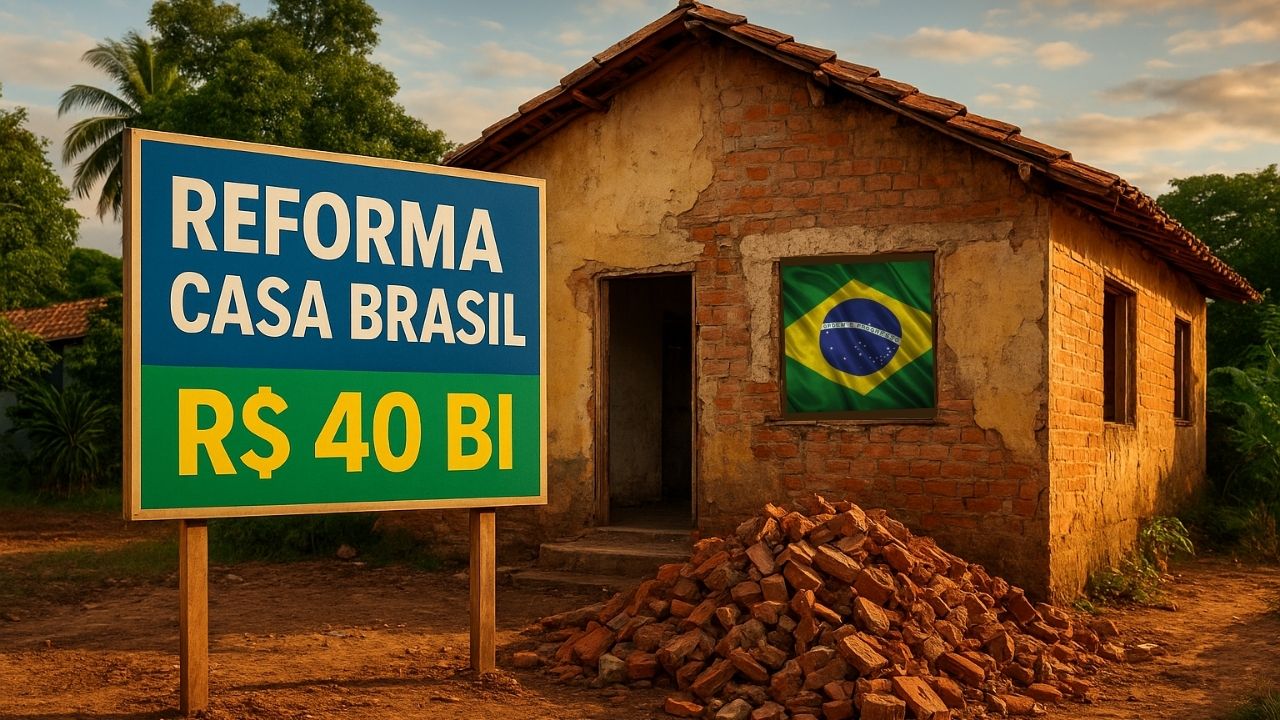


Initiative Aims to Benefit 1.5 Million Families with Up to R$ 30,000 for Housing Improvements; Find Out Who Is Eligible for the New Government Program.
The federal government officially launched the Reforma Casa Brasil, the new government program focused on financing housing improvements for families that already own their homes. The initiative, which is part of the Minha Casa, Minha Vida (MCMV) resumption, aims to combat the qualitative housing deficit by offering credit for structural repairs, expansions, or sanitation works. As detailed by the administration, the program will be coordinated by the Ministry of Cities in partnership with the Caixa Econômica Federal.
With an ambitious goal of benefiting 1.5 million families by 2026, the program will make a total of R$ 40 billion in housing credit available. According to information from the InfoMoney portal, the funds will primarily come from oil royalties (via the Social Fund) and the Brazilian Savings and Loan System (SBPE), ensuring financing with reduced interest rates and free technical support for planning the renovations.
Who Will Be Able to Participate in the Reforma Casa Brasil?
The main focus of the new government program is families that already have a property but are in precarious conditions. InfoMoney highlights that the diagnosis includes serious problems such as leaks, chronic mold, roofs with leaks, or even structures at risk of collapse. The goal is to ensure the safety and health of these homes, lifting millions of people out of inadequate living conditions.
-
Former Marketing Agency Owner Thrives on Foraging for 250 Days, Sampling Over 170 Plants, and Says He No Longer Remembers Supermarkets

-
IKEA’s AI Handles Nearly Half of Customer Calls, Company Reassigns 8,500 Staff as Design Consultants, Boosting Revenue by €1.3 Billion
-
Owner of Havan Visits Paraguay to Discuss Lower Taxes, Local Suppliers, and International Expansion with President

-
Brazilian Construction Retail Chain Closes After 60 Years, Begins Liquidation Sale Across Five Cities




To organize access, the government divided the public into two income brackets. The “Improvement Bracket 1” serves families with a monthly income of up to R$ 3,200. The “Improvement Bracket 2” targets those earning between R$ 3,200 and R$ 9,600. The program also provides special and more advantageous conditions for families that are enrolled in the Cadastro Único (CadÚnico), prioritizing those who most need state intervention for improved living conditions.
How Much Will Be Released and What Are the Payment Conditions?
Each family approved for the program will be able to receive a credit letter worth up to R$ 30,000. An important differentiator, according to InfoMoney, is that beneficiaries will not receive the money in cash. Caixa Econômica Federal will be responsible for paying the amounts directly to suppliers of construction materials and service providers (labor) who are properly accredited, ensuring the proper application of the resources.
Financing conditions vary according to the income bracket. For the “Improvement Bracket 1” (up to R$ 3,200), the interest will be 1.17% per month, subsidized by the Social Fund. For the “Improvement Bracket 2” (up to R$ 9,600), the interest rises to 1.95% per month, covered by the SBPE. The payment term, as stipulated, will be up to 60 months (five years), with the installment limited to 25% of the monthly family income. Each family unit can have only one active contract at a time.
What Is the Expected Impact and the Source of Funds?
The new government program does not aim to build new houses but rather to improve existing ones. The goal of 1.5 million families by 2026 directly addresses the so-called qualitative housing deficit, which refers to homes that exist but do not provide dignified or safe conditions for the residents. According to InfoMoney, the initiative is one of the five structural lines of the restructured MCMV, seeking to ensure quality and safety in popular housing.
To sustain this large-scale operation, the program will rely on a total investment of R$ 40 billion. Of this amount, the majority, R$ 30 billion, will come from the Social Fund, which is largely funded by oil royalties. The remaining R$ 10 billion will come from the Brazilian Savings and Loan System (SBPE), demonstrating a mixed strategy of public funding and the financial housing system to enable the renovations.
Do you agree with this change? Do you think it impacts the market? Leave your opinion in the comments, we want to hear from those who experience this in practice.