Portuguese
  Spanish


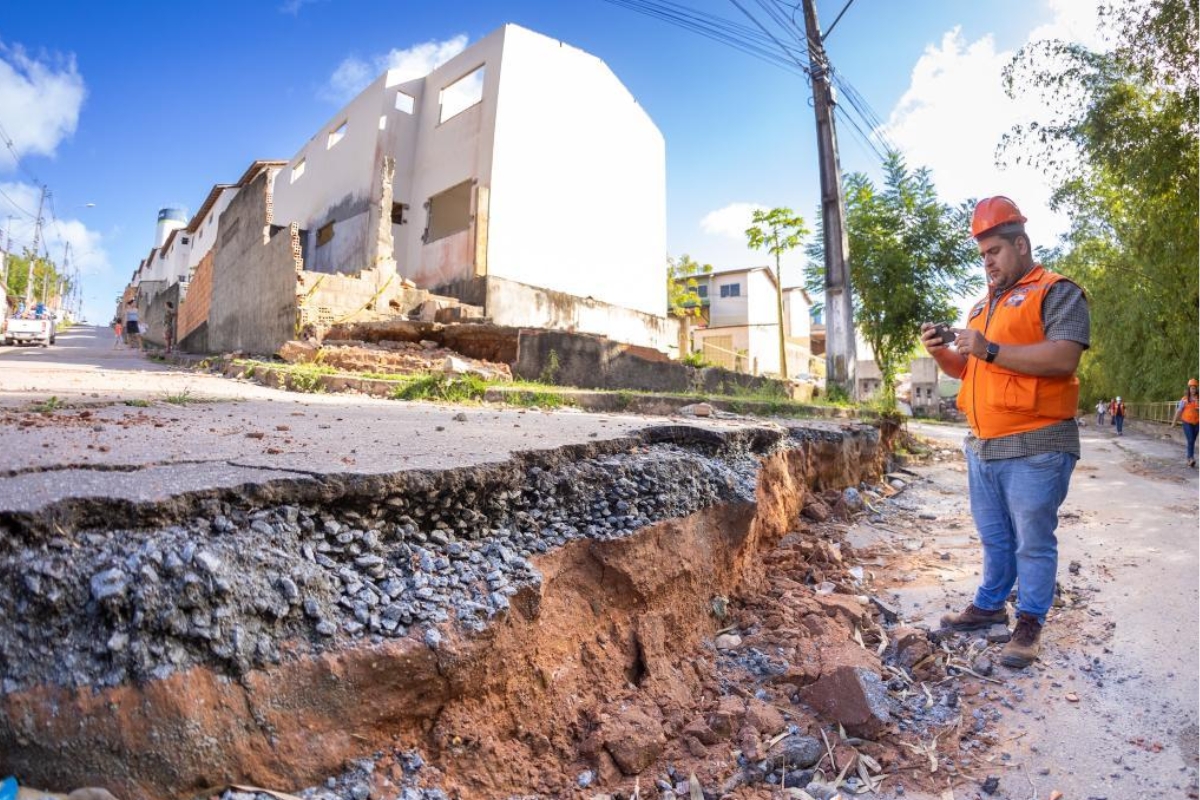

Braskem extracted rock salt in Maceió, Northeast Brazil, and 60,000 residents left homes after cracks
The ground began to subside in Maceió, capital of Alagoas, in Northeast Brazil, changing the lives of thousands of families. Neighborhoods like Pinheiro, Bebedouro, and Mutange started to live with cracks, sinkholes, and condemned properties.
The crisis gained momentum starting in 2018, when houses, buildings, sidewalks, and streets began to show signs of deformation. The problem was associated with the extraction of rock salt in the Alagoas capital.
The impact was direct on residents’ daily lives. Approximately 60,000 people had to leave their homes, while areas once full of life became practically empty.
-
Cape Verde’s World Cup Surprise: Betting on Electric Cars, a 5 MW Solar Plant, and an Ambitious Plan to Transform Energy for 600,000 Residents

-
Man Finds 1,469 Ancient Roman Silver Coins While Metal Detecting in Romania
-
Young Brazilian Siblings Go Viral for Catching Giant Fish, Launch Sport Fishing Project
-
72-Year-Old Retired Professor from Rural Brazil Recites 247 Digits of Pi in One Minute, Setting National Memory Record


2018 marked cracks in neighborhoods of Maceió, Northeast Brazil
Residents of traditional neighborhoods in Maceió, capital of Alagoas, in Northeast Brazil, saw the concept of home change abruptly. What once meant security now represented risk, uncertainty, and loss.
The first most serious occurrences involved Pinheiro, Bebedouro, and Mutange. Later, parts of Bom Parto and Farol also entered the map of affected areas.
The subsidence affected residential properties, commercial establishments, and public spaces. In many places, the ground opened fissures, leaving structures unsafe for use.

Extraction of rock salt destabilized underground cavities
The pointed cause for the problem was the extraction of rock salt, a mineral extracted at depth. This extraction left underground cavities that lost stability over time.
With unstable ground, there was movement of salt in the subsoil. This process caused subsidence, a term used to explain when the ground gradually sinks.
In the Pinheiro neighborhood, the situation became even more serious due to rainwater. Infiltration widened fractures, accelerated erosion, and favored the appearance of cracks on the surface.
35 mines were opened during mining activity in the Alagoas capital
During the operation in Maceió, capital of Alagoas, in Northeast Brazil, 35 mines linked to mineral extraction were opened. The cumulative effect of the activity altered the safety of urban areas occupied for decades.
With the advancement of risk, buildings and houses had to be demolished. In other places, properties remained under monitoring to track possible structural changes.
The stabilization forecast also shows the dimension of the problem. A geotechnics and geology specialist estimated that the neighborhoods could take about 10 years to achieve stability.
Families lost routine, neighborhood, and memories built over decades
Professor Lorena Martins, 36 years old, left the Jardim das Acácias housing complex in Pinheiro with her grandmother and aunt. Her apartment had no cracks, but the sidewalk sank and other blocks showed severe damage.
Lorena’s grandmother, Angelina Almeida, 85 years old, lived almost 50 years in the location. After leaving, she began to face depression and lost her routine of meetings, church, and socializing with old friends.
Human Resources manager Renata Costa also left Pinheiro, where she had lived for 25 years. Even after being compensated, she reported difficulty in rebuilding her life and recovering the neighborhood environment that existed before.


Compensation program presented 14,495 proposals by the end of April
According to Diario de Pernambuco, a Brazilian newspaper with national and regional coverage, Braskem reported that it created the Financial Compensation and Relocation Support Program in December 2019 to assist residents of the affected areas.
By the end of April, the program had presented 14,495 proposals. Of these, 12,637 were accepted, with an acceptance rate above 99% and only 62 rejections.
In the same period, 11,382 indemnities were paid. The sum of indemnities, financial aid, and legal fees exceeded R$ 2.38 billion.
December 2020 agreement targets future of vacated areas
In December 2020, the mining company developed a socio-environmental agreement focused on the future of the vacated spaces and their surroundings. The proposal involves urban reparation, environmental measures, and monitoring.
The agreement provides for actions on three main fronts: urban area, environment, and soil stabilization. It also includes the preservation of historical and cultural heritage, mobility, and compensation for collective damages.
The measures began to be discussed with authorities and with public participation. The challenge is to define what will be done in neighborhoods that have ceased to function as living communities.
The urban tragedy in Maceió, capital of Alagoas, in Northeast Brazil, transformed streets, buildings, and houses into marks of a crisis that has not yet ended. The displacement of 60,000 residents shows a social impact that goes beyond the cracks.
The subsidence caused by the extraction of rock salt left families separated from their memories, changed the city’s map, and keeps the Alagoas capital under pressure for reparation, stability, and a secure future.