Portuguese
  Spanish


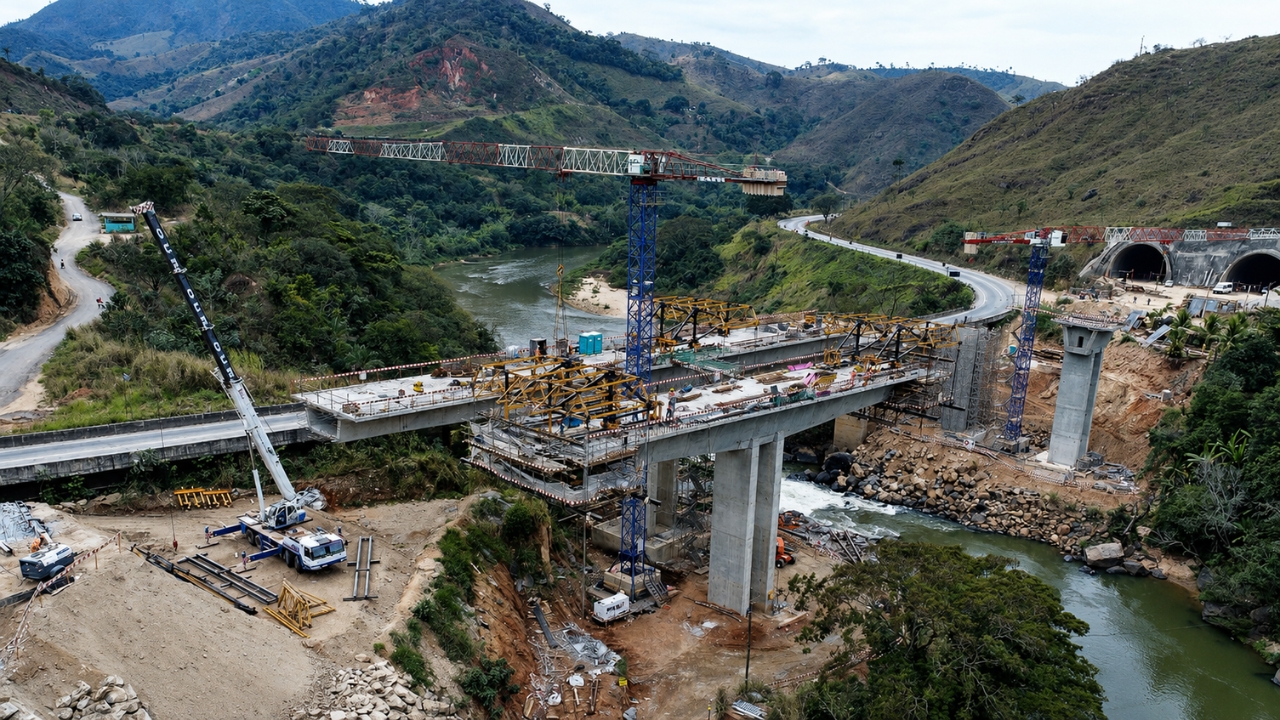

Survey by TCU shows that one in every two public works financed with federal resources is stalled or unfinished, with billion-dollar losses and a strong concentration in health and education.
Brazil had, until April 2025, 11,469 public works halted among 22,621 projects underway. The survey by the Federal Court of Accounts, cited by www12.senado.leg.br, shows that one in every two constructions financed with federal resources was interrupted or unfinished.
The picture is even harsher when looking at the money already spent: R$ 15.9 billion were invested in projects that did not reach completion. In many cases, the result is an abandoned structure, works that drag on for years, and services that never materialize.
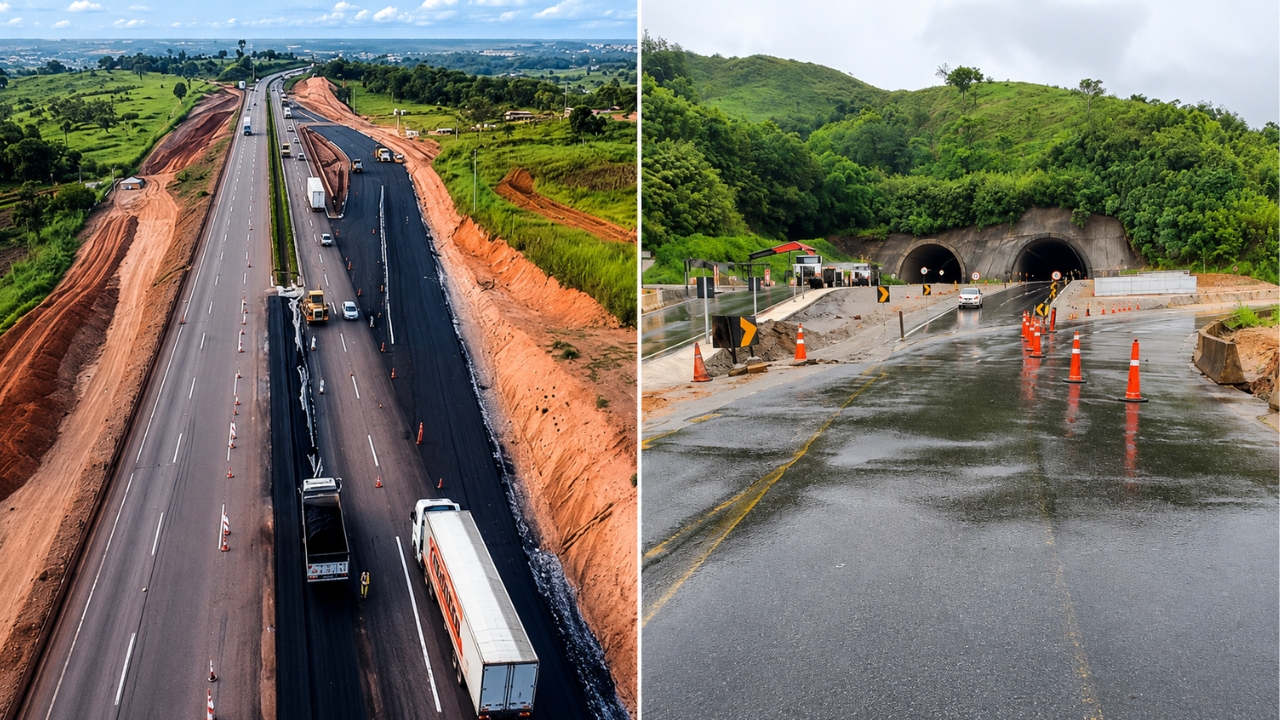
One of the most symbolic examples is the duplication of BR-381, in Minas Gerais. Started in 2015, the project consumed about R$ 530 million and remains without effective delivery, despite being one of the most important logistical corridors in the Southeast.
-
Sanitation Worker Transforms Street-Discarded Books into Library to Aid Underprivileged Children in Brazil

-
Gifted 8-Year-Old Brazilian Boy with IQ of 134, Holder of Over 15 Science Olympiad Medals, Faces Unexpected Challenge Highlighting a Widespread Issue for Families in Brazil.
-
End of an Era: Major Manufacturer Shuts Down Factory After 64 Years, Laying Off Over 150 Workers in Brazil
-
Former Banker Invests $24,000 to Create Award-Winning Burgers with Unique Brazilian Ingredients, Drawing Customers from Across Regions


One in every two federal works was still stalled in April 2025
Source: Agência Senado
The TCU numbers highlight the severity of the problem: from 2022 to 2025, the total number of stalled works grew by about 32%, while the number of projects barely changed, with an increase of only 0.2%. This means that the pace of opening new construction sites was not matched by the same capacity to complete what was already in progress.
In just one year, between April 2024 and April 2025, 5,505 new public works were started. Of this total, about 1,200 were already stalled during the period, equivalent to approximately 22%.
The survey itself, however, has limitations. The data is gathered by the TCU from different public agencies and entities, without a unified and complete registry of works in the country. Moreover, the criteria for defining a stoppage can vary, ranging from the absence of progress for 90 days to the formalization of an addendum for stoppage.
Education and Health Concentrate 70% of Stoppages
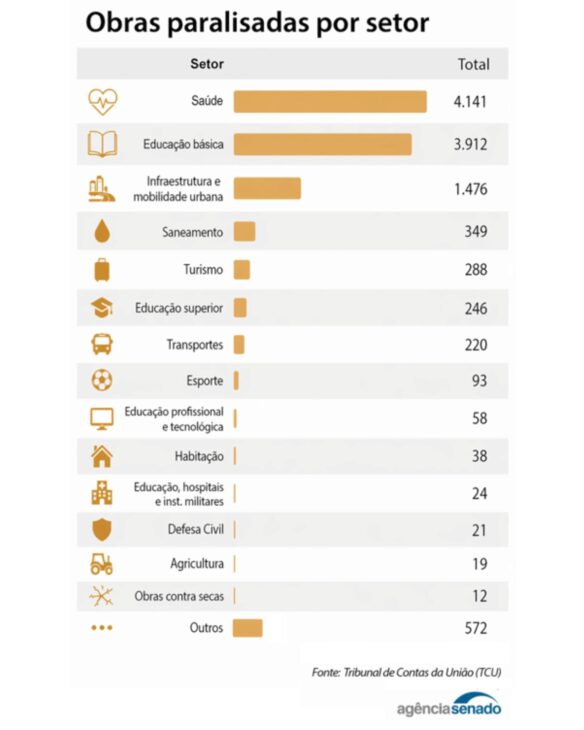
The majority of stalled works are precisely in areas that affect the daily lives of millions of Brazilians. Education and health account for 8,053 halted projects, which represents 70% of all stoppages mapped by the court.
For economist Evilasio Salvador, a professor at the University of Brasília, the concentration in these sectors is no coincidence. According to him, these are areas with high social demand, strong federal fragmentation, and dependency on transfers, which increases the risk of delay when the project fails, the local counterpart is lacking, or technical monitoring is absent.
In his assessment, when a project is poorly planned from the start, the problem cannot be solved with money alone. The difficulty arises earlier, in coordination, execution, and the state’s capacity to manage projects spread across the country.
Bahia, Maranhão, Pará, and Minas Lead in Number of Interrupted Works
In absolute numbers, Maranhão is in the lead, with 1,225 halted works. Following are Bahia, with 926, Pará, with 889, and Minas Gerais, with 874.
When viewed proportionally, the scenario is even more severe for Pará and Rio de Janeiro. The state of Pará had 65.5% of its works halted, while Rio de Janeiro reached 64.9%. Out of the 27 federative units, 14 had more than half of their projects interrupted.
Less than half of the halted works, about 4,700, have detailed records on the reason for the interruption. Even so, recurring data points to a well-known set of problems: planning failures, administrative limitations, financing difficulties, and obstacles related to local execution.


Congress and government attempt to unlock stalled projects
With the increase in stoppages, Congress and the Executive have begun discussing measures to resume projects and prevent further waste. One of the initiatives approved is Complementary Law 215, of 2025, which revalidates unprocessed outstanding payments from 2019 to 2022 and authorizes the use of these amounts until the end of 2026, focusing on contracts and agreements already underway.
Another proposal, PL 5.149/2023, aims to require public agencies at all levels to actively disclose data on ongoing and stalled projects, including contracts, schedules, measurements, payments, and photos. Meanwhile, the new Growth Acceleration Program has started prioritizing the resumption of interrupted projects before launching new ones.
In the end, the situation shows that the problem is not just the lack of completed projects. It’s the cost of leaving everything halfway. And while the country accumulates stalled construction sites, health, education, and infrastructure continue to wait to become real deliveries. If this issue affects you, share and leave your opinion on what is hindering public projects in Brazil.