






 Portuguese
  Spanish
  5 min of reading
  0 comments


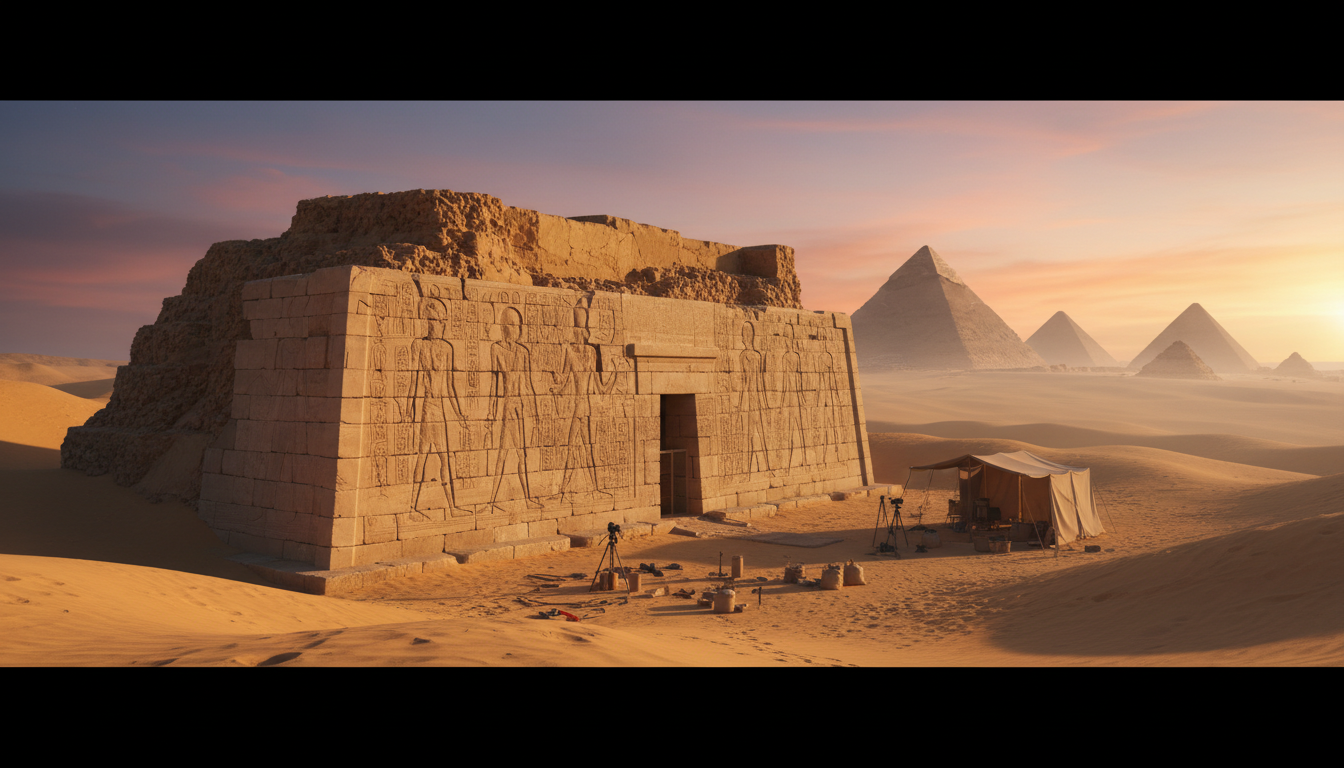
Ptahshepses served six pharaohs, married the daughter of a king, and was buried in a mastaba measuring 42 meters by 22 meters 4,400 years ago — Czech archaeologists used satellites to find him 160 years after the tomb was discovered and forgotten under the sand
He was born at the court of Giza, served six Egyptian pharaohs, and married the daughter of a king. He died at the age of 65 years, was buried with honors in a monumental tomb of Ptahshepses, and disappeared under the sands of the Western Desert for millennia. When a French scholar found him in the 1860s, he took artifacts to the British Museum — and the tomb vanished again.
Now, 160 years later, Czech archaeologists have rediscovered the tomb of Ptahshepses using satellite images and ancient maps. The find, announced by the Czech Institute of Egyptology at Charles University (Prague), revealed a complete mummy, preserved paintings, and intact canopic jars.
“The tomb of a man who changed the course of Egyptian history has thus been rediscovered, representing one of the greatest recent discoveries of the expedition”, stated Miroslav Bárta, head of research in Abusir, according to Charles University.
-
Chinese robots trained for two weeks to row a dragon boat at the Sichuan Festival in China, took full control when humans stopped rowing, and even made rice dumplings in one of the most unusual tests ever conducted with humanoids.

-
Public school students in Sergipe create an early autism screening kit for vulnerable communities without a doctor, in the year Brazil won 8 awards at the world’s largest science fair.
-
Brazilian creates ingenious hack with bus air conditioner water and transforms invisible dripping into savings of millions of liters; Capixaba system reuses condensation on the windshield, supplies the toilet on long trips, and has become a practice in Águia Branca’s fleet.
-
An 11-year-old boy left home with two cousins to sell popcorn for R$ 5, became an entrepreneur at 15, sells 100 buckets a day, and uses the profit to pay the entire family working in the business.


Who was Ptahshepses and why does his tomb matter
Ptahshepses was a high-ranking pharaonic official with an unparalleled documented career. Educated at the court of Pharaoh Menkaura, the last pyramid-building king at Giza, he bridged the transition between the 4th and 5th Dynasties of the Old Kingdom.
Throughout his life, he served under six consecutive kings: Menkaura, Shepseskaf, Userkaf, Sahura, Neferirkara, and Nyuserre. He married Khamaat, the daughter of Pharaoh Userkaf, consolidating his position as a bridge between the royal court and the state administration.
His tomb of Ptahshepses is considered a link between the simple mastabas of the early dynasties and the family funerary complexes that would come later. In this way, it documents the evolution of burial and mummification practices in the Old Kingdom.
- Period: 25th–24th centuries BC (~4,400 years)
- Location: between Abusir and Saqqara, south of Cairo
- Dimensions: mastaba of 42 m × 22 m, over 4 meters high
- Pharaohs served: 6 (Menkaura → Nyuserre)
- Wife: Khamaat, daughter of Pharaoh Userkaf
- Age at death: at least 65 years

How satellite images rediscovered the tomb of Ptahshepses
The first excavation of the tomb took place in the 1860s, conducted by the French scholar Auguste Mariette. He removed the false door and the lintel of the sepulcher, pieces that ended up in the British Museum in London, where they remain to this day.
After this intervention, the sand of the Western Desert covered the mastaba again. “It disappeared again under the sands”, explains Renata Landgráfová, director of the Czech Institute of Egyptology.
The modern search took several years until the team combined detailed satellite images with old maps of the Abusir–Saqqara region. In 2022, the tomb was finally located. The excavations extended over the seasons of 2022 and 2023, with the burial chamber examined in the spring of 2023.
Other recent rediscoveries in Egypt confirm the archaeological wealth of the region. A Spanish-Egyptian mission also revealed a monumental mastaba in Saqqara with artifacts from the Old Kingdom.

What archaeologists found inside the tomb
The burial chamber held a complete mummy, lying on its back in the partially open sarcophagus. Egyptian anthropologists confirmed that Ptahshepses died at at least 65 years.
In addition to the mummy, the team found canopic jars for internal organs, ceramics, and votive offerings. The tomb was robbed in antiquity, meaning that jewelry and treasures did not survive. However, the basic funerary equipment remained in place.
The entrance chapel preserved colorful paintings depicting scenes of offerings and hieroglyphs detailing Ptahshepses’s political career. Two serdabs, sealed rooms for statues of the deceased, and a limestone-blocked access corridor in situ complete the structure.
An unusual find drew attention: the first fish mummy recorded in this context, indicating even more diverse funerary practices than previously thought in the Old Kingdom.

The false door in the British Museum and the unique biography
The most famous piece from the tomb of Ptahshepses is no longer in Egypt. The false door, taken by Mariette in the 1860s, is displayed at the British Museum and contains a unique inscribed biography in Egyptology.
In it, Ptahshepses narrates his rise from a boy educated at the royal court to becoming one of the most powerful men in Egypt, marrying the pharaoh’s daughter. This first-person biographical narrative is one of the most detailed from the Old Kingdom.
The find compares to other discoveries that reveal the life of the Egyptian elite, such as the 10,000 golden mummies found in the Oasis of Bahariya. For more details, it is worth accessing the report from My Modern Met and the coverage from Czech Radio.

Research in progress and limitations
Bárta warns that “the research is still ongoing, and new discoveries are likely to be made to shed new light on his family and his time”. Therefore, the complete picture of the tomb of Ptahshepses is not yet finalized.
The confirmation that the mummy is indeed Ptahshepses is based on the biographical context of the tomb and age analysis (65+ years), but so far there are no published DNA results. The tomb was robbed in antiquity, which limits the inventory of personal items.
Still, the find is considered one of the most important archaeological rediscoveries in recent decades in Egypt. Funded by a grant from the American Research Center in Egypt, the Czech mission continues excavations in the Abusir–Saqqara region with plans for new seasons.


Be the first to react!