






 Portuguese
  Spanish
  5 min of reading
  0 comments


Technology uses ocean pressure to store excess electricity and could become an ally of offshore wind farms
Giant underwater spheres, installed on the seabed, are being studied as a new way to store renewable energy on a large scale. The proposal uses the pressure of water at great depths to store electricity generated by sources like sun and wind, two pillars of the global energy transition.
The technology is known as StEnSea, an acronym for Stored Energy in the Sea. According to Fraunhofer IEE, the German institute developing the project with partners, the idea transfers to the ocean floor a principle already used for decades in reversible hydroelectric plants.
The central point is simple to understand. When there is excess energy in the grid, water is pumped out of a hollow concrete sphere. When electricity is needed again, the seawater enters the structure again, moves a turbine, and generates energy.
-
Government allows new ID to be requested via mobile phone for home delivery with CPF as a unique number: Rio has already issued 4.4 million IDs, the document is free, has a QR Code, biometrics, and replaces the old ID until 2032.

-
Panic in Times Square this Thursday: shots were heard in the heart of New York, the crowd ran in a desperate rush, and the police arrested the shooter with the weapon used.
-
Pato Merlin becomes a phenomenon at the 2026 World Cup by wearing a Mexican jersey, garnering millions of views, and even challenging FIFA’s official mascots in popularity.

-
‘Capital do Diamante’ is in Brazil and surprises by recording only 12.7 °C, the lowest temperature in the Northeast, surpassing cities from three states in the official Inmet ranking and revealing a little-known side of Chapada Diamantina.




The secret lies in the pressure that exists where almost no one can reach
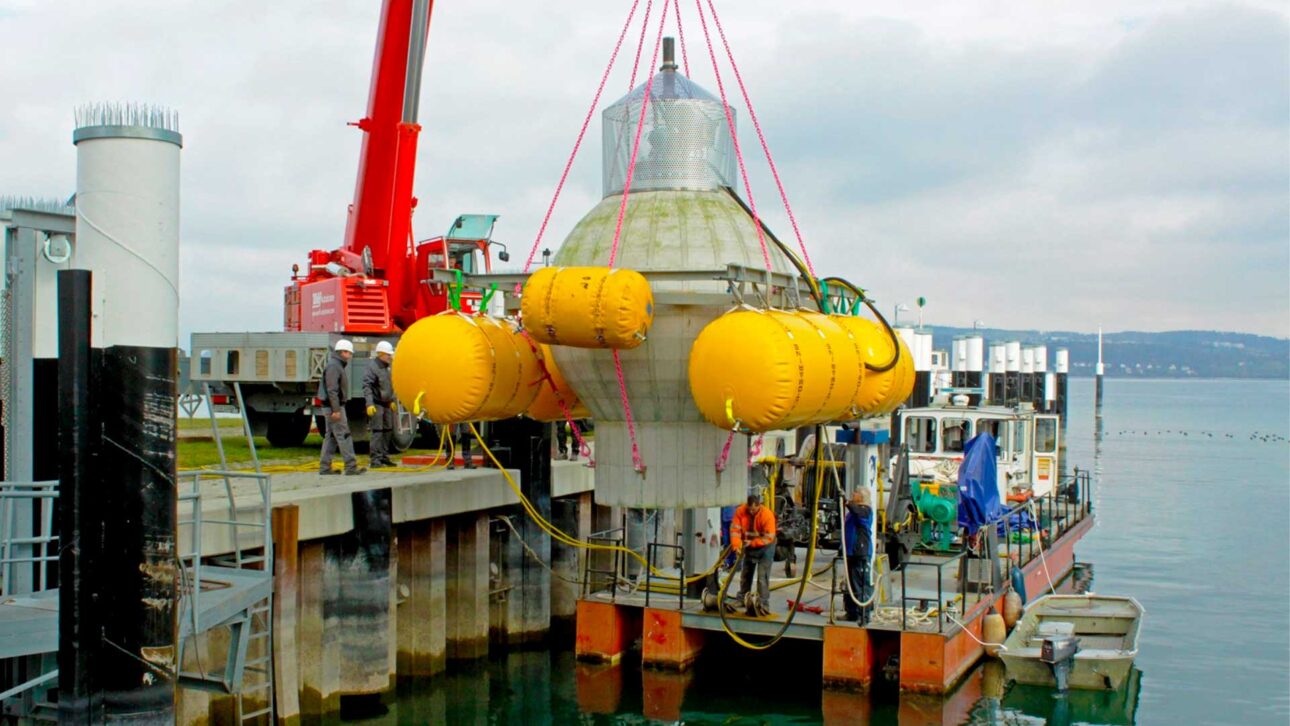
Depth is an essential part of the technology. In projects of this type, the spheres can operate in deep waters, between about 600 and 800 meters, where the water pressure is great enough to function as a sort of natural reservoir.
According to information from Fraunhofer IEE, the sea acts as the upper reservoir, while the empty sphere at the ocean floor acts as the lower reservoir. It is a maritime adaptation of pumped storage, but without the need to build large artificial lakes on land.
In practice, an empty sphere represents the charged system. To discharge, a valve is opened, water enters forcefully, passes through the turbine, and activates a generator. To recharge, excess electricity is used to pump the water out of the sphere.
This cycle draws attention because it tries to solve a known problem of renewable sources. Solar energy depends on the sun, wind energy depends on the wind, and neither delivers constant production throughout the day. Therefore, storing clean energy has become one of the major technological challenges of the energy transition.
After the lake test, the project moves to the ocean floor in California
The technology is not just on paper. As reported by Fraunhofer IEE, a smaller model has already been successfully tested in Lake Constance, Europe, at a depth of 100 meters. Now, researchers and partner companies are working to bring the solution to a real oceanic environment.
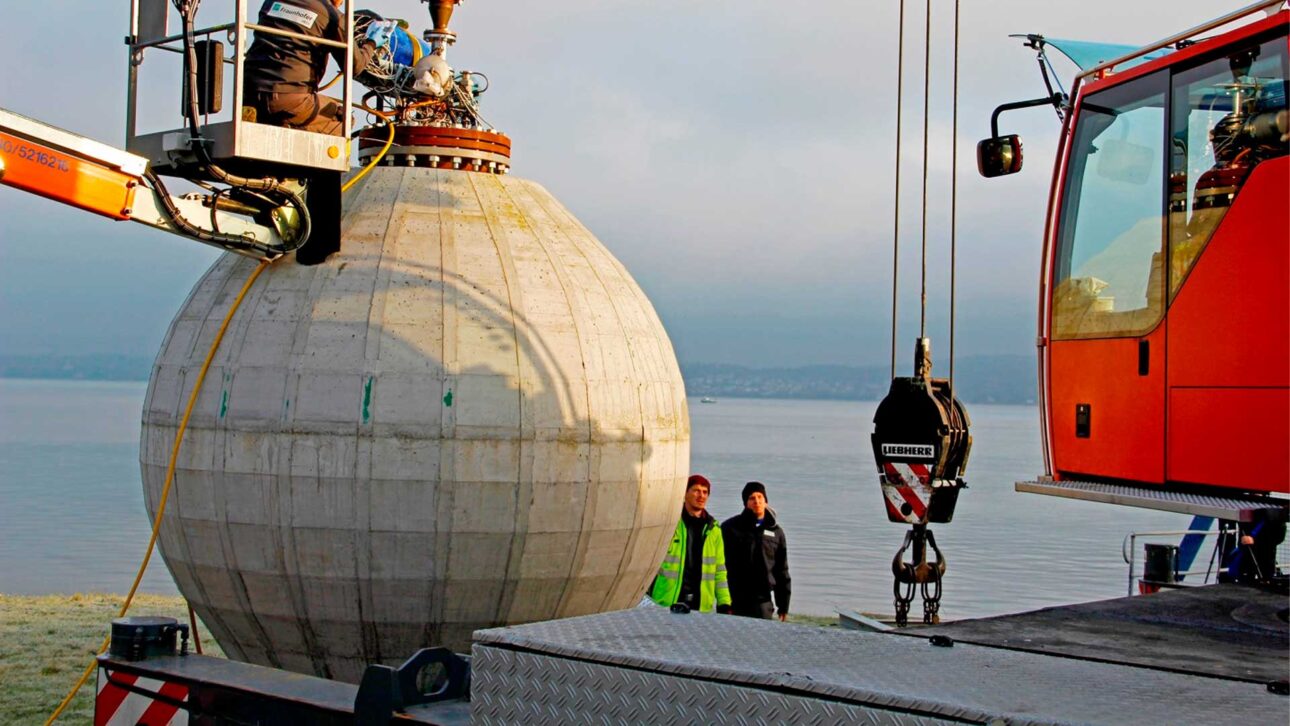
The next step involves a hollow concrete sphere about 9 meters in diameter and weighing approximately 400 tons. The structure will be tested in a coastal area near Long Beach, California, at an estimated depth between 500 and 600 meters.
The expected power for this prototype is 0.5 megawatts, with a capacity of 0.4 megawatt-hours. It is still a small scale compared to the needs of a national electrical system, but the goal of the test is not to power an entire city immediately. The aim is to validate manufacturing, installation, operation, and maintenance in an offshore environment.
The long-term plan targets larger spheres, about 30 meters in diameter. In this case, the technology could be organized in underwater parks, with several units connected to the coastal power grid or offshore wind farms.
The advance of renewables increases the race for long-term storage
Interest in this type of solution is growing because the expansion of renewable generation requires more flexible power grids. The International Energy Agency states that as solar and wind gain share, electrical systems need to better handle variations in production and demand.
The IEA projects that global renewable capacity should grow by almost 4,600 gigawatts between 2025 and 2030. This means more clean electricity entering the grids, but also more need for storage, transmission, digital control, and quick response to avoid waste.
Lithium-ion batteries already play an important role, especially in quick responses and short-term storage. But they do not solve all scenarios alone, especially when the need is to store energy for several hours or even longer.
It is in this space that technologies such as reversible hydroelectric, flow batteries, green hydrogen, and underwater systems can compete. The spheres on the ocean floor enter this list as a modular alternative, designed especially for regions with deep coastlines and offshore generation.
The promise is great, but the challenges are also at the bottom of the ocean
Despite its potential, the technology still needs to overcome significant obstacles. Installing giant structures hundreds of meters deep requires heavy engineering, specialized vessels, durable materials, and an operation very different from land maintenance.
The concrete needs to withstand pressure, corrosion, repeated operation cycles, and decades of use. According to data released by the project, the estimated lifespan of the spheres can reach 50 or 60 years, while turbines and generators would require replacement in shorter periods.
Another sensitive point is the cost. Fraunhofer IEE estimates that, in scenarios with several sphere parks, the full cycle efficiency would be around 75% to 80%. The number is competitive for large-scale storage, but viability depends on scale, logistics, and integration with the grid.
There are also environmental issues to consider. Even without creating onshore reservoirs, any structure on the seabed needs to undergo studies on its impact on the ecosystem, sediments, currents, noise, marine fauna routes, and fishing or port use areas.
Brazil can observe closely because it has coastline, wind, and a new offshore law
For Brazil, the technology is still far from commercial application, but the subject is not irrelevant. The country has an extensive coast, vast experience in offshore engineering due to oil, and has had, since January 2025, Law No. 15,097, which addresses the use of maritime areas for offshore electricity generation.
The most evident connection is in offshore wind energy. Offshore wind farms can produce large volumes of energy but are far from consumption centers. If part of this electricity could be stored near its generation, grid operation could gain more stability.
This does not mean that underwater spheres will be installed in Brazil in the short term. The country still needs to mature offshore wind projects, complementary rules, environmental licensing, grid connection, and economic models. Even so, the technology shows how the future of the electric sector may increasingly depend on solutions outside the traditional standard.
In the end, underwater spheres are not a magic solution. They are an attempt to turn ocean pressure into an ally of clean energy. If tests confirm safety, viable cost, and durability, the seabed may cease to be just a remote environment and become a strategic part of the future electric grid.
What do you think of this idea of storing clean energy in giant spheres at the bottom of the sea? Does the technology seem like a promising solution for the future, or is it still too far from reality? Leave your opinion in the comments and join the discussion.






Be the first to react!