






 Portuguese
  Spanish
  6 min of reading
  0 comments


In Shark Bay, formations built by microorganisms help scientists understand the planet’s oxygenation and show why rare coastal environments need to be protected
On the west coast of Australia, a shallow and seemingly ordinary beach holds one of Earth’s oldest stories. In Shark Bay, formations known as stromatolites continue to grow slowly in salty waters and help scientists understand how microorganisms changed the planet’s atmosphere.
These structures are called “living rocks” because they are not just mineral blocks. They are built by microbial communities, mainly cyanobacteria, capable of trapping sediments, forming layers, and participating in processes that resemble very ancient marine environments.
The importance of these formations is linked to the Great Oxygenation Event, which occurred about 2.4 billion years ago. It was during this period that oxygen began to accumulate more significantly in the atmosphere, paving the way for profound transformations in terrestrial life.
-
Luciano Hang, owner of Havan, reveals the secret everyone wanted to know: how the retailer chooses cities for new stores of up to 50,000 m², aims for 200 units in Brazil, and plans to open 7 more megastores in 2026.

-
Brazil’s most charming train route: The 1927 Maria Fumaça travels 10 km through the Serra da Mantiqueira on an 80-minute journey with live music, historical stop, wooden carriages, and a Minas Gerais restaurant car.
-
Labor shortage challenges agriculture in Brazil: the country lost 4.3 million rural residents, only 1 in 10 producers in SC has family succession, and the sector responds with a 100-hour program and R$ 4 billion in investments.
-
With an estimated fortune of up to R$ 1 billion, Ratinho maintains a beachfront mansion in one of the most valued areas of SC, with a rare private dock among luxury properties and an exclusive view of the sea in Itapema.



The article published by Revista Oeste on June 17, 2026, drew attention to this scenario by highlighting how the modern stromatolites of Shark Bay function as a window to the past. The central point, however, requires caution: the current structures are not the same intact rocks from 2.4 billion years ago, but living analogs of processes that marked the primitive Earth.
Stromatolites show how small microorganisms changed an entire planet
Stromatolites form when microbial mats accumulate sediments and favor the precipitation of minerals, especially calcium carbonate. Over time, this process creates hardened layers, often in rounded or wavy shapes.
In practice, each structure functions as a living record of biological and mineral activity. The outer part concentrates active microorganisms, while the internal layers hold signs of processes accumulated over long periods.
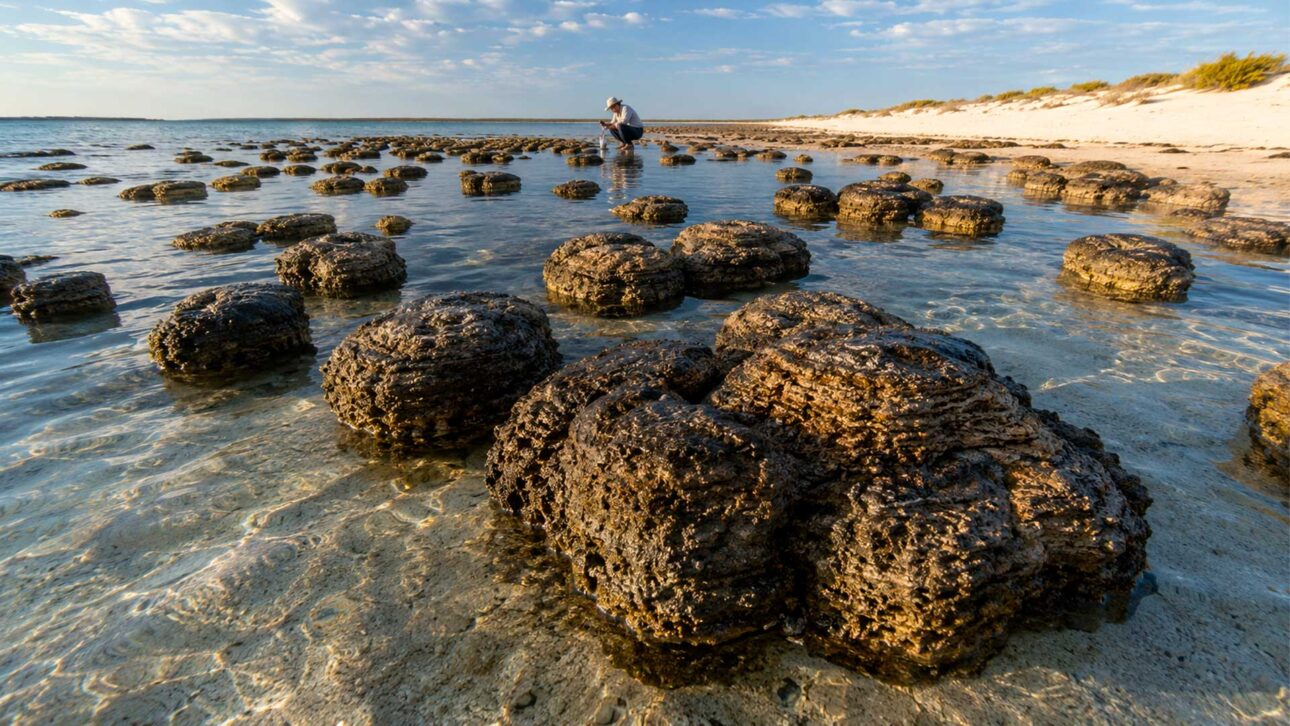
The role of cyanobacteria is decisive because they perform oxygenic photosynthesis. In this process, these microorganisms use light, water, and carbon dioxide to produce energy, releasing oxygen as a byproduct.
For billions of years, this oxygen did not immediately accumulate in the atmosphere. Part of it reacted with minerals, especially iron dissolved in ancient oceans, until the planet’s conditions allowed for a broader change.
Shark Bay became a world reference for preserving rare formations in hypersaline waters
Shark Bay is located at the westernmost point of Australia and is internationally recognized for its coastal ecosystems. According to UNESCO, the region hosts in Hamelin Pool some of the most diverse and abundant examples of living stromatolites on the planet.
The site was inscribed as a World Heritage Site on December 13, 1991. According to the Department of Biodiversity, Conservation and Attractions of Western Australia, the protected area covers about 2.2 million hectares and includes marine waters, islands, peninsulas, seagrass beds, and habitats of threatened species.
What makes Hamelin Pool so special is the combination of shallow waters, high evaporation, and elevated salinity. This condition limits the presence of many animals that could scrape or consume the microbial mats, allowing the stromatolites to continue growing.
In common seas, similar structures have become much rarer over the course of evolution. With the emergence and diversification of animals capable of grazing on microorganisms, many microbial mats began to be destroyed before forming large structures.
The connection with oxygen helps explain a turning point in the history of life
Before the great oxygenation, Earth had a very different atmosphere from today. Free oxygen was scarce, and many organisms lived in anaerobic conditions, meaning they did not depend on this gas to survive.
Over time, the activity of photosynthetic microorganisms contributed to changing this scenario. According to NASA Astrobiology, the Great Oxygenation Event is estimated to have occurred between 2.5 billion and 2.3 billion years ago, when oxygen began to accumulate significantly in the atmosphere.
This change was neither simple nor beneficial for all organisms of the time. For life forms adapted to environments without oxygen, the new gas could pose a threat, while for other lineages it opened metabolic possibilities that would later be fundamental for complex organisms.
That is why stromatolites are so important to science. They help visualize how microscopic communities, without animals, plants, or forests, were able to interfere with the chemistry of the ocean and the atmosphere.
Living rocks are not common fossils and function as layered ecosystems
Unlike a traditional fossil, which preserves remains or marks of ancient organisms, modern stromatolites are active environments. They gather microorganisms that live in different zones, according to the presence of light, oxygen, nutrients, and organic matter.
The upper layer usually receives more light and concentrates photosynthetic organisms. It is in this region that oxygen production can occur more intensely, especially when cyanobacteria are active.
In intermediate layers, other microorganisms recycle nutrients and organic matter. This part shows how stromatolites function as small integrated systems, where the product of one group can serve as a resource for another.
In the deeper layers, where there is less oxygen, microbes adapted to anaerobic conditions may live. This organization helps researchers study environments similar to those that existed when complex life had not yet dominated the planet.
According to information from Shark Bay’s educational material, the stromatolites and microbial mats of Hamelin Pool appear in shallow waters and depend on light, which limits their occurrence to certain depths. This reinforces the direct relationship between environment, salinity, lighting, and the survival of these formations.
Climate change and coastal pressure threaten structures that grow slowly
Despite their reputation for resilience, stromatolites depend on a delicate environmental balance. Changes in water temperature, salinity, ocean acidity, and coastal circulation can affect the stability of these systems.
A study published in the scientific journal Life warns that microbial ecosystems like those in Shark Bay may be vulnerable to extreme events, sea level rise, acidification, and changes in rainfall patterns. These changes can affect the conditions that allow the formation and maintenance of stromatolites.
Ocean acidification is concerning because it interferes with carbonate minerals, which are important for the construction of these structures. If the water chemistry changes persistently, the ability to form and preserve mineral layers can be compromised.
Sea level rise can also alter circulation in Hamelin Pool. If the entry of ocean water changes the salinity of the region, the natural protection against grazing organisms may decrease.
Moreover, unregulated tourism, trampling, coastal works, and changes in water quality can cause local damage. Since these formations grow slowly, seemingly small impacts can take a long time to be reversed.
What these rocks reveal about the future of scientific research
The interest in stromatolites goes beyond geology. They are also studied by biologists, astrobiologists, and researchers investigating how life can arise and adapt in extreme environments.
As these systems resemble very ancient processes, they serve as models to understand the early Earth. At the same time, they help scientists think about signs of life that could be sought on other planets or moons, especially in environments where minerals and microorganisms might have interacted.
The great lesson from Shark Bay is that the history of life does not depend solely on large animals, forests, or visible fossils. Long before that, microorganisms were already participating in chemical cycles capable of transforming oceans and the atmosphere.
Therefore, the so-called living rocks are more than natural curiosities. They show that the Earth began to “breathe” through slow processes, accumulated over millions and billions of years, until creating conditions for life as we know it today.


Be the first to react!