






 Portuguese
  Spanish



The James Webb Telescope Makes a Surprising Discovery at the Edge of the Milky Way, Pushing Science to the Limit and Revealing Incredible Details About the Distant Universe That Are Fascinating Scientists
The James Webb Space Telescope (JWST) is redefining the boundaries of space exploration, and this time, its gaze is directed towards an impressive region at the edge of our own galaxy, the Milky Way. Since its launch in December 2021, the telescope has been capturing images of the deep universe and providing unprecedented data.
However, its most recent discovery is closer to home, in what astronomers are calling the “Extreme Outer Galaxy.”
This area is located about 58,000 light-years from the heart of the Milky Way, known as the Galactic Center. For comparison, our solar system is about 26,000 light-years from the center of the galaxy, which means this new region observed by the JWST is truly at the edge of our galaxy.
-
China Develops Custom 140-Ton Electric Mining Truck with 770 kWh Swappable Battery, Deploys 290 Units in Xinjiang’s Largest Zinc Mine

-
Meta to Launch Arena, a New Prediction App Targeting 3.56 Billion Users, Competing with Polymarket and Kalshi

-
Scientist Challenges Famous Human Evolution Theory, Argues Homo Sapiens Evolved Gradually Over Thousands of Years
-
15-Year-Old American Builds Ocean Generator with PVC Pipe and 3D-Printed Propeller for $12, Wins National Prize, Presents at White House, and Makes Forbes 30 Under 30 List




The research revealed a region filled with clusters of stars in full “stellar explosion,” a period of intense and rapid star formation.
Exploring the Digel Molecular Clouds
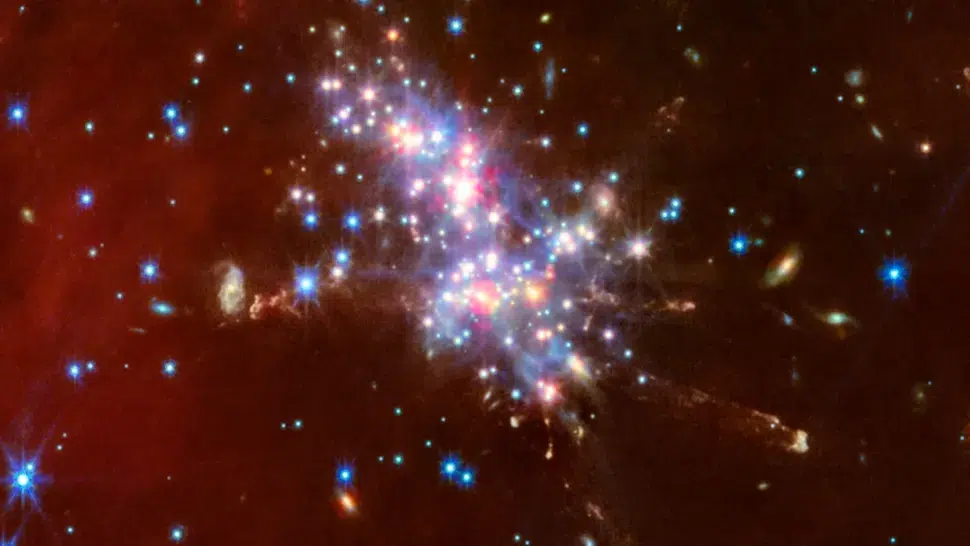
The new images captured by the JWST show two dense gas molecular clouds, called Digel Cloud 1 and Digel Cloud 2. These clouds, spanning many light-years, are the “stellar nurseries” where young stars are rapidly being born.
The data were captured by the Near Infrared Camera (NIRCam) and the Mid-Infrared Instrument (MIRI) of the James Webb Telescope, which can penetrate through cosmic dust and provide detailed images of these regions.
The Digel Clouds are different from other areas of the Milky Way because they have a peculiar composition. They are low in “metals,” which, in astronomical jargon, refers to any element heavier than hydrogen and helium.
This composition makes the Digel Clouds an excellent object of study, as it simulates the conditions of dwarf galaxies, providing clues about the early history of the Milky Way.
The Birth of Proto-Stars
Among the most fascinating objects captured in the images are proto-stars, stars in formation, still surrounded by clouds of gas and dust. These proto-stars do not have enough mass to initiate nuclear fusion—the process that transforms hydrogen into helium, marking the beginning of a star’s life.
However, proto-stars are extremely active bodies, ejecting jets of superheated plasma from their poles. These jets, visible in the images from the JWST, are a striking feature of this early stage of star formation.
“In the case of Digel Cloud 2, I did not expect to see such active star formation and such spectacular jets,” says Natsuko Izumi, the lead researcher.
Stellar Jets and Subclumps
In regions 1A, 1B, 2N, and 2S of the Digel Clouds, the team observed intense star formation activity. In region 2S, in particular, astronomers detected long jets of material being emitted by young stars.
What makes this discovery even more interesting is the fact that a “subclump” of stars was identified within this region, shooting jets in various directions, like a true cosmic fireworks show.
These jets are formed when material falling towards forming stars is expelled from the poles, creating plasma displays that travel thousands of kilometers through space.
Mike Ressler from NASA’s Jet Propulsion Laboratory and a member of the research team described this discovery with enthusiasm: “What was fascinating and surprising to me in the JWST data is that there are several jets shooting in all different directions from this cluster of stars. It’s a bit like a firework, where you see things shooting off in one direction and then another.”
Unraveling Mysteries of the Milky Way
The discoveries made by the James Webb Telescope are just the beginning of a series of studies aimed at uncovering more mysteries about star formation in extreme regions of the Milky Way.
The research team will continue to explore how different environments influence the birth and evolution of stars of various masses within these clusters.
Additionally, there is particular interest in investigating circumstellar disks in star formation regions. These disks of material around young stars are responsible for planet formation, and scientists hope to discover why the disks of stars in the Digel Clouds seem to have a shorter lifespan than those found in regions closer to our solar system.
Looking to the Future Through the James Webb Telescope
With the power of the JWST, astronomers are closer than ever to understanding how stars and planets form and evolve in different regions of the galaxy.
The telescope, with its ability to observe the universe in infrared wavelengths, allows scientists to look through cosmic dust and obtain details that were previously out of reach.
This research is just the beginning of a new era in astronomy, where it will be possible to study the history and evolution of stars on various scales.
As scientists continue to combine data from different telescopes and observatories, understanding of star formation and galactic evolution will expand, leading to more surprising discoveries.






