






 Portuguese
  Spanish
  6 min of reading
  2 comments


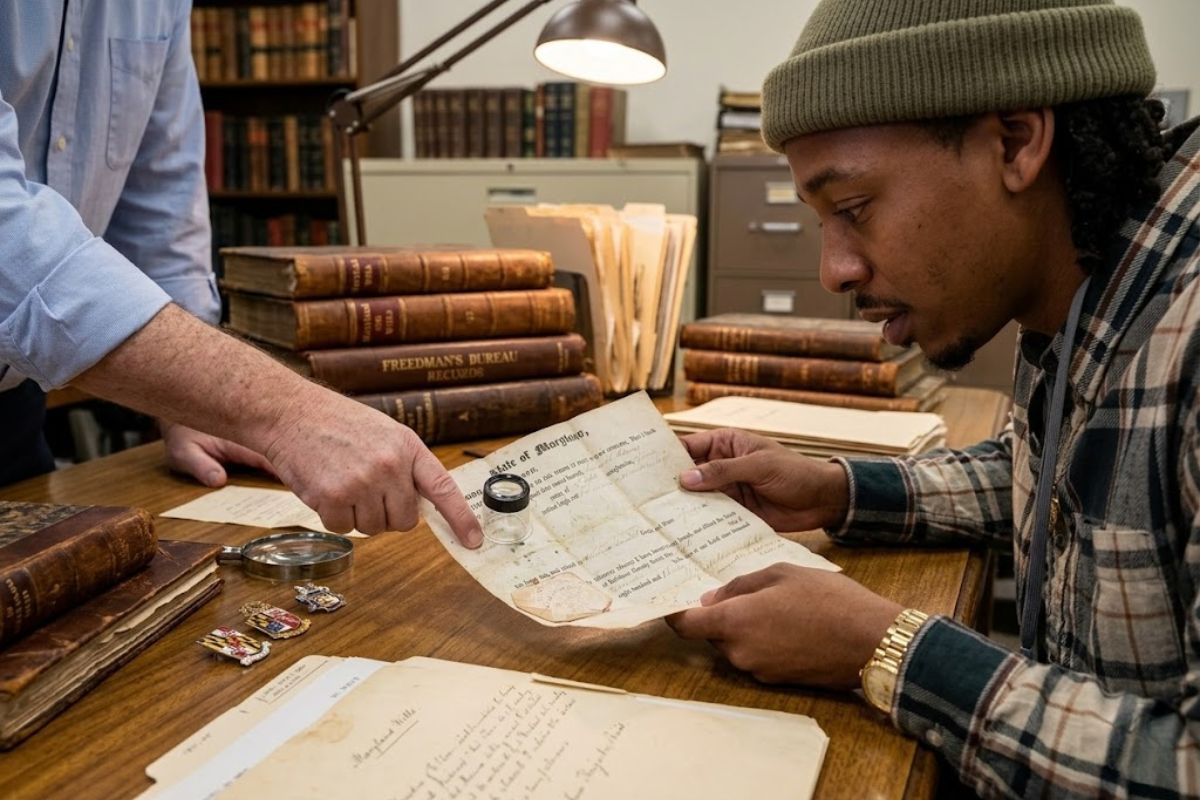


Cleaning at His Mother’s House Led Aaron Haines to a Freedom Document Preserved by the Family, Produced in 1834 and Dated 1817, Identifying Samuel Jones, A Free-Born Black Man in Anne Arundel, Maryland, Mobilizing Conservatives and Researchers from American Ancestors and Opening New Historical Questions
Aaron Haines had no idea that a routine task, clearing out rooms and sorting boxes at his mother’s house, would end up leading to a freedom document that crossed generations. The paper came to him as a family heirloom, passed from mother to daughter, and had been kept for years until it was opened with attention and perplexity, as if it were something difficult to fit into at first glance.
The discovery gained more weight when he decided to seek genealogy experts in Boston. Between curiosity and responsibility, Haines began to treat the find as a piece that could support memory, identity, and research, not only for his family but also for the social history of a period when black names and trajectories were often pushed into the shadows.
A Domestic Cleaning That Turned into Historical Investigation
The starting point is simple: the document was found during the organization of his mother’s house and, according to Haines himself, the feeling was as if he were living an episode of a historical program, like those he usually watches.
-
Science wants to know what football does to you: study gathers smartwatch data to understand the real impact of World Cup emotions on the human body

-
Lasers penetrate the dense forest of the Chocó Andino and reveal more than 200 mounds, 100 terraces, and ancient roads in just 600 hectares, suggesting a much larger pre-Hispanic landscape hidden near Quito.

-
Fossils millions of years old reveal that giant capybaras once dominated Chile, a country where the largest rodent on the planet simply no longer exists today.

-
Former coal mining area in the central United States receives nearly 17,000 solar panels generating 9.8 megawatts, serving over 650 subscribers and including about 200 low-income families without installing anything on rooftops.


This comparison reflects the mix of surprise and anxiety of someone who suddenly realizes that there is an entire story folded inside an old envelope.
But the real turning point happens when curiosity stops being just a reaction and becomes a method. He saves, revisits, tries to understand what he has in hand, and seeks specialized help. What seemed like just an old sheet turns into a research object.
The Role of American Ancestors and Why “Letting the Document Speak” Matters
In Boston, Haines takes the find to American Ancestors, an institution focused on genealogy and family history. There, the approach does not begin with grand assumptions but with a principle of caution: allowing the record itself, with its form, materiality, and signs of time, to indicate what it is.
This stance is clear in the work of conservator Todd Pattison, who focuses on restoring and preserving documents. For professionals like him, details such as support fibers, appearance of the writing, and mode of production help differentiate the old from the merely aged, the legitimate from the reproduced.
In such workshops, the evaluation involves observing whether something appears handmade, if there are signs of mechanization, and how printing techniques and strokes behave over time.
Authenticity: What a Conservator Can See in Silence
The confirmation does not come from a “guess,” but from physical signs. Pattison identifies the find as legitimate and describes the piece as a folded parchment, preserved and with still legible writing. This level of integrity is uncommon when discussing something nearly two centuries old because folds, moisture, handling, and improper storage typically compromise the structure regarding reading.
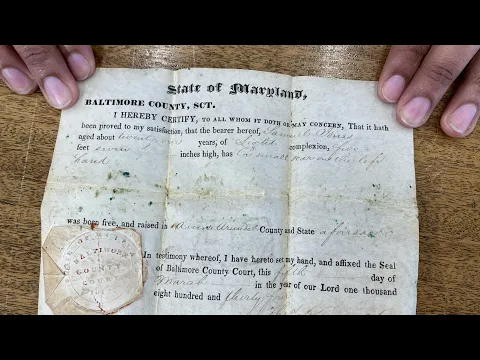
Another relevant detail is the presence of a sealed date of 1817 associated with the record, while the production of the document itself is attributed to 1834.
Rather than becoming an automatic contradiction, this opens a historical interpretation front: dates can relate to procedures, prior records, validations, or references that reappear in later documentary instruments, especially in bureaucratic routines.
What the Freedom Document Reveals About Samuel Jones

Among the central information is the name: Samuel Jones. The record states that he was 21 years old when the document was signed and describes him as a free-born black man in Anne Arundel County, Maryland. This type of declaration carries enormous significance in a country where slavery structured laws, economy, and social relations for centuries.
Besides his origin, the document includes physical characteristics used for identification: light skin, about 5’7″ tall, and a small scar on his left hand. This level of description is not an aesthetic detail; it is a mechanism of control and proof. In systems that allowed contesting someone’s freedom, any bodily mark could become an argument for validation or suspicion.
Why Free Black People Needed to Carry This Type of Record
The existence of a freedom document should not be read as a “guarantee of peace.” On the contrary: the very need for this paper indicates a scenario where free blacks could be questioned, detained, kidnapped, and returned to slavery. Carrying the document was often a way to try to reduce the risk of an interaction that could end in institutional violence.
This context explains why such records were valuable and, at the same time, vulnerable. Valuable because they served as proof; vulnerable because they depended on physical preservation, social recognition, and acceptance by authorities. Losing the document could mean losing one’s own protection, especially during travels, crossings between localities, or situations where a person’s word was not considered sufficient.
When Official History Collects Some Names and Forgets Others
The evaluation of the find also provokes an uncomfortable discussion: why do certain collections have an abundance of documents from elites and a scarcity of materials linked to marginalized groups? There is recognition of an institutional bias: for a long time, collections prioritized “founding fathers,” wealthy families, and celebrated figures, while records of black, poor, or unprivileged individuals remained out of the shelves.
In this scenario, the freedom document found by Haines becomes more than just a family item. It operates as proof that fundamental stories have been deliberately obscured, and as a reminder that many of these trajectories only reappear when someone opens a drawer, revisits a box, and decides not to ignore what they found.
The 10 Million Names Project and the Patient Reconstruction of What Was Erased

At American Ancestors, researcher Danielle Rose works on the 10 Million Names Project, an effort to recover and restore names of enslaved people in the United States. The logic is straightforward: without names, there is no traceability; without traceability, history becomes a faceless statistic. And for many families, recognizing a name is the beginning of recognizing a life.
The project also relies on unexpected contributions. Many people do not realize they may have something relevant at home: a birth certificate, a letter, a receipt, a note, a work record. Haines’ discovery reinforces this point concretely: a document kept for generations, without fanfare, can connect with larger initiatives and expand collective understanding of the past.
The Emotional Weight of a Lightweight Paper and What It Changes Moving Forward
Haines describes the find as light and thin, but filled with history, honor, and power. It’s not hard to understand why.
By recognizing that he is where he is because an ancestor “took that step,” he translates a feeling of gratitude linked to survival, resistance, and family continuity, in a country where black freedom often had to be proven on paper.
At the same time, the impact itself seems to grow over time. He talks about taking time to measure the weight of what he held in his hands and how the document speaks not only of his family but also of the country.
When such a record reappears, it does not close a story; it opens questions. The next step tends to be more research: cross-referencing names, seeking other records, and understanding how Samuel Jones’s life connected to later trajectories.
The discovery of a freedom document from 1834, preserved within a family and recognized by experts, shows how history can be hidden in common places and reappear when someone decides to look carefully.
Between Boston and Maryland, between a folded parchment and a network of researchers, the case exposes a simple truth: memory is also an archive, and an archive is also a dispute.
In your family, is there any old paper, photo, letter, or record that no one else can explain properly, but you suspect holds a larger story?
Have you ever experienced a situation where a cleaning, move, or organization brought to light something that changed your view of your origins? And if you found such a document, what would you do first: keep it, show it to someone, or start investigating?








Uma história e um legado e tanto… assim que o meu pai faleceu fui atrás da família, pois ele havia iniciado a árvore genealógica. Com os papéis em mãos fui do Rio Grande do Sul para Petrópolis/ RJ em busca dos parentes. Não só encontrei muitos primos e primas assim como doei vários pertences, que estavam na família a várias gerações, para o Museu Casa do Colono em Petrópolis. Os meus pais eram descendentes dos colonizadores da cidade. Uma das bíblias que tínhamos era datada em 1837… nela estava escrito os nomes daqueles que nasceram e faleceram… a chamo de Bíblia cartório, pois naquela época era assim que eles registravam os familiares. Sou a favor das doações para que as próximas gerações saibam o quanto foi árduo abrir campo para os mais novos assim como também contar as histórias daqueles que se descende.
Estou tentando montar a árvore genealógica da minha ha família, pelo lado da minha mãe e do lado do meu pai.