






 Portuguese
  Spanish
  3 min of reading
  1 comment


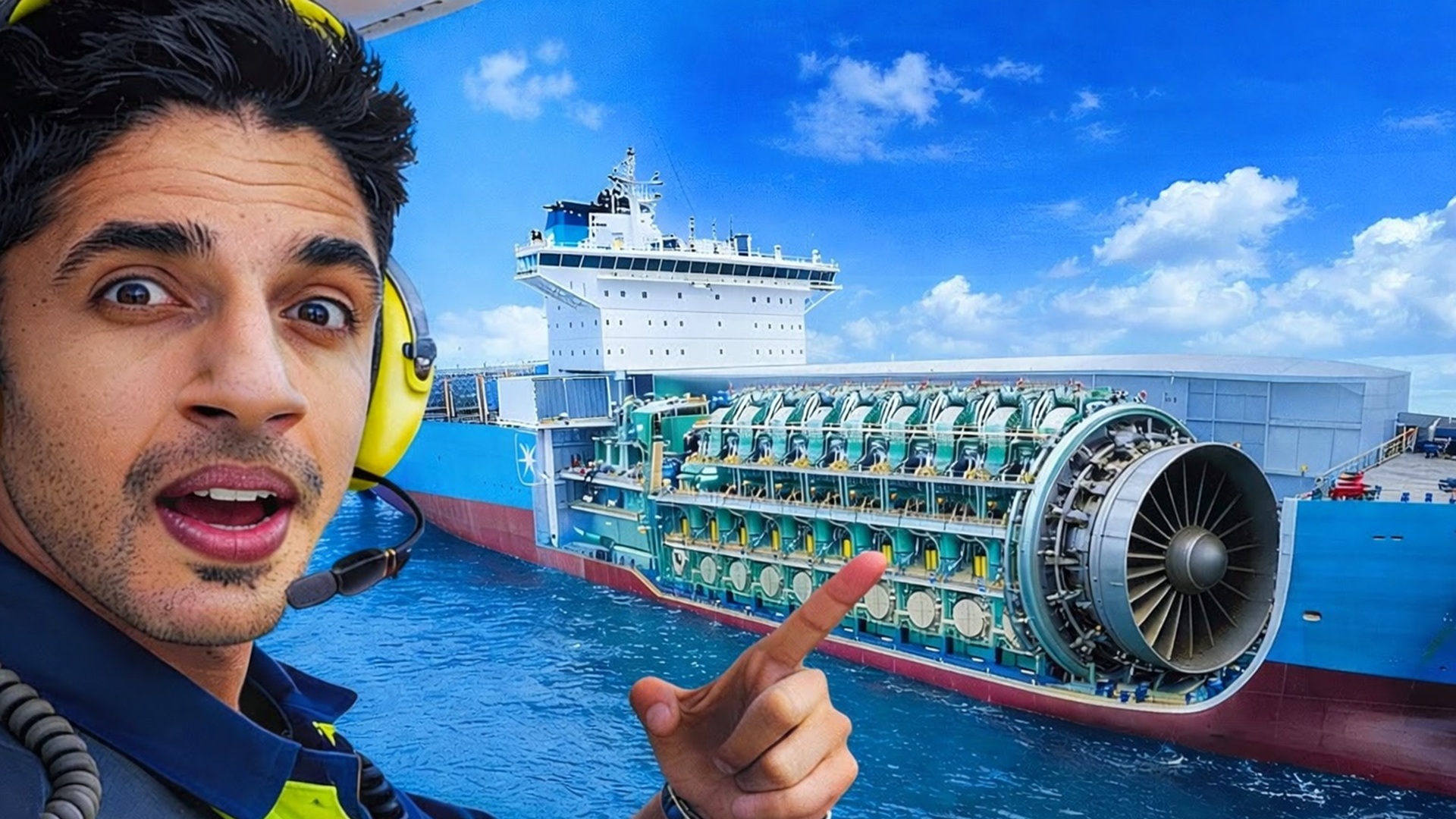


The Largest Ship in the World Houses a Maritime Engine with 14 Cylinder House-Sized, 167-Meter Propeller Shaft, and Systems Distributed Across Multiple Decks, Revealing an Internal Structure Comparable to a Building and Illustrating the Extreme Scale of Modern Naval Engineering
Upon entering the largest ship in the world, a man faces dimensions that exceed any common reference of naval engineering. The maritime engine occupies several decks, has 14 cylinders the size of houses, and creates an internal space that resembles an industrial building.
The Initial Impact Upon Entering the Largest Ship in the World
The experience begins with a guided tour led by a second officer, who presents deck by deck of the largest ship in the world while the engine and machines are turned off. The engine room is not a conventional space, but the very structural area of the vessel.
Right at the entrance, the scale is imposing. The engine cylinders extend vertically and appear stacked within an environment that conveys a sense of infinity, reinforcing the magnitude of the cargo ship.
-
17-Year-Old Julia Leguiza Wins Brazil’s Only Gold at Major International Women’s Math Olympiad, Achieving Best Latin American Performance

-
Facing high living costs, 33-year-old man converts VW Transporter into a camper van to travel with elderly dogs, saving £1,550 monthly.

-
China Restores Over 13 Hectares of Mangroves in Fujian Using Innovative Tree and Shrub Technique to Combat Waves and Capture Carbon
-
Brazil’s Rio State Deploys 480 Hidden Cameras in Reserves to Track Jaguars, Tayras, and Peccaries After 27 Years Without Updating Threatened Species List



Dimensions of the Hull and Position of the Central Engine
From the upper decks, the officer explains that the largest ship in the world is about 400 meters long. The engine is positioned near the center of the vessel, directly influencing the entire internal distribution of systems.
This configuration causes the propeller shaft to extend approximately 167 meters.
The component travels through the interior of the ship like a long technical corridor, connecting the engine to the propeller located at the hull’s end.
Control Room and Continuous Monitoring
The tour continues to the Control Room of the Engine, considered the nerve center of the largest ship in the world. In this environment, engineers monitor essential parameters through various screens and operate the systems from a main console.
The generator controls work in an integrated manner with emergency systems, fire panels, and monitors responsible for keeping the entire vessel energized and safe. According to the officer, if something fails, the impacts can be immediate and widespread.
Auxiliary Systems and Large-Scale Equipment
In the deeper areas of the largest ship in the world, the complexity increases. Storage areas hold large volumes of spare parts, while boiler platforms concentrate imposing-sized equipment.
There is also a fresh water generator that converts seawater into drinking water for onboard use. Starting air compressors, used in engine startup, share space with oversized pumps and piping, making tracking the systems a technically demanding task.
Ballast, Propeller Shaft, and Maintenance Routine
On the lower platforms, the visitor observes ballast water treatment equipment and more sets of pumps before entering the shaft tunnel. The walk along the propeller shaft highlights the actual size of the largest ship in the world from the inside.
The tour ends with emphasis on the work of engineers who work long shifts maintaining machines of this scale, ensuring the continuous operation of a vessel whose internal dimensions are comparable to that of an entire building.





Os Sulzer dos primeiros grandes navios tinham perto de 109.000 hp. E agora? Não devem ter mudado muito. Impressionante.