






 Portuguese
  Spanish
  5 min of reading
  0 comments


Developed by the Third Institute of Oceanography, the technique was cataloged among 35 ecological innovations selected by the government. In Fujian, scientists assess each stretch of the coast before planting and combine tall mangroves and shrubs, an approach that China treats as coastal armor against the waves.
China tests the soil, salinity, and tides before planting a single seedling and restores more than 13 hectares of mangrove in Fujian with a technique that combines trees and shrubs to withstand the waves and capture more carbon. The method shows how science has changed the way of recovering the coast.
The technique was reported by the portal China Daily, developed by the Third Institute of Oceanography, was selected by the Ministry of Natural Resources and the National Forestry and Grassland Administration as one of the 35 proven innovations from the country’s latest ecological catalog, which covers 10 critical areas. It is part of the accelerated ecological plan for the 15th Five-Year Plan, from 2026 to 2030. In Fujian, researchers assess the coastal area, from soil to salinity and tides, before planting and combine tree and shrub species in a coastal armor approach, which also increases carbon sequestration.
Assess the coast before planting the first seedling
![Technicians conduct an environmental survey for a mangrove restoration project in Ningde, Fujian province, on May 28. [Photo: CHINA DAILY]](https://clickpetroleoegas.com.br/wp-content/uploads/2026/06/China-testa-o-solo-a-salinidade-e-as-mares-antes-de--1290x726.jpg)
In China, researchers in Fujian province who were preparing to restore more than 13 hectares of mangrove in a mudflat in Ningde did not go straight to the seedlings. Instead, they started with a comprehensive assessment of the coastal area, in an environmental survey conducted on May 28.
-
Brazil’s Rio State Deploys 480 Hidden Cameras in Reserves to Track Jaguars, Tayras, and Peccaries After 27 Years Without Updating Threatened Species List

-
Brazilian City Revitalizes Nearly Extinct Ecosystem by Planting 11 Million Native Trees and Paying Residents to Restore Forests Over 40 Years

-
Victorian-era Glass Dumped into the North Sea Returns as Rare Multicolored Gems on Seaham Beach, Attracting Global Collectors.

-
Brazilian Researchers Develop Technology to Extract Drinking Water from Air Humidity Using Recycled Synthetic Fiber


“Just like a doctor conducts tests before treatment,” said Chen Shunyang, an engineer at the Third Institute of Oceanography.
According to the engineer, the team tests the size of soil particles, the salinity of seawater, and tide levels, in addition to measuring the elevation of the mudflat. Only through this physical assessment, according to him, is it possible to determine if, where, and how to plant, ensuring the survival of species, with a customized project for each location.
Trees and shrubs together against the waves
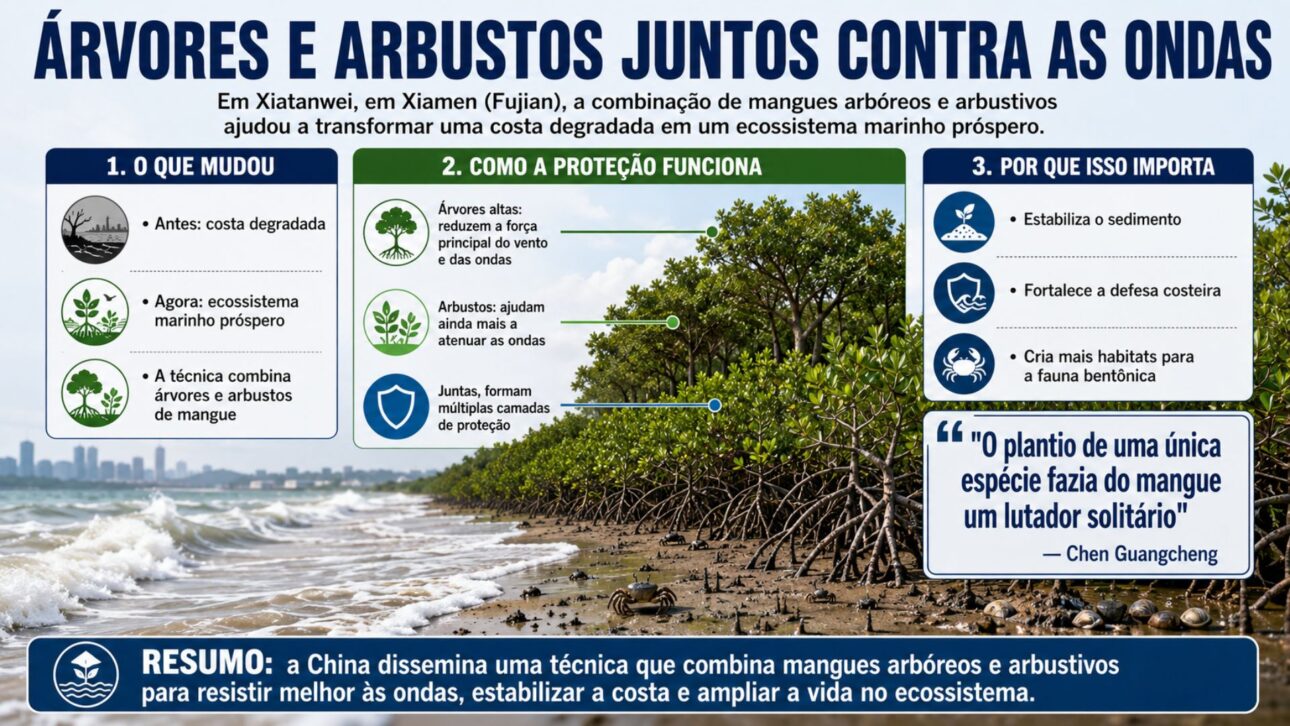
At the Xiatanwei restoration site in Xiamen, also in Fujian, a composite plant community is well established, and what was once a degraded coast is now a thriving marine ecosystem. Researchers describe the approach as placing multiple layers of protection on the coast, combining tree and shrub mangrove species, the coastal armor that is at the heart of the technique China disseminates.
“Planting a single species made the mangrove a solitary fighter,” said Chen Guangcheng, a researcher at the institute.
Now, the trees and shrubs withstand the waves together. The tall trees reduce the main force of the wind and waves, while the shrubs further contribute to wave attenuation, stabilizing the sediment and providing more habitats for benthic fauna.
A marine paradise for coastal fauna
The recognition of the technique relies on a growing history of ecological transformation that China has been promoting on the coast. Chen Jiahui, an associate researcher at the institute, described the restored mangrove strikingly.
“A vibrant marine paradise,” stated Chen Jiahui.
In this environment, which illustrates the type of restoration that China wants to expand, the tree canopies function as top-floor terraces for birds and insects, the trunks and branches offer climbing corridors for snails and crabs, and the undergrowth provides more space for snail attachment. The vertical structure multiplies niches for coastal fauna.
How the mangrove captures more carbon
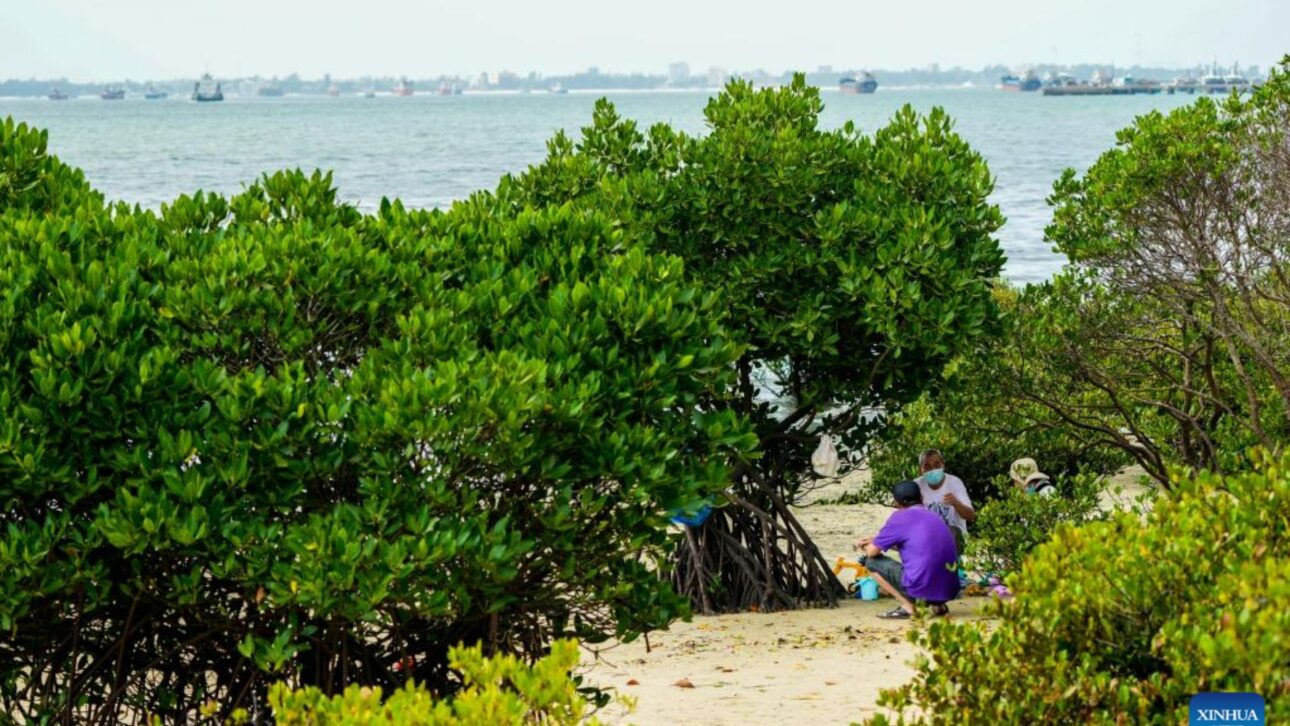
Besides protection against the waves, Chen Guangcheng highlighted the role of the composite plant community in increasing carbon sequestration, a central point for China in climate accounting. Traditional single-species planting relied solely on the tree canopy for photosynthesis, leaving the space below unused.
In composite mangroves, both the upper canopy and the lower stratum vegetation contribute to the photosynthetic capture of carbon, while the complex above-ground structure reduces the export of fallen leaves by the tides. This increases the supply of organic matter for carbon accumulation in the soil, enhancing the role of the mangrove in carbon sequestration.
Measuring Carbon and China’s Ecological Catalog
To measure soil carbon stock, the team developed a method to remove roots from different depth layers along the soil cores, preventing live roots from being counted twice as organic carbon. This can improve the accuracy of estimating mangrove carbon stock and provide a reliable basis for carbon sequestration accounting in China.
The technique, developed by the Third Institute of Oceanography, was recently cataloged among the 35 proven innovations selected by the Ministry of Natural Resources and the National Forestry and Grassland Administration.
It supports the methodology of the national mangrove reforestation project, under the country’s voluntary greenhouse gas emission reduction program, part of the accelerated ecological plan for the period from 2026 to 2030.
In China, mangrove restoration in Fujian gained a precision technique that assesses soil, salinity, and tides before planting a single seedling and combines trees and shrubs to form a coastal armor against waves while increasing carbon capture.
Developed by the Third Institute of Oceanography and cataloged among 35 proven innovations, the method has already restored over 13 hectares in Ningde and supports the national carbon accounting framework.
According to researchers, the combination of tree and shrub species transforms degraded coasts into thriving ecosystems, which points to a path that can inspire mangrove restoration in other parts of the world.
And you, what do you think of China's precision technique for restoring mangroves? Do you believe that Brazil, which has large mangroves, could adopt similar methods on its coast? Share your opinion and exchange ideas with other readers about the environment and science.




Be the first to react!