Portuguese
  Spanish


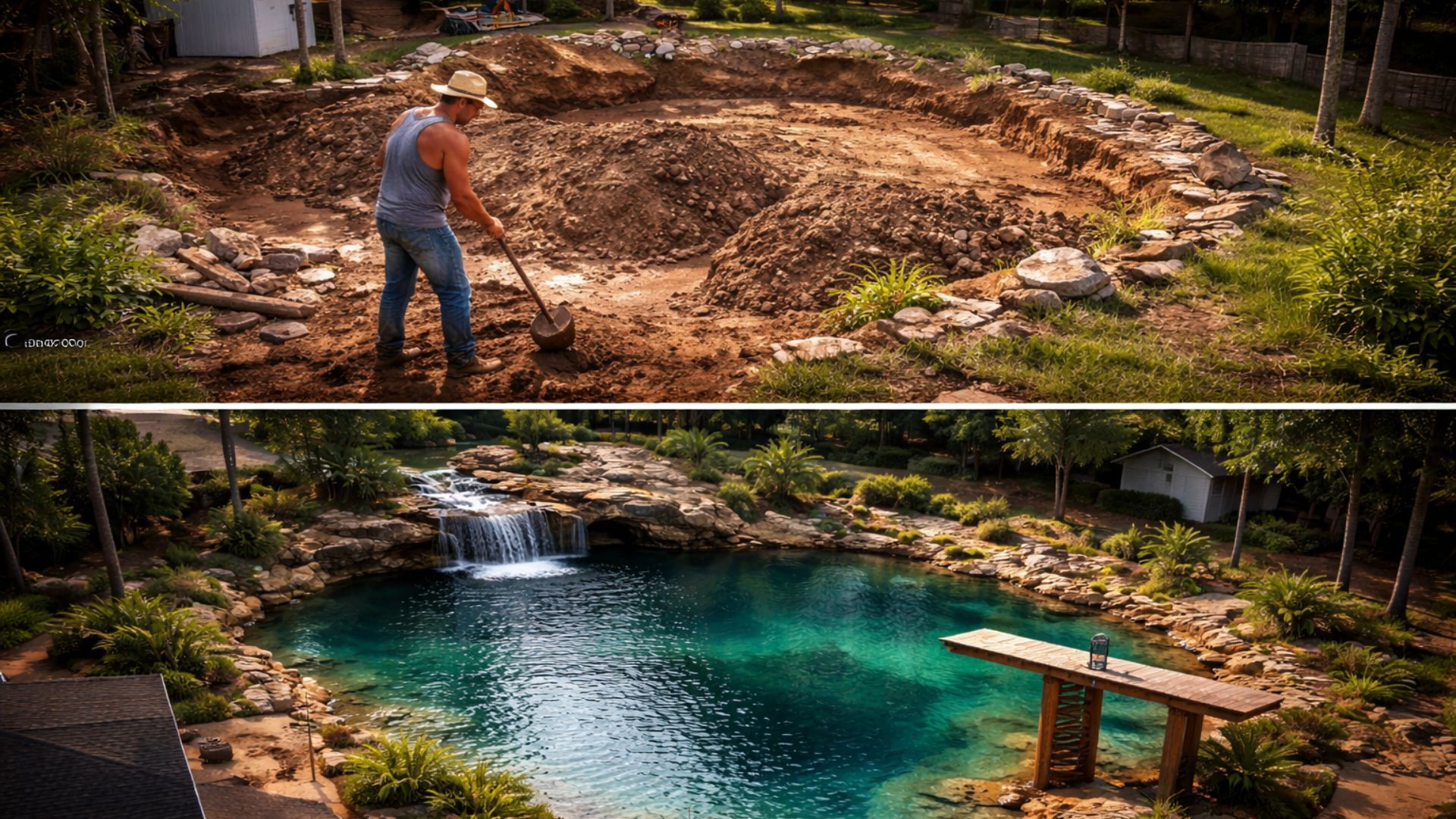

Personal Project Transforms Residential Area Into Large Artificial Lake, Built Over Nearly Three Decades, Focused On Leisure, Open Swimming, And Community Conviviality, Gathering Handcrafted Solutions, Robust Structure, And Natural Aesthetics Integrated With The Urban Surroundings.
A residential backyard in Covington, Tennessee, in the United States, has become the setting for a private pond after nearly three decades of gradual work by a resident of the city.
Over the course of 29 years, Micky Thornton expanded and remodeled the area until it became a pool of unusual proportions, described by him as a lake with an estimated volume of 500,000 gallons, equivalent to about 1.9 million liters of water.
The construction began in 1993, during the Labor Day holiday in the United States.
-
Exploring Nazareth: Uncovering the Historical Setting of the Annunciation, Not Proving a Biblical Miracle

-
Former Student Returns to Teach Over 100 Children in São Paulo How PET Bottles Can Help Protect the Oceans
-
Man Buys Metal Detector for Recovery Walks, Discovers 27.2 kg Gold Nugget in Brazil

-
Brazilian Mayor Uses Humorous Sign to Raise Awareness About Littering, Goes Viral on Social Media


From the beginning, the intention was to avoid the traditional pattern of residential pools, with geometric lines and conventional finishes.
The proposal prioritized a look closer to nature, as well as enough space to swim without a feeling of confinement.
Gradual Construction Shaped The Project Over The Years
The project did not start with its current appearance.
The structure evolved progressively, as available time and financial resources allowed for new interventions.

In the initial phase, the area was covered with a simple lining, described as a polyethylene tarp.
As the years went by, the material was replaced by more durable solutions, until it reached the current version in shotcrete.
Reports indicate the use of hundreds of cubic yards of gunite and about 40,000 pounds of steel in the structure.
The numbers were presented by Thornton himself in interviews with local and international media.
At the same time, the shape of the pond was adjusted to maintain organic contours.
Instead of a single bottom, the space now features different depth levels.
The shallower areas allow for leisure and prolonged stays in the water.
The central sections concentrate greater depth, enabling jumps and dives.
Waterfall, Rope, And Diving Board Integrate The Pond
In addition to the volume of water, the space includes elements rare in residential environments.
The materials describe the presence of waterfalls with exposed stones, which help reinforce the feeling of a natural lake.
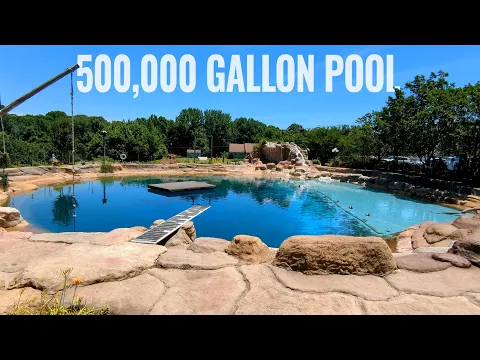

There is also a rope for jumping, attached to an old telephone pole secured with a large amount of concrete.
Another highlight mentioned is the installation of a diving board integrated into the deeper area of the pond.
The set expands recreational use possibilities and differentiates the space from conventional pools.
Although some reports mention a depth of up to 4.5 meters, sources generally describe the variation in levels and safety for jumps. There is no public consensus on the exact measurement of the deepest point.
Own Maintenance System And Collective Use Of The Space
Maintaining such a large volume requires specific solutions.
Thornton claims to have designed and built his own water pumping, circulation, and filtration systems.
The waterfalls and constant movement help oxygenate the lake.
Quality control involves regular maintenance and ongoing electricity consumption.
Over time, the pond evolved from being merely a domestic project.

The space started to host family gatherings, social events, and community activities.
Reports mention birthday parties, weddings, baptisms, and meetings of sports groups.
On certain occasions, access was allowed for a fixed donation.
In one of the reproduced accounts, Thornton’s wife stated she was surprised to receive around 50 visitors in a single day.
The situation illustrates how the transformed backyard gained a social function beyond private use.
Among concrete, steel, water, and landscaping, the space reflects decades of continuous dedication.
Without haste and without a closed project from the start, the pond was shaped over nearly three decades.
What drives a person to maintain such a large project for so long, transforming a common backyard into a gathering place that attracts attention far beyond the neighborhood?