Portuguese
  Spanish


In a public school in the southern zone of São Paulo, a former student turned her return to her roots into an environmental education, recycling, and circular economy initiative. The initiative involved students, families, and residents in a campaign that aims to practically show that the plastic discarded daily can stop being a problem and start generating benefits for the community.
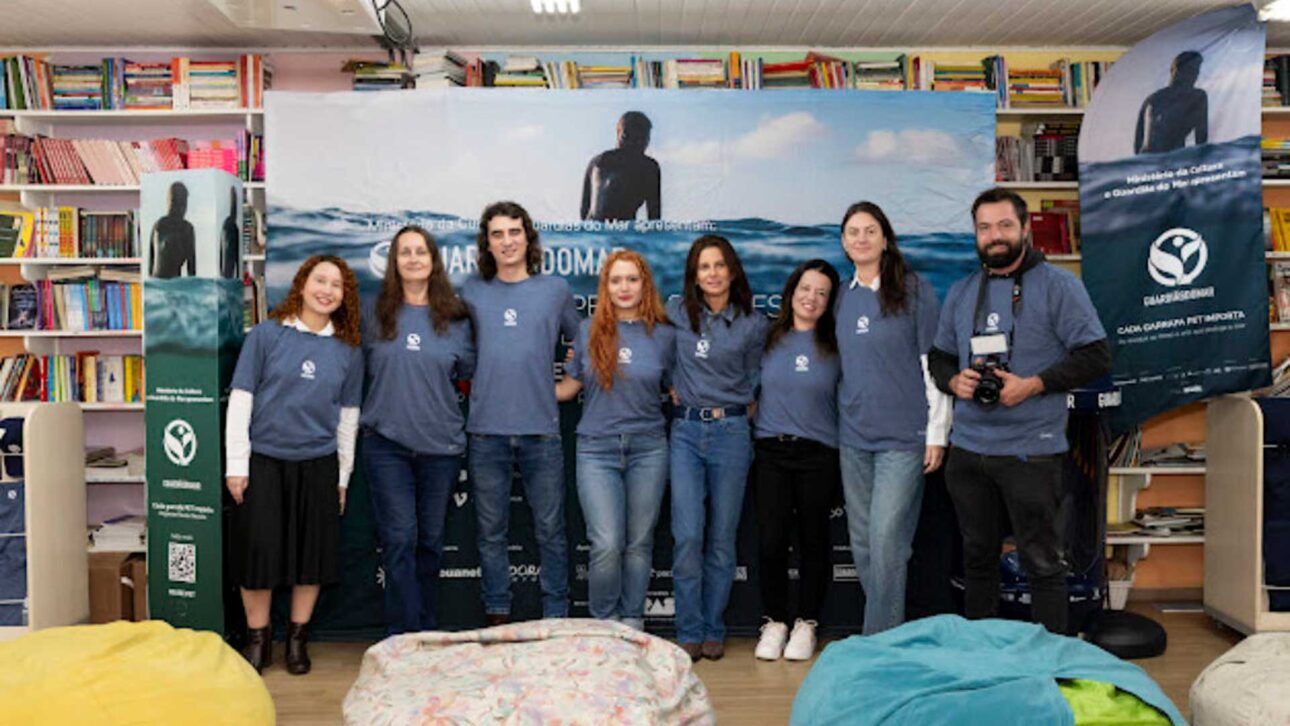
A former student of EMEF Cacilda Becker, in the southern zone of São Paulo, returned to the school where she studied as a child to lead an environmental education action with more than 100 children. The mobilization was organized by the project Guardiãs do Mar and highlighted a problem that starts far from the beach but can end up in rivers, seas, and oceans, the incorrect disposal of plastic.
The initiative was conceived by Patricia Almeida and involved lectures, educational challenges, activities on selective collection, circular economy, and reverse logistics. The goal was to show students that there is no “throwing away” when it comes to waste, because all discarded material needs to go somewhere.
The action also marked the launch of the Guardiãs do Mar Waste Hero REUSE PET Challenge, a campaign that aims to mobilize students, teachers, families, and residents of the region in the coming months. The school became a mobilization point for collecting recyclables, with the possibility of transforming part of the collected volume into resources for the school unit itself.
-
Man Buys Metal Detector for Recovery Walks, Discovers 27.2 kg Gold Nugget in Brazil

-
Brazilian Mayor Uses Humorous Sign to Raise Awareness About Littering, Goes Viral on Social Media

-
Award-Winning Japanese Restaurant Reveals It Has Preserved Part of the Same Frying Oil for 66 Years

-
American Youth Transforms from Severe Obesity to U.S. Air Force Enlistment, Losing 90 Kilograms in Two Years



The return to school became a practical lesson on the path of plastic
The strongest point of the initiative is not just in the collection of PET bottles, but in the way the topic was presented to the children. Instead of treating recycling as a distant obligation, the action brought into the classroom examples close to the students’ routine, such as packaging consumed at home, on the way to school, or during breaks.
During the mobilization, students participated in quizzes, activities, and discussions about zero waste, proper waste separation, and material reuse. The idea was to bring concepts that often appear as theory into a concrete experience, with direct impact on the school and the neighborhood.
Sustainable gifts made from RPET, a material produced from recycled PET bottles, were also distributed. This detail helped to show an important stage of the circular economy: waste does not need to be the end of the line, it can return as raw material for new products.
Why a local action addresses a problem that affects rivers, seas, and oceans
Plastic pollution is a global challenge, and plastic waste could almost triple by 2060 if the current model of production, consumption, and disposal continues without significant changes. The entity also points out that millions of tons of plastic waste leak into aquatic ecosystems every year.
This data helps explain why an action in a public school in São Paulo can have a direct connection to ocean protection. Before reaching the sea, part of the improperly discarded waste passes through streets, sewers, streams, and rivers. When collection fails or waste is abandoned, the problem ceases to be just urban and also affects natural environments.
Environmental education comes in precisely at this point. When a child understands where the packaging they discarded goes, selective collection ceases to be an abstract rule and starts to make sense in daily life. It’s a simple change, but one capable of influencing entire families.
The campaign aims to involve families and turn recycling into a resource for the school
The Guardians of the Sea Waste Hero REUSE PET Challenge extends the action beyond the initial event. The proposal is to involve students, teachers, families, and residents in a recycling chain until December, creating a routine of proper delivery of recyclable materials.
EMEF Cacilda Becker was integrated into the Green Mining platform, which works with smart reverse logistics solutions to recover post-consumer packaging. In practice, this means creating a more organized path for waste to be collected, tracked, and sent for recycling.
Part of the materials should also be used in a creative workshop and an open art exhibition. With this, the campaign tries to show that what many people call waste can gain educational, cultural, and environmental value.
Another relevant point is the possibility of remuneration for residents registered on the platform linked to the initiative. Thus, recycling ceases to be just an individual gesture and connects with income generation, territorial mobilization, and strengthening of the circular economy.
PET has recycling potential, but still depends on correct collection and separation
Brazil has a more structured PET recycling sector than many other types of plastic, but the path still depends on collection, sorting, and public participation. According to ABIPET, the country records 410 thousand tons of recycled PET and 53% of packaging discarded by consumers recycled.
Agência Brasil reported in March 2025 that the volume of recycled PET packaging in 2024 was 14% higher than recorded in 2022. The progress shows that there is recovery capacity, but also reinforces that correct disposal is still crucial for the material to actually reach the recycling chain.
Companies in the sector have also expanded their structures. Indorama Ventures, involved in the mobilization mentioned by the initiative, announced in 2023 the expansion of its post-consumer recycled PET production capacity in Juiz de Fora, Minas Gerais, from 9 thousand to 25 thousand tons per year.
Even so, recycling does not solve everything on its own. The best result comes from a combination of waste reduction, reuse, selective collection, reverse logistics, and continuous environmental education. That’s why actions in schools can have a greater effect than it seems at first glance.
When the child understands the problem, the community starts to change together
UNESCO, through its ocean literacy program, advocates that educators, communities, and policymakers better understand the ocean’s influence on humanity and the impact of human actions on the ocean. This vision helps place the school at the center of the environmental response.
In the case of EMEF Cacilda Becker, the difference lies in the emotional bond of someone who returned to share knowledge. Patricia Almeida returned to the place where she studied to talk about rethinking, reusing, recycling, and respecting. The message gains strength because it comes from a real story of belonging.
When students participate in a campaign that involves the school itself, the neighborhood, and families, environmental education stops being a book subject. It starts to appear in the backpack, in the home kitchen, in bottle disposal, and in the question about the destination of each package.
In the end, the initiative shows that protecting the oceans does not only start on beaches or cleaning boats. Often, it starts in a classroom, when a child realizes that a correctly discarded PET bottle can stop being pollution and become part of a collective solution.
The story of EMEF Cacilda Becker shows how small actions can gain scale when school, families, and community walk together. Do you believe that recycling projects like this should reach more public schools? Leave your opinion in the comments and tell if you’ve seen any similar initiative in your city.