Portuguese
  Spanish


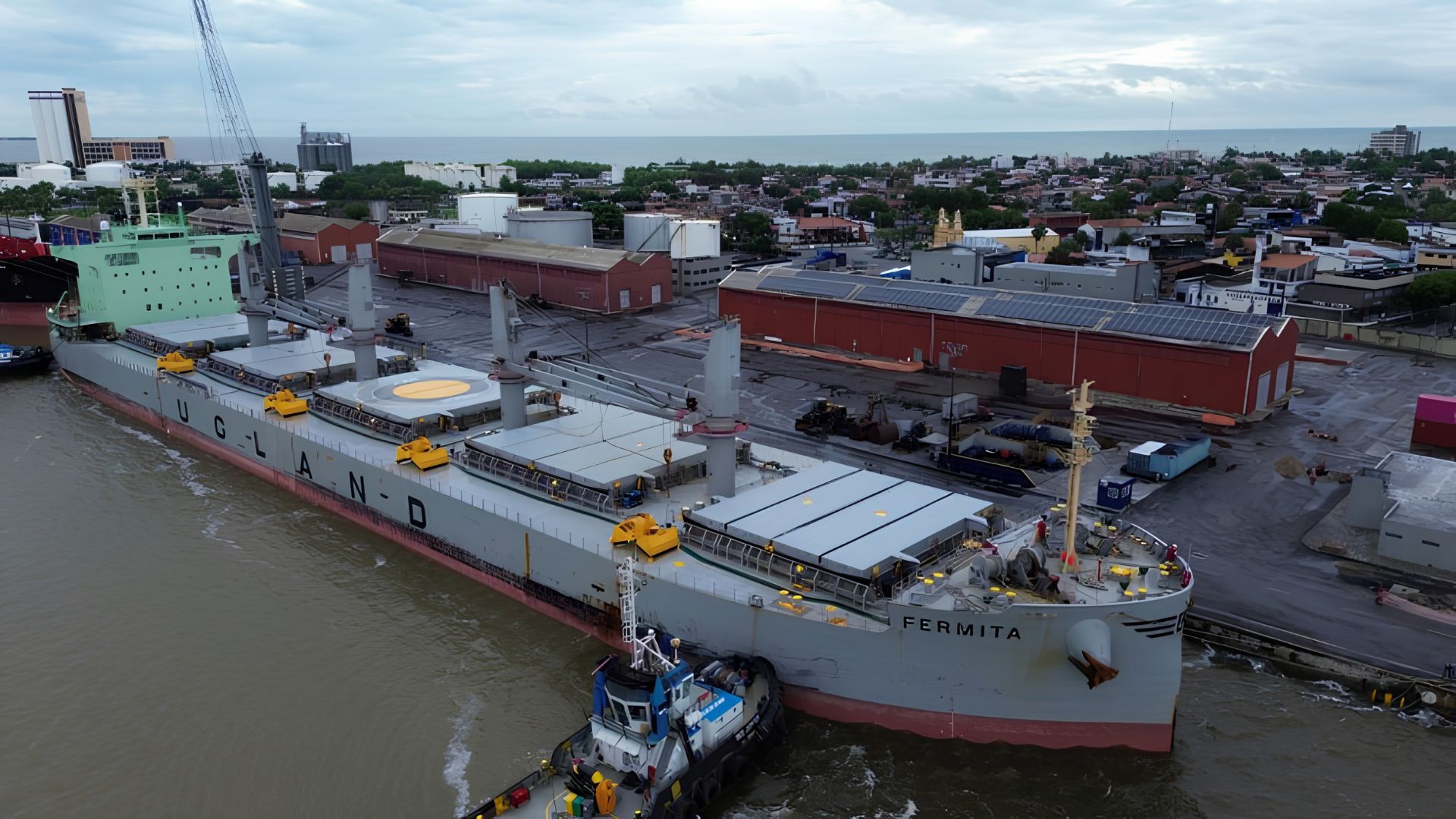

Ship from the USA breaks record at the Port of Cabedelo by unloading almost 48 thousand tons of petcoke for Paraíba industries.
On May 5, 2026, the Port of Cabedelo, in Paraíba, registered an operational milestone by receiving the ship Fermita, pointed out by the Government of Paraíba as the largest vessel ever received by the terminal. With approximately 200 meters in length, the bulk carrier arrived from the United States bringing almost 48 thousand tons of petcoke, a solid fuel derived from petroleum used as an energy input in large-scale industrial chains.
The operation drew attention not only for the size of the ship but also for the logistical weight of the cargo. According to ClickPB and the State Government, in a report published on May 5, 2026, the Fermita docked at berth 103/105 with 47,734 tons of petcoke, imported by Companhia Siderúrgica Nacional and Elizabeth Cimentos, with the involvement of maritime agency Heytor Gusmão and port operator MARLOG. In practice, the ship’s arrival transformed an industrial cargo into a showcase of the Paraíba port’s new operational capacity.
Fermita ship breaks historical record by becoming the largest vessel ever received in Cabedelo
The docking of the Fermita was considered an operational milestone for the Port of Cabedelo. With approximately 200 meters in length, the vessel surpassed all previous records of the Paraíba terminal in size and cargo volume.
-
Brazil’s Port of Santos to Receive New $1.1 Billion Container Terminal, Tecon Santos 10, Set to Begin Operations in 2029

-
Ports without drivers and cabins already move containers like automated factories: robotic cranes, autonomous electric vehicles, and software transform giant terminals into 24-hour logistics machines.
-
About 300 American ports still breathe diesel from trucks, cranes, and locomotives, but they are now trying to electrify heavy machinery to clean the air for 31 million nearby residents.

-
A 220-meter giant powered in part by solar energy and lithium batteries has just unloaded nearly 5,000 Chinese cars at the Port of Itajaí. It is the first of ten Grimaldi super ships and the first in the world prepared to run on ammonia as fuel.




According to the state government, the operation required detailed technical planning, including depth monitoring, specialized maneuvers, and coordination between port authorities and private operators.
The reception of a vessel of this size indicates an advance in the port’s operational capacity, especially in a highly competitive segment such as industrial solid bulk.
The event also reinforces Paraíba’s logistics infrastructure expansion strategy, which seeks to increase participation in national maritime trade.
Cargo of almost 48 thousand tons supplies strategic sectors of Brazilian industry
The product transported by Fermita was petcoke, also known as petroleum coke. It is a solid residue generated during petroleum refining, primarily used as industrial fuel due to its high calorific value.
In Brazil, the material is widely used by cement industries, steel mills, and some power generation operations.

According to information released by the government of Paraíba, the cargo unloaded in Cabedelo was destined for CSN and Elizabeth Cimentos, two companies with strong energy demand in their industrial processes.
The transported volume shows the scale of logistical dependence of these production chains, which need to move tens of thousands of tons to maintain continuous operations.
Port of Cabedelo enters the radar of solid bulk logistics in the Northeast
Historically, the Port of Cabedelo had a more modest participation compared to large port complexes in the Northeast, such as Suape and Pecém. However, in recent years, the terminal has been undergoing modernization processes and an increase in operational capacity.
The arrival of the Fermita symbolizes this transformation. Operations of this size require not only adequate physical infrastructure but also technical capacity for navigation, docking, and cargo handling.

This type of operation places the port at a new level of regional competitiveness, especially in the movement of solid bulk linked to heavy industry. Furthermore, the event strengthens Paraíba’s strategic role in Northeastern industrial logistics.
Petcoke from the United States reinforces international dependence on industrial fuels
Another important aspect of the operation is the origin of the cargo. The petcoke transported by Fermita came from the United States, one of the main global producers of this industrial fuel.
This highlights how part of Brazilian industry still heavily relies on imported energy inputs, especially in high thermal demand sectors such as cement and steelmaking.
Even being an energy powerhouse in several areas, Brazil remains integrated into international industrial supply chains, which makes port operations of this type strategic for the economy.
Furthermore, the use of large ships for petcoke transport reduces logistical cost per ton, increasing import efficiency.
Operation requires depth, dredging, and technical precision in a limited port area
Receiving a 200-meter vessel in a port like Cabedelo involves significant technical challenges. Ports need to ensure adequate depth, maneuvering space, and operational stability for large vessels.
In recent years, the Port of Cabedelo has undergone dredging and modernization processes precisely to expand its capacity to receive larger ships.

Without these interventions, operations of this level would be unfeasible, as any depth limitation can prevent the entry of loaded vessels.
This point helps explain why Fermita’s arrival was treated as a historic milestone by the port administration.
Solid bulk remains among the most strategic cargoes in Brazilian maritime logistics
The operation also highlights the importance of solid bulk for the Brazilian port system. Unlike containers, these cargoes are moved in large continuous volumes, requiring specific storage and unloading infrastructure.
Solid fuels, ore, fertilizers, and grains are part of this segment, responsible for a large portion of national port movement.
The scale of these operations transforms ports into fundamental pieces of the industrial chain, as logistical interruptions can directly affect production and supply.
Northeast expands participation in high-scale port operations
The movement recorded in Cabedelo occurs in a broader context of strengthening Northeastern logistical infrastructure. In recent years, ports in the region have been receiving investments in dredging, electrification, automation, and capacity expansion.
This movement accompanies the growth of industrial and agricultural activity in different Northeastern states, increasing the demand for more robust maritime operations.
The arrival of larger ships in the Northeast shows that the region is expanding its capacity to compete for cargo that previously concentrated in a few Brazilian ports.
Operation reinforces strategic importance of port infrastructure for national industry
The Fermita case demonstrates how port infrastructure is directly linked to industrial competitiveness. Without adequate logistical capacity, entire production chains can face increased costs and supply difficulties. In the case of petcoke, large-scale maritime transport is essential to make the import of the fuel economically viable.
This transforms ports into strategic structures not only for export, but also to ensure the functioning of Brazil’s domestic industry.
Given this advance, do you believe that smaller ports in the Northeast can truly compete for space with the country’s large logistics complexes, or will the concentration of Brazilian infrastructure still remain dominated by a few giant terminals?