





 Portuguese
  English
  Spanish
  3 min of reading
  0 comments


Building a brick wall requires prior calculation of the area, correct choice of materials, proper preparation of the mortar, and attention to alignment, steps that help avoid failures, improve the structure’s resistance, and prepare the surface for the final finish
The construction of a brick wall begins before laying: the width must be multiplied by the height to calculate the area in square meters and guide the purchase of necessary materials for the work.
This first step helps estimate the quantity of items that will be used. With the wall measurement in hand, the next step is to gather the basic materials to raise the structure.
Among the recommended items are cement, construction sand, nylon threads, a large shovel, and a trowel used to level the cement and lay it on the bricks. In many cases, the mortar also receives gravel or another type of stone.
-
Four thousand PET bottles became a 24m² house in the interior of São Paulo, as ten students proved that it’s possible to build a home from floor to ceiling with recycled plastic, spending 30% less than a brick construction.

-
Man builds entire village with over 1 million PET bottles and impresses with creativity; known as Plastic Bottle Village, the project even erected a four-story castle with 40,000 bottles and entered the Guinness World Records.
-
Concrete made with seawater and marine sand challenges one of the basic rules of civil construction, replacing common steel with corrosion-resistant reinforcements, and can turn islands and coastal works into laboratories of a new salty engineering.
-
New Pomerode bridge progresses after operation with 7 concrete beams of 31 meters and 82 tons each, lifted by 4 cranes, while the connection between Atiradores and XV de Novembro aims to alleviate congestion in the Center during days of intense tourism.





The choice of materials should consider the function of the work. When the construction is more rustic or requires greater resistance, the guidance is to apply the appropriate ingredient in the mixture, respecting the intended type of use.
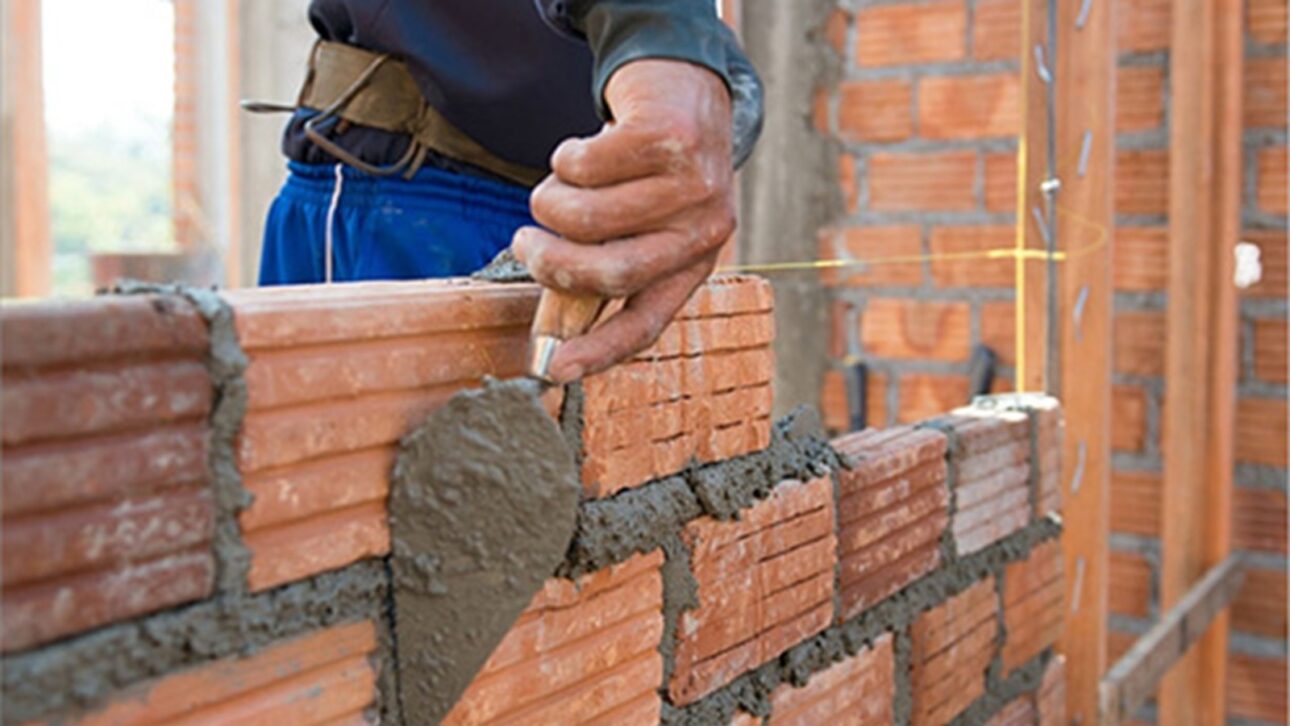
Brick wall requires proper mortar
Each cement recipe serves a different purpose within the construction. For foundations, construction bases, and subfloors, the recommended mixture includes one bag of cement, eight and a half cans of sand, eleven and a half cans of stones, and two cans of water.
In pre-fabricated constructions, slabs, and beams, the proportion changes. In this case, each bag of cement should be mixed with four cans of sand, five and a half cans of stones, and one and a quarter cans of water.
The correct preparation of the cement is pointed out as an important part for the brick wall to have firm support. The mortar must meet the needs of the work, avoiding failures that could compromise the regularity and resistance of the structure.

Laying Starts from the Base
With the base prepared, the wall construction can begin. The guideline is to apply a layer of cement on the floor and then position the bricks one by one, always applying cement on the sides before laying them.
In the second layer, the process requires a new application of cement over the first row already assembled. This step helps the bricks to remain firm, fitted, and even during the wall’s ascent.
The alignment should be done with the help of a string tied close to the wall under construction. This string can be attached to two fixed supports, maintaining the leveling reference throughout the work.
The wall should be raised gradually, following the guide of the string and the continuous application of the mortar. In the end, the entire surface receives a cement coating, a step that precedes the drying period.
Finishing Includes Lime, Putty, and Paint
After the cement is dry, the finishing begins with the application of lime. This initial painting serves to prevent mold and bacteria on the wall’s surface.
After the lime dries, the wall receives putty. The process requires a wait of 48 hours before sanding, a step that prepares the surface for the final painting.
With the sanding completed, the wall is ready for painting. The finishing sequence depends on the drying time between steps and the correct application of the products indicated for the surface.
Although the process is simple in stages, execution depends on attention to proportions, alignment, and drying intervals. The wall gains stability when each phase is done in the correct order, without skipping the preparation of the mortar or the finishing.
Have you ever built, renovated, or closely followed the assembly of a brick wall? Share your experience, questions, or precautions you usually take during measurement, mortar preparation, brick laying, and final wall finishing in the comments.





Be the first to react!