Portuguese
  Spanish


Research shows that concrete with seawater and marine sand, reinforced with anti-corrosion composites, can change coastal constructions, ports, and islands.
For decades, one of the most repeated rules in civil engineering was clear: seawater and marine sand should not be used in conventional reinforced concrete. The reason was always the same. The salts and chlorides present in these materials accelerate the corrosion of steel reinforcements and compromise the durability of structures. Now, this logic is beginning to be rewritten. Researchers have started to develop a new generation of concrete with seawater and marine sand designed precisely to function in coastal environments, where these resources are abundantly available.
The change did not occur because salt ceased to be aggressive, but because engineering began to replace the most vulnerable element of the system. Instead of relying on traditional steel, some of the most advanced research has started to use fiber-reinforced composites, the FRP, materials much more resistant to corrosion. As a result, what was previously considered unsuitable material is starting to gain ground in projects for marine infrastructure, coastal bridges, breakwaters, islands, and constructions in regions with a shortage of freshwater and river sand.
Conventional concrete depends on freshwater, river sand, and steel, and this is precisely where the problem begins
Civil construction remains among the activities that consume the most raw materials on the planet. In the case of conventional concrete, the dominant combination for over a century has always involved freshwater, river sand, and steel reinforcements.
-
Abandoned House Renovation Fixes Decades-Long Leak in Two Days with Red Steel Roof Installation

-
Man Builds Entire House by Hand from Abandoned Pallets Found in Brazilian Forest, Complete with Round Door and Matching Doghouse
-
California Diverts 65% of Construction Waste from Landfills, Repurposing Millions of Tons into Road Base, New Asphalt, and Wood Chips
-
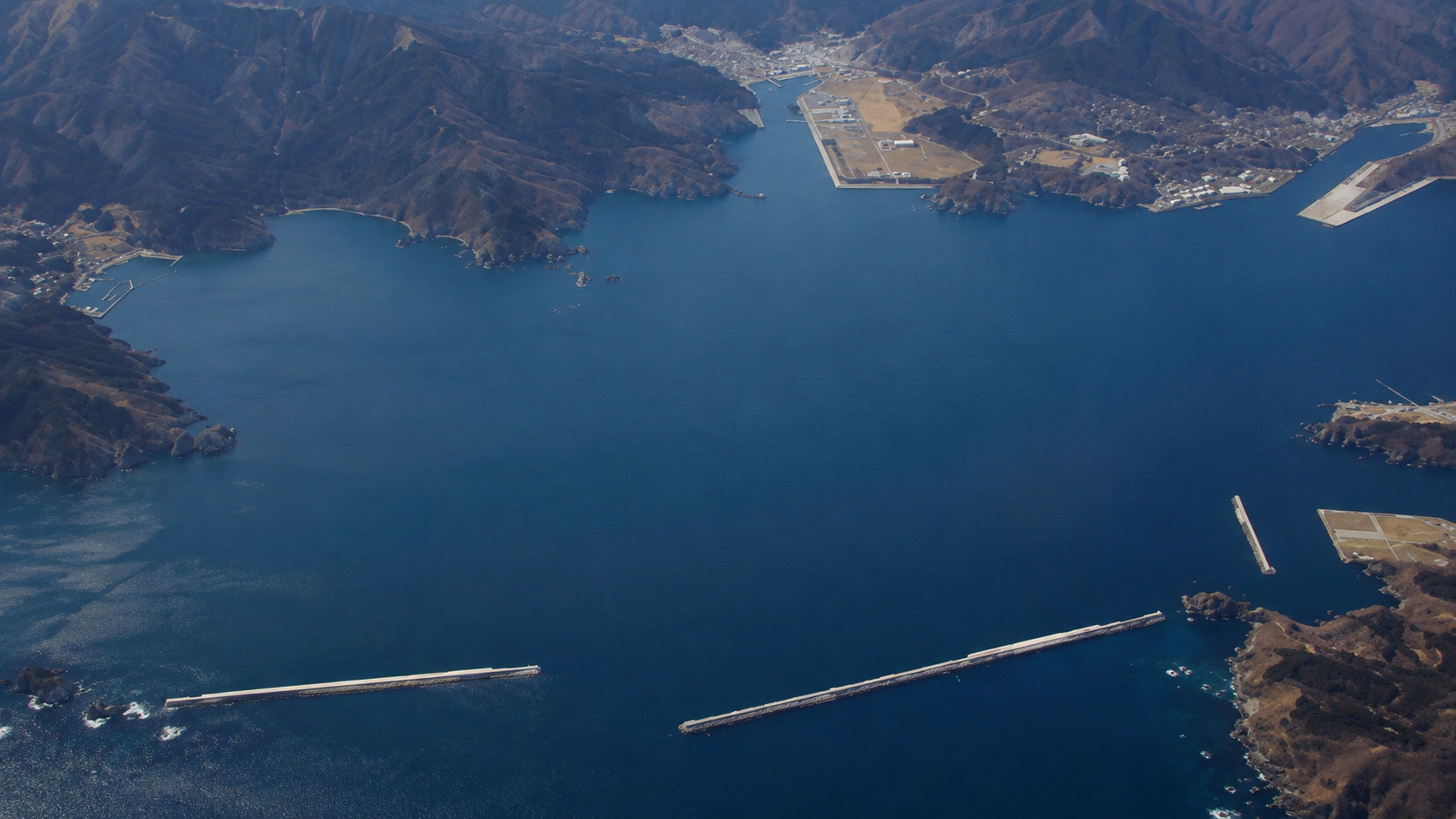
Japan Constructs World’s Deepest Sea Wall in the Pacific, Sinking Massive Concrete Structures for Three Decades



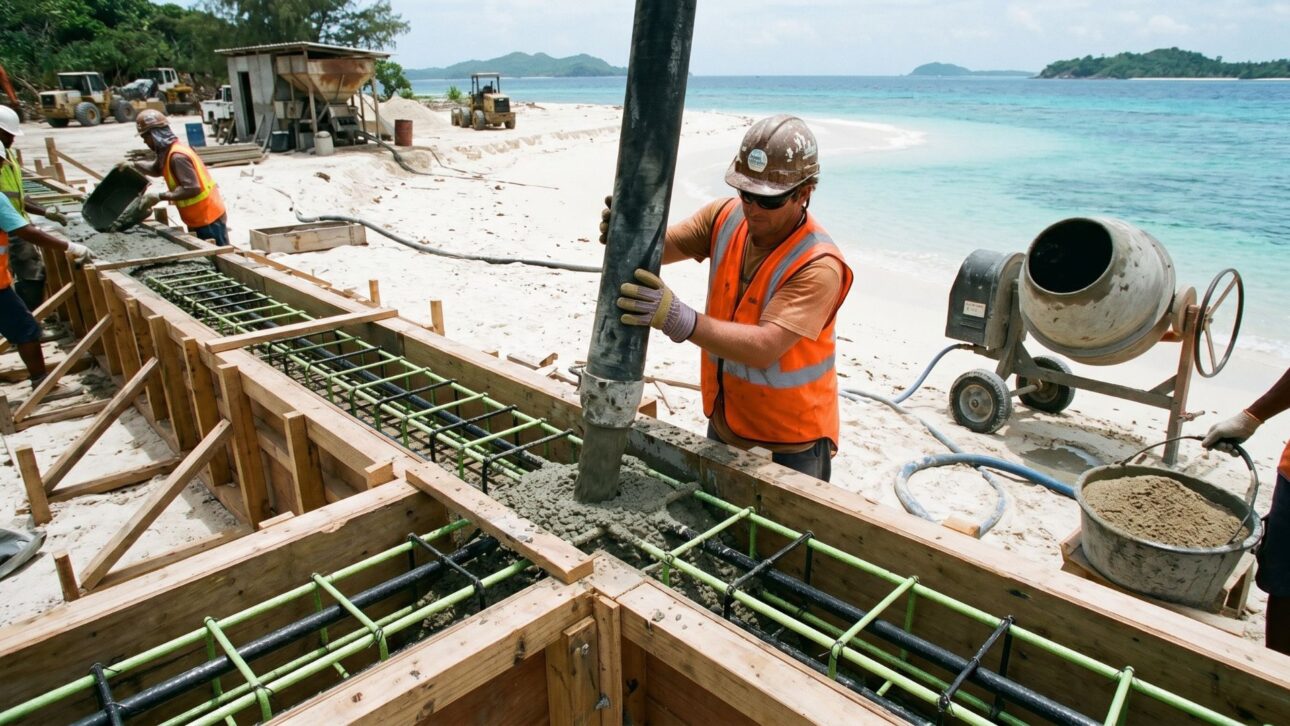
This model works well in most urban constructions but becomes more expensive and more difficult in coastal areas, islands, and archipelagos, where transporting these materials can heavily impact the total construction cost.
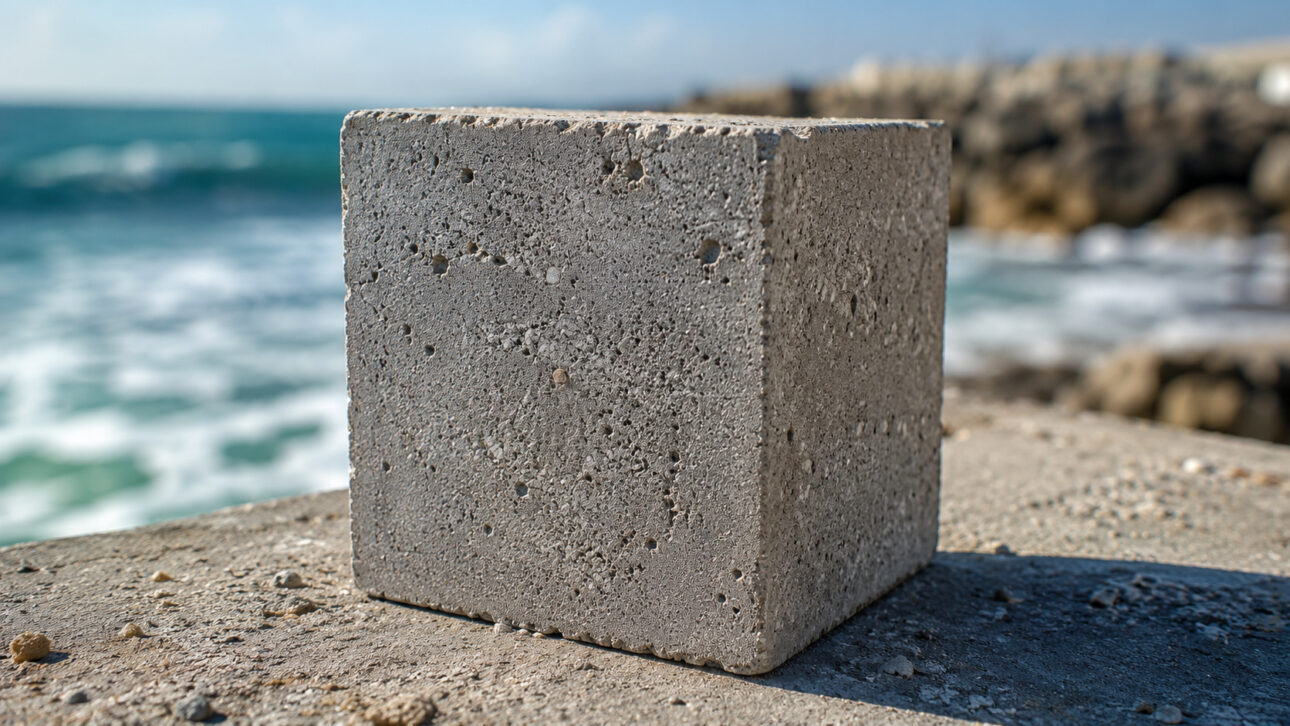
It was precisely this limitation that led researchers to study the so-called seawater sea-sand concrete, the concrete produced with seawater and marine sand. The idea is simple in origin and revolutionary in practice: to use in construction precisely the materials already available on the coast, reducing transportation, pressure on rivers, and freshwater consumption. The historical obstacle was never in the concrete alone, but in the behavior of the metallic reinforcement within it.
The greatest obstacle has always been steel corrosion, not concrete strength
According to the review published by the University of Miami, concrete produced with seawater and marine sand can exhibit mechanical performance comparable to conventional concrete under various conditions, including good strength development. The central problem is not in the concrete body, but in the presence of chloride ions, which accelerate the corrosion of steel reinforcements and reduce structural lifespan.
This point stalled the broader adoption of the technology for decades. As long as the structure depended on conventional steel, the direct use of marine materials would continue to be seen as high risk. Therefore, the real breakthrough did not come from the water or the sand, but from replacing the reinforcement with materials less vulnerable to the marine environment.
FRP became the component that allowed the use of seawater and marine sand without repeating the old problem
The review by the University of Miami indicates that the combination of concrete with seawater and marine sand and reinforcements with FRP, fiber-reinforced polymers, can precisely solve the durability problem associated with high chloride concentrations.
Since these composites do not behave like steel in the face of corrosion, they pave the way for a new structural logic in aggressive environments.
In practice, this means replacing one of the most traditional bases of engineering with another reinforcement solution, often more expensive, but much more adapted to coastal realities. This change transforms previously avoided materials into potential raw materials for durable structures, especially where the marine environment is already part of the operational landscape of the construction.
Researchers have already developed ultra-resistant marine concrete with more than 180 MPa
According to the Hong Kong Polytechnic University, this technology has already advanced far beyond theory. Research teams involved in the topic have managed to develop ultra-high-performance marine concrete with compressive strength exceeding 180 MPa, a level far above the conventional concrete used in most residential and commercial buildings.
The advancement was not limited to laboratory mixing. The same team reports the development of innovative structural members and connections in systems that combine FRP with this ultra-high-performance marine concrete. This shows that the debate has moved beyond academic curiosity and into the realm of real structural application.
Ports, coastal bridges, islands, and marine infrastructure are among the most promising uses
The Hong Kong Polytechnic University highlights that the use of seawater and marine sand makes even more sense in projects located precisely in coastal zones, where the transport of fresh water and river sand increases costs, fuel consumption, and logistical emissions. In these environments, working with locally available materials can significantly change the economic equation.
Among the most promising applications are marine infrastructures, coastal works, bridges, artificial islands, offshore facilities, and structures continuously exposed to the marine environment.
In remote locations, the potential gain is not only in durability but also in simplifying the supply chain and reducing dependence on inputs transported from long distances.
Engineering still faces costs, long-term testing, and barriers to mass adoption
Despite the advances, the technology has not yet become the dominant solution in civil construction. The review by the University of Miami itself indicates that broader adoption depends on advances in long-term durability, structural behavior, standardization, and economic feasibility, especially since the composite materials used as steel substitutes remain more expensive in many applications.
Even so, the movement is clear. The growing number of studies, projects, and structural systems developed with FRP and seawater sea-sand concrete shows that engineering has begun to treat this possibility as one of the most serious fronts for works in coastal regions.
What once seemed to violate an elementary construction rule is now beginning to be seen as a technically plausible alternative in specific scenarios.
A historical rule of civil construction begins to be rewritten
For over a century, fresh water, river sand, and steel have formed the dominant basis of modern reinforced concrete. Now, the most advanced research indicates that this combination does not need to be universal.
In marine environments, where logistics are challenging, natural resources are different, and corrosion is a constant threat, a new generation of concrete is starting to gain ground.
If studies continue to confirm the durability of systems reinforced with corrosion-resistant composites, seawater and marine sand may cease to be treated as enemies of civil construction and become part of the solution in some of the most challenging projects on the planet. It is not the end of conventional concrete, but it may be the beginning of a new logic for coastal engineering.