Portuguese
  Spanish


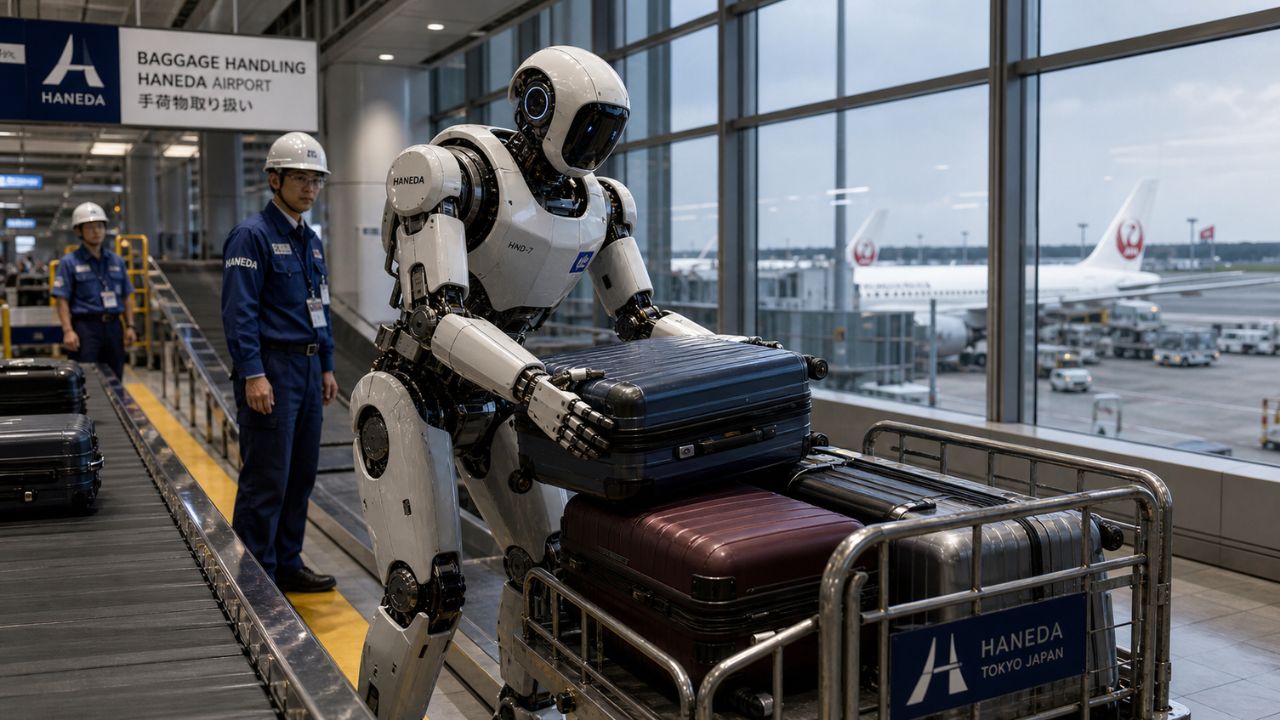


Japan Airlines humanoid robots begin operating at Tokyo airport to address labor shortages in the sector.
In May, Japan Airlines will launch a two-year pilot project with humanoid robots at Haneda Airport in Japan. The initiative will initially be applied to cargo handling, with plans for expansion to cabin cleaning and runway equipment operation. The project emerges as a direct response to the country’s shrinking workforce, caused by an aging population and a significant increase in international tourism. The robots were developed in partnership with GMO AI & Robotics.
Humanoid robots at the airport start with the heaviest tasks
In the initial phase, humanoid robots at the airport will be responsible for intense physical activities, such as moving cargo containers. During a demonstration for the press, the machines performed these tasks in a controlled environment, showcasing the technology’s potential.
The choice to start with cargo operations is not random. These functions require constant physical effort and are considered less attractive to human workers, especially in a scenario of labor shortage.
-
Polar Air Mass to Hit Brazil: Temperatures to Plummet in Nine States, Near Freezing in the South with Frost Risk Until Monday

-
Chinese “dark factories” produce electric cars 24/7 with minimal human intervention, as Zeekr assembles 800 units daily, raising concerns in Brazil.

-
Spectacular Green Aurora Seen from Space Illuminates International Space Station, Captivates French Astronaut

-
In Tasmania, a Beach Features a Natural Stone Mosaic Formed by Earth’s Cracks Millions of Years Ago


Additionally, the company is already studying expanding the use of technology for:
- Internal aircraft cleaning
- Ground equipment operation
- Support for airport logistics activities
Worker shortage drives the use of humanoid robots
The advancement of humanoid robots is directly linked to a structural change in Japan. The country faces two simultaneous factors:
- Accelerated population aging
- Growth of international tourism
According to JTB Group data, over 7 million foreign visitors arrived in Japan in just the first two months of 2025. This increase puts pressure on airports and services, demanding more workers — something the local market cannot supply.
According to Tomohiro Uchida, the situation is already critical. He highlighted that, despite the modern and automated appearance of airports, a large part of operations still heavily relies on human labor.


Japan Airlines bets on humanoid robots as a sustainable solution
For Japan Airlines, the use of humanoid robots at the airport goes beyond an emergency solution. The company sees the initiative as a long-term strategy to improve working conditions.
According to Yoshiteru Suzuki, the proposal is to reduce the physical burden on employees by transferring heavier tasks to machines. However, he emphasized that critical functions, especially those related to safety, will continue to be performed exclusively by humans.
Function comparison: humans vs. robots at the airport
| Task type | Current responsible | Future responsible (project) |
| Heavy cargo handling | Humans | Humanoid robots |
| Cabin cleaning | Humans | Robots (in testing) |
| Equipment operation | Humans | Robots (planned) |
| Security management | Humans | Exclusively humans |
Expansion could transform airports in Japan
Although the use of robots in airports is not new — models are already used for security and public assistance — the differentiator of this project lies in its scale and type of activity.
The introduction of humanoid robots at the airport for heavy operational functions represents a significant advance. Should the results at Haneda be positive, the expectation is that the technology will be adopted by other airlines.
This possibility gains strength in the face of a common problem in the sector: the growing difficulty of hiring. Thus, the project can become a reference not only in Japan, but also in other countries facing similar challenges.
With information from EXAME