






 Portuguese
  Spanish


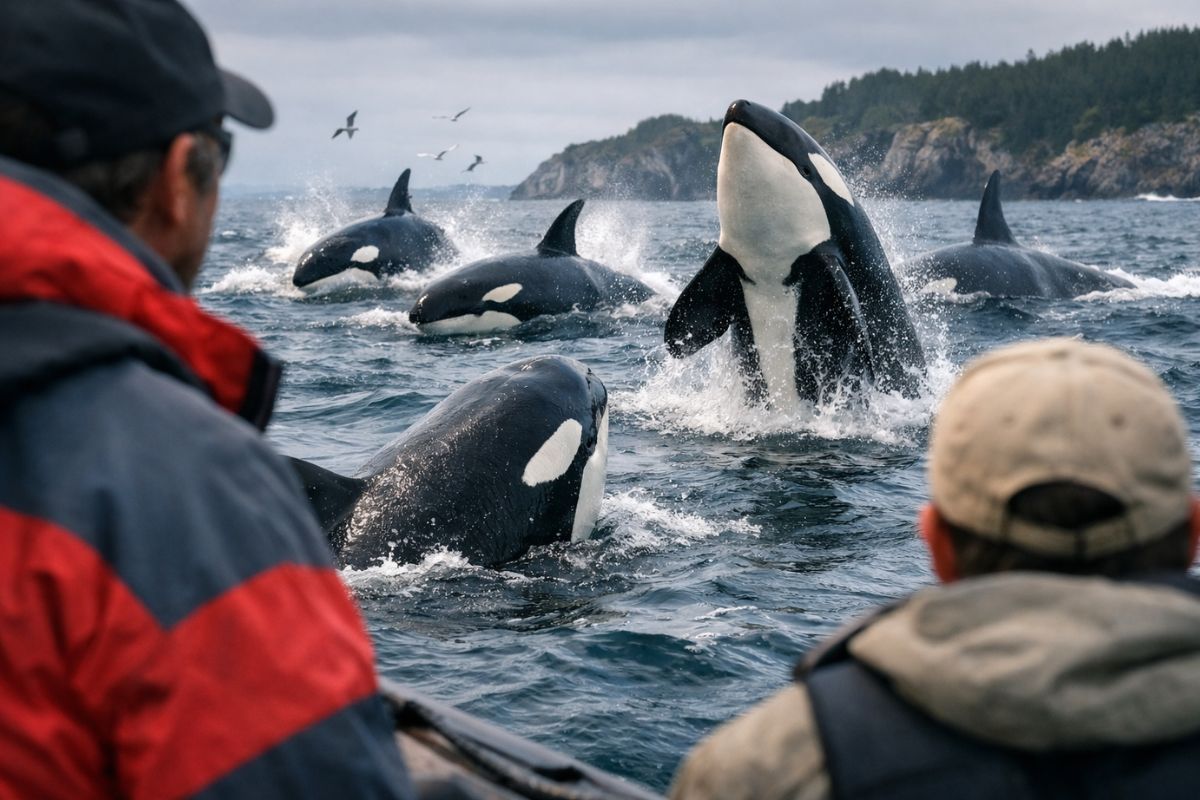


Orca Zena Spent A Year In Captivity Near Nakhodka, In The Sea Of Japan, Was Released After A Rescue With 70 Experts And GPS, And Reappeared Hunting And Receiving Food.
In the ocean, few stories blend science, risk, and emotion like the reintroduction of a captive-born orca. Zena’s release, kept for a year in cramped pens near the Russian coast, put experts in front of a real dilemma: being free is not enough, one must survive.
The outcome defied expectations, as the orca not only reappeared but was seen swimming and hunting with other orcas, receiving food from them, in a rare gesture suggesting strong bonds. At the same time, each stage of this release exposed how reintroducing a social animal is a fragile, costly process full of possible consequences.
What Was The Prison For Orcas In The Sea Of Japan And Why Did It Shock So Many People

The described setup was a series of pens at sea, near the Russian city of Nakhodka, on the coast of the Sea of Japan.
-
Pedal-Powered Washing Machine Made from Bicycle Parts Cleans Clothes in Three Minutes Without Electricity, Leaves Them 80% Dry.

-
Sixth-grader in Miami wins Lemelson Young Inventor Prize for creating water-absorbing concrete using discarded oyster shells and charcoal.
-
Brazilian Researchers Develop Portable, Painless, Radiation-Free Breast Cancer Tracker Using Microwaves, Costing Around $200 and Potentially Replacing $240,000 Mammograms
-
Beer as a Vaccine? Scientist Develops Experimental Method with Live Yeasts, Tests Own Brew, and Publishes Results on Zenodo


The site became known as a prison for orcas and belugas after drone footage showed several animals crammed into small enclosures, which drew the attention of the international community and the media.
From then on, specialists who visited the site reported that many animals were in terrible condition. There were skin injuries, a possible indicator of health problems.
Indignation grew because, despite the commercial value mentioned for an orca, the animals were being kept as if they were disposable, confined and subjected to an environment that combined stress, limited space, and adverse conditions.
How Nearly 100 Belugas And 11 Orcas Were Captured And Why The Capture Was Considered Illegal

In the summer of 2018, four Russian companies supplying marine mammals to aquariums captured nearly 100 belugas and orcas over several months.
The capture was declared illegal, but the animals were not simply returned to the sea immediately. Instead, they were placed in cramped pens, and the described plan was to sell the marine creatures to marine parks, primarily in China.
The situation drew attention also due to the scale. There were many belugas in the footage from the site because, according to the case description, there were only 11 orcas in captivity, while there were around 90 belugas.
The contrast between the total number of animals and the limited space reinforced the perception that this was not a one-off operation, but a profit-driven capture and retention system.
Who Was Zena, How Long Was She Held, And What Signs Of Suffering Appeared
The orca Zena, described as being 8 years old, spent about a year in this prison. During winter, she began to show signs of frostbite and infection.
The water was very cold and stagnant, and the orca could barely move to warm herself. The report emphasizes that the suffering was not abstract: there was a physical impact and a risk of worsening health.
This point is crucial to understand why the release became a race against time. In a social and active animal, the combination of intense cold, limited mobility, and constant stress creates a scenario where the orca may leave captivity alive, but weakened for the next challenge, which is much tougher than it seems.
The Greatest Dilemma Of Releasing An Orca: Real Risk Of Not Surviving In The Wild
The fear was not only about how Zena would react to freedom but what would come next when she had to exist without the artificial structure.
The history itself reinforces that orcas can lose survival skills in captivity, especially skills related to hunting and adapting to long distances.
The problem becomes more serious because orcas and belugas live in groups. An animal separated from its group risks not finding another to integrate with.
Additionally, there is the issue of feeding: an animal fed by people may not recognize live prey as food, or may not be able to hunt on its own. For a young orca, still an “adolescent,” this could mean starving to death, not due to lack of food in the environment, but due to lack of repertoire to obtain it.
Why The Release Could Not Happen In The Same Place And How It Turned Into A Gigantic Operation
The animals could not be released in the same location where they were captured, as this would cause a huge ecological impact.
The report describes a potential imbalance from placing many predators back in the same area, as well as keeping people too close to the release.
The solution was to transport everyone, including Zena, in a logistics operation considered extremely stressful for animals already under pressure and with health problems.
The process was long and controversial, with debates about whether captive orcas could survive in the wild.
As many animals were captured while still very young, at a few months old, they were separated from their families too soon. In the wild, young orcas alone, without the group, simply would not survive.
The Journey Of Hundreds Of Miles, The Giant Bathtub And The Six-Day Trip To The Sea
The transport operation was described in detail. The orcas were removed from the enclosure, placed in a truck-trailer equipped with a giant bathtub filled with water, and taken hundreds of miles north.
The chosen release site was the Amur River, heading to the Sea of Okhotsk, about 1100 miles away from where the orcas and belugas were captured.
To reach the sea, the animals in the tubs were loaded onto a barge and sent on a six-day journey downriver to reach their destination.
At part of the route, the trailer trip was so stressful and the vehicle shook so much that workers climbed into the tubs to pet the orcas and try to calm them down.
This image is brutal because it shows a constant human effort to prevent the stress of transportation from becoming a sentence even before freedom.
Moreover, there were floods and bad weather conditions that delayed the transport of dozens of animals and even threatened to completely halt the releases.
In the end, the process took four whole months to transport all the animals from prison to the release site.
The Team Of 70 Specialists, The Trackers, And The Attempt To Get “Everything Right”
The operation was described as the largest rescue program of its kind. There were 70 specialists supervising the transport, including veterinarians and scientists, along with two personal assistants for each individual.
Before being released, the animals were fitted with GPS tracking devices to monitor their future, which reveals the level of uncertainty: no one wanted to release them and simply lose track because the risk of failure was real.
This type of monitoring is also a way to turn an emotional act into an observable process.
When reintroducing an orca, every piece of data matters because the case has no clear precedents. The report itself emphasizes that no one had ever done anything like this before, so there was no way to rely on previous experience to predict the outcome.
The Ghost Of Keiko And The Hard Lesson About Releasing An Orca Unprepared
The story provides a powerful contrast with the orca Keiko, known for appearing in the movie Free Willy. The popular narrative suggests a cinematic release, but the report points out that the reality was different: after the success of the film, the public found out that Keiko was not free; he was performing in a park in Mexico, under poor conditions.
When efforts were made to return Keiko to the wild, the outcome exposed the core of the problem. Keiko had been captured at around 2 years old and spent more than 10 years in captivity.
Even if the mother theoretically could be alive, finding her was practically impossible, as well as the rest of the family.
The central point is that Keiko lost his survival instinct and did not know that live fish were food. When offered fish to catch, he would return it to the trainers as if he were playing fetch.
The report also describes that after a long life in captivity, it was not possible to simply release him and walk away. To keep up with wild orcas swimming long distances, he needed to build stamina and lungs.
Keiko began to follow a boat during long swims in the open ocean, gradually learning, but his love for people overcame his instincts, especially with children. After meeting a father and daughter fishing, he followed them to shore.
The ending was sad. In 2002, Keiko was released to swim freely. In December 2003, it was announced that he had died. He never managed to integrate into a group and ended up dying of pneumonia.
The comparison with Zena is direct: Zena and the other orcas from the prison had only been in captivity for a year, which put them in a much better position than Keiko, although this did not guarantee success.
Why Choosing The Right Place Is Crucial And How Belugas Released In The Wrong Habitat Raised Alarm
The narrative reinforces that the release site cannot be random. If it is the wrong option, the animal may not survive. There is an example of belugas released in November 2019 in the Sea of Japan near a nature reserve but outside their normal habitat.
They “definitely did not like” the place, and for wild animals, not liking could mean death.
For an orca, the risk is similar and even more complex because it is essential to understand to which ecotype the individual belongs.
The report insists that orcas are not a monolithic species: there are differences in behavior, living areas, and diet. If an orca ends up where there is no usual food for miles, it may try to find food but eventually starve.
Zena is cited as an example of an orca that feeds on mammals, migrates a lot, and hunts silently.
If she were released among resident orcas that only eat fish, she would not adapt. At best, there would be difficulty; at worst, starvation due to lack of suitable prey.
The Social Problem: Why An Orca Is Almost Never Accepted Into Another Group
Even if the ecotype and habitat are correct, there is one obstacle that seems almost insurmountable: the social life of orcas.
The report describes that groups of orcas are like families where the animals are born and spend their entire lives.
It is extremely rare for an orca from one group to be accepted into another. Outside of males who mix the genetic pool, families are very isolated.
The separation is so profound that each group has its own dialect, with whistles, squeals, and specific sounds.
This creates a real chance of rejection: even if they are “of the same species,” letting someone into a family that speaks a different language is difficult.
The consequence is cruel: without a group, the orca would have to survive alone.
And loneliness, for orcas, is not a detail. The report emphasizes that orcas are social and hunt in groups.
There are even studies indirectly cited suggesting that orcas simply cannot survive outside a group, because the social structure is part of the survival mechanism.
The Disappearance: The Orca Loses The Tag And Disappears From Monitoring
With this set of risks, Zena’s story enters the tensest part. She was released on July 16, 2019.
A month later, on August 16, the orca shed the tracking tag. Without it, tracking Zena became very difficult. The last direct observation mentioned occurred on September 4.
This disappearance is the type of event that fuels pessimistic predictions. Without GPS, without constant viewing, the natural interpretation would be to imagine that the orca could be alone, hungry, disoriented, or dead.
For weeks and months, the release could have turned into just another case where human effort ends in silence.
What The Data From Other Orcas Suggested About Routes And Behavior After Release
Even without Zena’s signal, satellite monitoring of other orcas allowed for some conclusions. The report mentions that during the summer and early fall, the orcas remained in the Shantar district, in the northwest part of the sea, traveling to traditional summer hunting grounds, such as Tugur Bay and Uda Bay.
There is also an observation regarding behavior: if you release a male and young females into the wild, they do not head straight for open sea.
They tend to stay close to the coast until they reach greater maturity, and only then would the female be released to join them. This kind of detail tries to show that reintroduction is not an immediate leap into full adult life in the ocean, but a gradual transition, full of dependencies.
The Rare Reappearance: The Orca Reappears In A Group, Hunting And Sharing Food
The outcome changes the tone of the story. The orca released from the Russian prison was spotted by a filming crew from Frozen Planet 2.
Zena was recognized by the mark on her dorsal fin. And the finding was surprising: she seemed to be doing very well.
According to the report, Zena was seen swimming and hunting with other orcas. More than that, these orcas shared food with her, a gesture described as indicative of a very good relationship and close bonds. This scene is rare because it connects survival and social acceptance. It is not just a living orca, it is an included orca.
Zena was lucky not to have lost her hunting and social skills over time in captivity. It also acknowledges that it is unclear whether she reunited with her old family or was welcomed by another group.
There is no way to be sure because information is lacking about where and how Zena was captured, and whoever did that should not share.
Still, the emotional and plausible hypothesis within the report is that she would have returned and been accepted by close relatives, and that one year was not enough time to forget dialect and bonds.
Why This Case Became A Rare And Emotionally Powerful Example In The Ocean
The story of a released orca often carries public expectation of a happy ending, but the scientific and logistical reality tends to be harsh.
Here, the ending is not presented as a simple victory, but rather as an exception.
There are risks at every stage: illegal capture, confinement in cramped pens, signs of illness, stressful transport over thousands of kilometers, adverse weather, loss of tracking tags, disappearance, and the almost insurmountable obstacle of social acceptance.
And yet, the orca reappears thriving. This makes the case emotionally powerful not by romanticizing the process, but by showing that, under specific conditions, a social animal can regain group life.
The report concludes with an idea that touches more than just the discussion about captivity: the strength of family ties and belonging, applied to a species that lives in closed communities and rarely accepts strangers.
In your opinion, should the release of an orca like Zena always happen only in supervised sanctuaries, or is it still worth trying a full reintroduction when the captivity was brief and there is a real chance of reintegration?





Meu Deus que dó
Muita gente mal
Quero pensa em dinheiro,tem que deixar os animais livres
Graças a Deus vocês os ajudaram a soltarem eles ,mesmo alguns tiveram contra tempos uma judiação,que essas pessoas que fizeram muito mal a eles ,paguem pelo ocorrido,porque uma vida desses pequeninos não vão voltar mas …
Al océano con ellas
Considero q jugó un papel importante la edad de la orca y su experiencia anterior a ser capturada. A mí entender, si se hubiese tratado de un **** muy joven, seguramente no sólo la hubieran rechazado sino que la hubieran matado y devorado