






 Portuguese
  Spanish


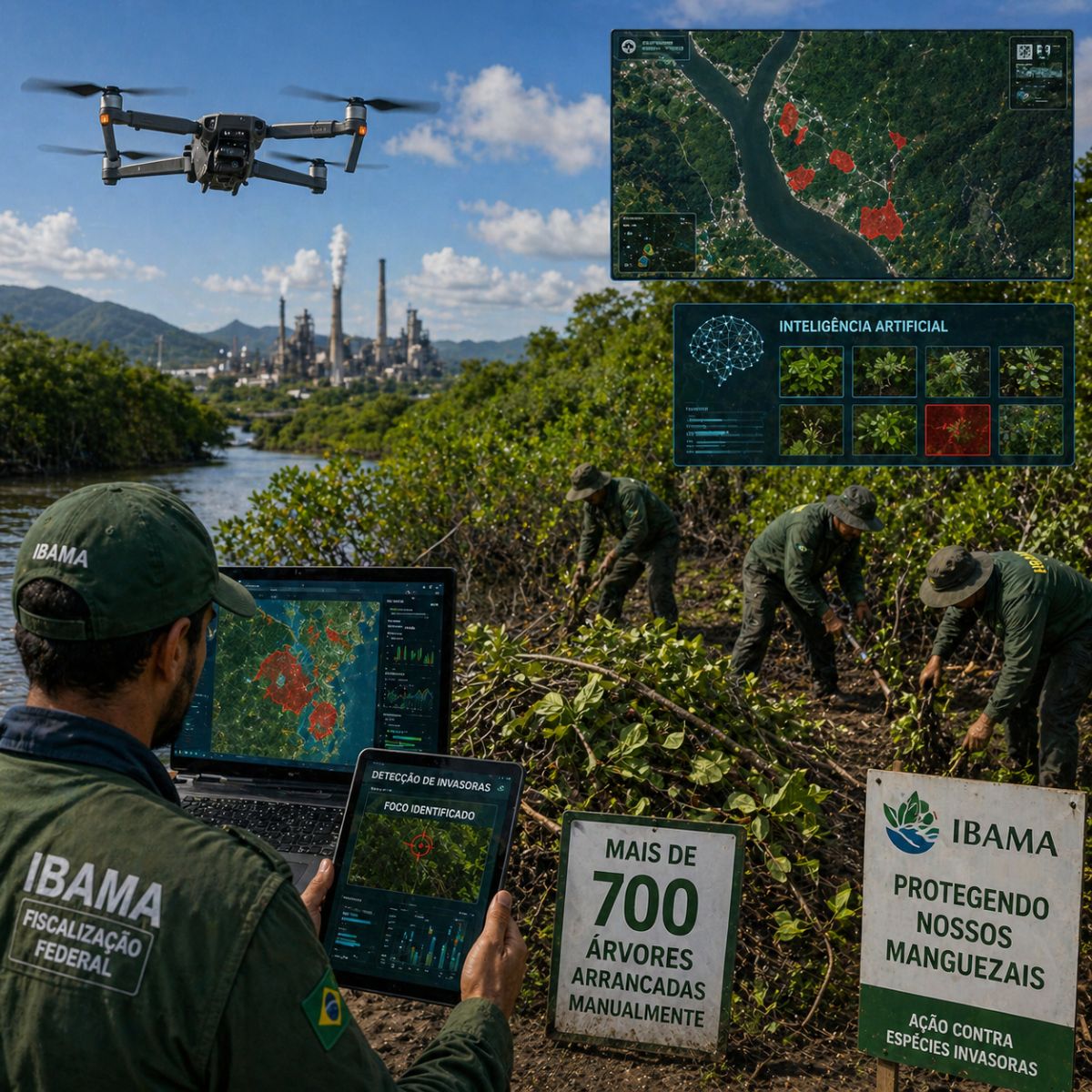

Ibama and the São Paulo Forest Foundation intensified the fight against Sonneratia apetala, an invasive Asian plant known as apple mangrove, found so far only in the mangroves of Cubatão. The operation uses drones, remote sensing, and artificial intelligence to map the species before it spreads along the Brazilian coast. More than 700 trees have already been uprooted, and experts believe that total eradication is still possible.
Ibama is in a race against time in the mangroves of Cubatão, in Baixada Santista, to eliminate an invasive plant that could cause irreversible damage to Brazilian coastal biodiversity. The species is Sonneratia apetala, originally from Asia and popularly known as apple mangrove, which arrived in the São Paulo mangroves through still not fully clarified means and established itself with accelerated growth that threatens to directly compete with native species for space, light, and nutrients.
The operation’s differential lies in the technology employed. Instead of relying solely on manual searches in hard-to-reach areas, Ibama’s technical team uses drones for aerial mapping with very high-resolution images, remote sensing to detect individuals of the plant at different stages of development, and artificial intelligence to expand the scale of surveys. The combination of these tools allows identifying apple mangrove specimens that would be invisible in conventional inspections, especially when the plant is still young and blends in with native vegetation.
What is the apple mangrove and why does it threaten Brazilian mangroves?

According to information released by the Gov portal, Sonneratia apetala is an arboreal species native to Southeast Asia that easily adapts to mangrove environments. Its growth is significantly faster than that of native species, which gives it an advantage in competing for resources such as sunlight, space, and soil nutrients. In countries where it was introduced without control, the plant dominated entire mangrove areas and reduced the biological diversity that sustains the coastal food chain.
-
Pennsylvania Mine Creates Ice in Summer Heat and Melts in Winter, Turning a Mountain Crevice into a Reverse Natural Refrigerator

-
China Accelerates Global Expansion of Robotics: From Smart Vacuums to Industrial and Humanoid Machines, Millions Exported to Over 150 Markets
-
Polar Air Mass to Hit Brazil: Temperatures to Plummet in Nine States, Near Freezing in the South with Frost Risk Until Monday
-
Chinese “dark factories” produce electric cars 24/7 with minimal human intervention, as Zeekr assembles 800 units daily, raising concerns in Brazil.





In Brazil, the apple mangrove has so far only been identified in the mangroves of Cubatão, which specialists consider an window of opportunity. As long as the invasion is restricted to a single location, total eradication is still technically feasible. If the species spreads to other points along the Brazilian coast, containment would become exponentially more difficult and expensive, potentially compromising ecosystems that support artisanal fishing, protect the coast against erosion, and function as nurseries for hundreds of marine species.
How Ibama uses drones and artificial intelligence to find the plant
The operation carried out between April 15 and 17 combined three layers of technology to ensure precision in mapping the bioinvasion. Drones flew over strategic areas of the Cubatão mangroves, generating very high-resolution images that allow distinguishing the canopy of the apple mangrove from native vegetation, a task that would be impossible from ground level due to the density of the vegetation and the flooded terrain.
The data collected by the drones were subjected to photointerpretation and remote sensing, techniques that identify spectral differences between plant species and allow detecting individuals of the invasive plant in early stages of growth. Ibama is also testing the use of artificial intelligence to automate the analysis of these images, which can multiply monitoring capacity and allow surveys on a scale that the human team alone could not cover. After digital mapping, field inspections validate the data and support the planning of subsequent removals.
Results so far: more than 700 trees uprooted
The joint work between Ibama and Fundação Florestal has already resulted in the removal of over 700 trees of the invasive species in the mangroves of Cubatão. The removal is done manually, pulling each specimen by the root to prevent regrowth, a laborious process that requires field teams operating in wet and difficult-to-access terrain. The volume of specimens removed indicates that the invasion had already advanced further than initially imagined.
In addition to direct suppression, Ibama acts in identifying new areas for future intervention. The testing of artificial intelligence aims precisely to expand detection capacity to find specimens that may have escaped previous operations and which, if not removed, would act as foci of reinfestation. The strategy is to eliminate 100% of individuals before the plant produces enough seeds to disperse through ocean currents and colonize other mangroves along the coast.
Why eradication needs to be fast and what happens if it fails
Sonneratia apetala produces fruits that disperse through water, meaning that ocean currents can carry seeds from Cubatão to other mangroves in Baixada Santista and, eventually, to the coast of other states. If the species escapes the current containment area, the eradication operation would turn into a permanent control operation, much more expensive and with uncertain results.
The international precedent is concerning. In China, Sonneratia apetala was intentionally introduced to reforest degraded areas and ended up dominating entire mangroves, replacing native species and reducing the biodiversity of coastal ecosystems. In Brazil, the strategy is precisely to prevent this scenario from repeating, taking advantage of the fact that the invasion is still concentrated in a single location. Ibama‘s action is part of the National Strategy for Invasive Alien Species, which prioritizes rapid responses when total eradication is still possible.
What’s at stake for mangroves and for those who live from them
Mangroves are coastal ecosystems that function as nurseries for fish, crustaceans, and mollusks that sustain the artisanal fishing of entire communities. They also protect the coast against erosion, filter pollutants, store carbon, and harbor biodiversity that depends exclusively on this environment to survive. The entry of an invasive plant that competes with native species threatens all these functions simultaneously.
For the fishermen of Cubatão and Baixada Santista, the health of the mangroves is a matter of income and food security. If the apple mangrove dominates the native vegetation, the reduction in biodiversity will directly affect fish and crab stocks that depend on the mangrove structure to reproduce. Ibama‘s operation with drones and artificial intelligence is not just an environmental action: it is the protection of an ecosystem that sustains human lives and local economies.
Did you know that an Asian plant threatens Brazilian mangroves, or did you think biological invasions only happened with animals? Tell us in the comments what you think about the use of drones and artificial intelligence in environmental protection and if you think Brazil is acting fast enough.






