Portuguese
  Spanish


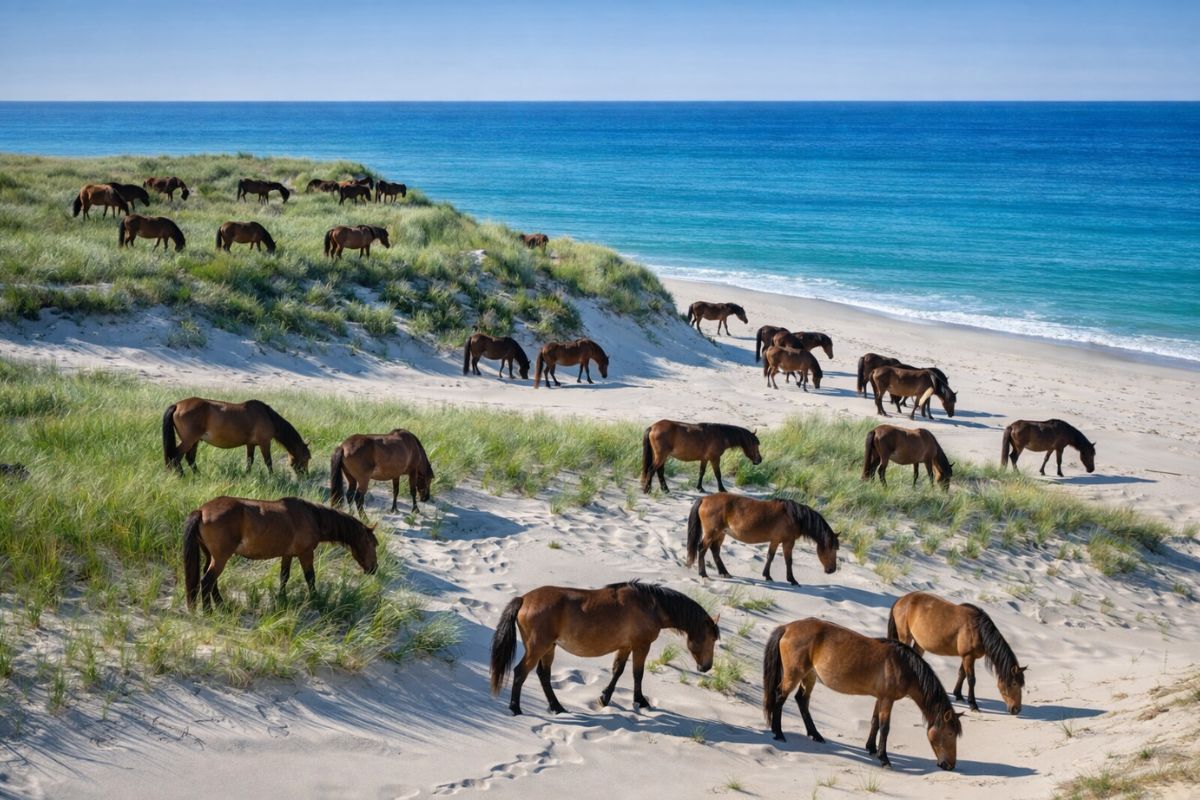


Know The Island In Canada Where More Than 500 Wild Horses Live Free On Horse Island, Protected As A National Park In Nova Scotia.
The wild horses on this island in Canada look like they came straight out of a documentary: they roam freely among dunes, swamps, and freshwater lagoons, without fences, roads, or farms. Away from human routine, the so-called Horse Island has become a living laboratory of how an entire population of animals can sustain itself in an isolated environment in the middle of the Atlantic.
What started with a small group of animals left there by a ship decades ago has transformed into more than 500 wild horses in a protected territory. The island in Canada has been transformed into a national park in Nova Scotia, which limits visits, controls access, and ensures that these animals continue to live free, practically without human interference.
Where Is Horse Island In Canada
Horse Island is located about 300 kilometers southeast of Halifax, in Nova Scotia, on the Atlantic coast.
-
Texas Teens Win $50,000 at World’s Largest Science Fair for Developing Non-Surgical Brain-Controlled Bionic Prosthesis with 98% Accuracy

-
Samsung Galaxy A27 Launches with 6.7-inch Super AMOLED Display, Full HD+ Resolution, Android 16, Six Years of Updates, Snapdragon 6 Gen 3, and Dust and Splash Resistance; Available for Pre-order in the US for $350

-
Five Brazilian Students Invent Drug Test Pen That Detects Date Rape Drugs in Seconds
-
Viedma Glacier Retreat in Patagonia Uncovers 900-Meter-Deep Basin, Making Viedma the Deepest Lake in the Americas


It is an island in Canada classified as remote, surrounded by open sea and also famous for another impressive nickname: it is known as the “Cemetery of the Atlantic” due to the many shipwrecks recorded in the region over the centuries.
Aside from the shipwrecks, what dominates the landscape of the island in Canada today are the sand dunes, swamps, and shallow lagoons where the wild horses quench their thirst.
The entire area has been incorporated into a national park, managed by Canada’s national parks and reserves system, precisely to keep this isolated ecosystem as intact as possible within Nova Scotia.
Seen from afar, the animals form cinematic scenes, running in groups across the dunes, crossing soggy areas, and stopping to drink at the lagoons.
This setting has turned Horse Island into one of the most sought-after nature tourist spots in Nova Scotia, even with the typical restrictions of a national park.
How So Many Wild Horses Ended Up On An Isolated Island
The big question is: how did so many wild horses end up on an isolated island in Canada surrounded by water on all sides?
Accounts cited by scholars indicate that it all started with a ship passing through the region many years ago. Ponies were reportedly left on the island as a way to offload animals or create a future reserve.
These first animals stayed, adapted, and began reproducing without any human management, until forming the herd that today makes Horse Island a symbol of free life.
Over time, the wild horses spread across the dunes, the grassy areas of the swamps, and the margins of the lagoons, occupying nearly all areas with usable vegetation.
The result is an estimated population of more than 500 wild horses sharing the space with seabirds, seals, and other species that also use this island in Canada as a refuge.
Instead of farmers and fences, what controls the animals’ expansion is the physical boundary of Horse Island itself and the environment’s carrying capacity.
The Life Of Wild Horses Among Dunes, Swamps, And Lagoons

In day-to-day life, the wild horses of Horse Island have to make do with what the environment offers. They graze in grassy areas that grow in the lower parts of the dunes and in the swamps, walk long distances in search of freshwater, and face strong winds typical of the North Atlantic.
The freshwater lagoons are essential to keep this population of wild horses functioning.
Around these lagoons, many animals concentrate, alternating between resting, socializing, and feeding, always within the natural limits of this island in Canada. Meanwhile, birds and seals make the area a living mosaic of marine and terrestrial fauna.
At the same time, the very fragility of the environment means that the existence of the wild horses depends on a fine balance.
Any sudden change in vegetation, water availability, or the dynamics of winds and tides could directly impact life on this Horse Island, reinforcing the importance of its national park status in Nova Scotia.
Protection As A National Park And Limited Access
The transformation of Horse Island into a national park and federal reserve of Canada has completely changed the relationship between humans and animals there.
The site is managed as a protected area, focusing on research, monitoring, and conservation, not mass tourism.
Access to the island in Canada is controlled by the Canadian Coast Guard and the national park authorities.
Visits are limited and require prior permission, precisely to avoid stressing the wild horses or compromising the delicate vegetation of the dunes and swamps. Instead of hotels, there are only support structures for technical teams.
Scientists and meteorological research teams stay on Horse Island for designated periods, collecting data on climate, dune dynamics, fauna, and the behavior of wild horses.
This careful management is one of the reasons why the national park in Nova Scotia is a reference in the protection of island ecosystems.
Other Islands Dominated By Animals, From Pigs To Wild Chickens

Horse Island is not the only place in the world where farm animals have taken over an isolated territory.
The very base video reminds us of the famous pig island in the Caribbean, where pigs left by sailors adapted so well that today they swim in crystal clear waters and have become a tourist attraction.
In the United States, there is also a barrier island between Maryland and Virginia where horses descend to the beach, run close to the waves, and graze in coastal grassy areas.
And in Hawaii, the island of Kauai has gained fame as the “chicken island,” with thousands of birds living freely on beaches, parking lots, and gardens after hurricanes destroyed chicken coops and scattered the animals.
These examples show that when a domestic species escapes and finds a conducive environment, it can establish itself durably.
But few cases are as emblematic as that of the wild horses of Horse Island, on an island in Canada that is now a national park in Nova Scotia.
Why The Story Of Horse Island Draws So Much Attention
The story of this island in Canada is an invitation to reflect on our relationship with nature. On one side, a group of domestic animals left by a ship turned into a population of wild horses that today symbolize freedom.
On the other hand, it was necessary to transform Horse Island into a national park in Nova Scotia to ensure that this freedom does not turn into environmental degradation.
Seeing more than 500 wild horses living free, without fences and without direct human interference, helps to understand how island ecosystems are sensitive and, at the same time, fascinating.
Horse Island has become a case study on international conservation, management of feral species, and boundaries of coexistence between tourism and protection.
In the end, the wild horses of this island in Canada are a reminder that human decisions from the past continue to shape landscapes and ecosystems to this day.
It is up to current and future generations to decide whether these animals will continue galloping freely over the dunes of this national park in Nova Scotia or if this balance will be lost.
And you, would you visit Horse Island to see these wild horses up close on an isolated island in Canada in the middle of the Atlantic?