Portuguese
  Spanish


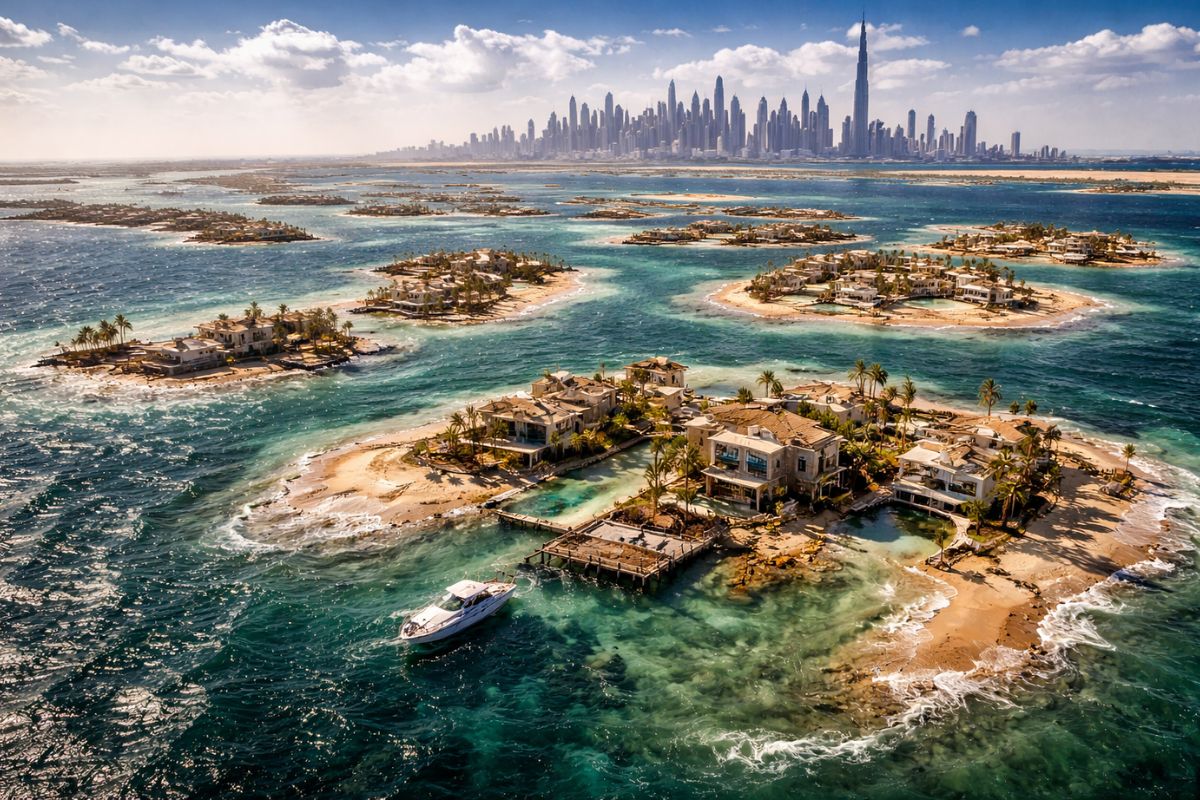


Artificial Islands Project In The Shape Of A World Map, Created To Be The Eighth Wonder And Billionaire Playground 4 Km From Dubai, Deforms, Rots The Sea And Exposes The Cost Of Trying To Redesign The Earth With Money
At first glance, the idea seemed brilliant. At the gates of Dubai, an entire world map would be drawn on the sea with 300 artificial islands, copying the outlines of the continents from the sky. Each piece of sand would be a fake country, sold for millions to celebrities, mega investors, and sheikhs in search of an exclusive status symbol.
Today, that same world map is worth more as a metaphor than as real estate. Instead of mansions, palm trees, and luxury parties, what exists are mounds of waterlogged sand, rusty machinery, stagnant green water, heavy odors, and security watching over a vast absence. The archipelago that was supposed to be the eighth wonder of the world has turned into a silent monument to human excess and the limits of nature.
How Dubai Decided To Draw A World Map In The Sea
In the early 2000s, Dubai had three main ingredients: a lot of money, unbridled ambition, and a simple problem.
-
Neon Blue Glow in Brazilian Waters Captivates Locals and Goes Viral, Unveiling Rare “Sea Fire” Phenomenon

-
Forgotten Map Leads Diver to Shipwreck with Gold, Rare Jewels, and Secrets Hidden for Nearly 350 Years
-
Furong: The 2,000-Year-Old Chinese City Built on a 60-Meter Waterfall Becomes a Global Tourist Phenomenon

-
YouTube Inventor Dubbed “Real-Life Tony Stark” Builds Robotic Legs for Father’s Day, Creating a Wheelchair That Conquers Stairs and Rough Terrain



The emirate wanted to be the global capital of tourism, but its natural coastline was only about 70 kilometers long. For those dreaming of endless resorts, this was almost nothing.
The solution was radical. If land had run out, it was time to create more land. First came Palm Jumeirah, the famous palm-shaped island.
The bet turned out so well that the sale of the properties sold out in a few days, fueling the feeling that anything thrown into the sea with a good render and a glossy brochure would turn to gold.
That’s when developers decided to go further. Instead of another palm tree, they conceived a complete world map in the Persian Gulf.
There would be about 300 islands, carefully positioned to resemble Europe, Africa, America, and Asia. There was a particular England, a particular France, even a particular Russia.
Celebrities bought into the idea: a rock star took “Britain”, a legendary pilot received one of the plots of land as a symbolic gift.
While millionaires pointed to the catalog and bought “countries” without stepping foot on them, many ordinary people looked at the projects and called it geological and financial madness.
In forums, they said that the first big storm would wash the archipelago away, that it wasn’t possible to “throw sand into the sea and call it real estate”, that it was all just a scam or computer graphics.
The Engineering That Tried To Tame The Sea To Sustain The World Map

Engineers knew the challenge was enormous. From a technical standpoint, the beginning was a showcase of engineering. The first difficulty was the material itself.
It seemed logical to use the desert sand surrounding Dubai, but this type of grain is rounded by the wind and slips easily. In water, this “carpet of little balls” simply washes away.
The solution was to vacuum the bottom of the Persian Gulf. The marine sand has more angular grains, which lock together and create a firmer base.
On top of this material, the team used vibrocompaction: large probes were driven into the newly created ground and made the mass of sand shake, expelling air and water, until the assembly was almost as rigid as concrete.
To protect all this, they erected a huge breakwater ring made of millions of tons of rock, laid with the aid of GPS, stone by stone, with centimeter precision. From a technical standpoint, it was a spectacle.
It seemed that humanity had finally found a way to draw a world map on water, using physics to its advantage.
What no one included in the equation was the factor that isn’t in any engineering spreadsheet: the fragility of the global economy.
When Money Ran Out, The World Map Began To Melt
By around 2008, the project seemed to be heading for a great triumph. About 70 percent of the islands from the world map had already been sold, machines working day and night, jets of wet sand shooting up to the sky, and everything indicated that the inauguration was a matter of time.
Then the global financial crisis exploded. Dubai’s real estate market collapsed, with violent price drops in a few days.
Investors who up until yesterday were competing for each island began trying to recover deposits and escape exposure. The financial fuel for the work vanished in an instant.
The problem is that stopping an artificial island in the middle of the process is not like halting the construction of a building halfway. An unfinished building stands, waiting for return.
A newly born mound of sand in the sea is another story. Without the final protection of rocks and infrastructure, that world map literally began to move.
As the years went by, investors returning to “see their country” faced a disturbing reality. Smaller islands, eroded edges, silted channels to the point where boats ran aground.
Images seen from space showed what seemed impossible: the outlines of the world map began to blur, like ice cream forgotten in the sun.
From Eighth Wonder To Toxic Archipelago
Erosion was not the only problem. As time went by and maintenance money disappeared, the water around the islands changed its face.
Instead of crystal blue, greenish tones appeared, heavy odors, dead fish floating, and a thick texture, almost like soup.
On the street, theories emerged from all sides. Some swore that construction companies were dumping sewage into the sea to save money, others spoke of chemical leaks, secret experiments, and masked accidents.
The reality was less conspiratorial and harsher: the very shape of the archipelago blocked the natural circulation of water.
Fearing storms, the creators surrounded the ensemble with an almost continuous barrier of breakwaters. This “wall” held the waves, but also held the flows that renew the sea.
Within the design of the world map, the water stopped. Without circulation, the sun heated the surfaces, dissolved oxygen disappeared, and algae proliferation exploded.
The phenomenon has a technical name, eutrophication, but the result is simple to understand: instead of a resort, the world map began to turn into a large salty swamp.
Those who still try to land in some areas find the smell of stagnant water, accumulated dirt, and a sense of decay that contrasts with the promises of the catalogs.
The World Map Did Not Fail Alone: Ghost Palms And Unstable Sand
The failure of the world map is not an isolated case. Alongside the project, other megastructures in Dubai are heading toward the same uncomfortable place between science fiction and silent ruin.
The second large artificial palm, much bigger than the first, was completed in design terms, but remains practically empty, without houses, established streets, or real life.
Viewed from above, its “leaves” are strips of bare sand advancing into the sea, like a giant ghost neighborhood drawn in pencil and never colored.
The problem is not just financial. There is a structural issue: artificial islands are layers of compressed sand that need decades to stabilize.
If you put too much weight too quickly, the ground can behave like thick liquid, in a process called liquefaction.
Building heavy towers in these conditions is almost an invitation to disaster, with the risk of foundations giving way and structures leaning.
These projects have grown too large to complete safely and too expensive to demolish. They are stuck between dream and concrete, without a clear way out.
The “Heart Of Europe”: Insisting On The Impossible Within The World Map
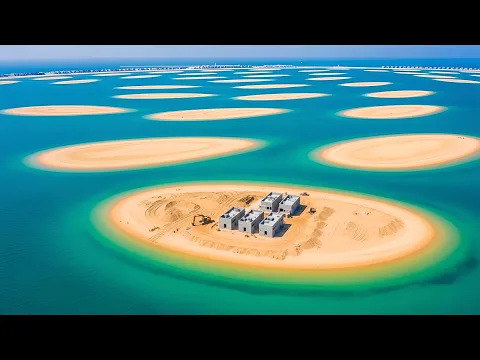

Even with the complicated history, Dubai did not shut the project down. In the midst of the landscape of empty islands from the world map, a new chapter tries to retell the story: the Heart of Europe, a group of islands transformed into a themed European resort.
The proposal is as ambitious as the previous failures. Streets with climate control promise cool breezes and light rain in the scorching heat.
There is talk of snow rooms and even open areas covered in ice, all in an environment where the natural thermometer exceeds 40 degrees. In theory, visitors would walk on cool sidewalks, under programmed drizzles, as if they were in another latitude.
Underwater, the idea is even bolder. Some of the most expensive properties are floating villas with submerged rooms, where the resident would wake up surrounded by coral reefs and marine life. The problem is that, in practice, the surrounding water was dead and murky.
The solution was to create a “thematic sea” within the real sea: tons of rocks were placed, corals began to be planted manually by divers, in an attempt at “underwater landscaping” that requires constant work.
Critics call this a very expensive façade, a postcard scenario sustained by a simple and dangerous logic: money from new buyers paying off old debts.
Instead of correcting the mistake of building a world map on unstable sand, the region now relies on even grander projects to keep the wheel turning.
Unrestrained Ambition, Immutable Physical Laws
While part of the world map sinks, distorts, and ages before maturing, Dubai announces new megaprojects. A “Dubai Moon,” a gigantic sphere mimicking the Earth’s satellite in the city.
A “Green Spine” over 100 kilometers of climate-controlled structures cutting through the desert. Vertical forests, underground cities, projects to manipulate the weather with drones that would induce rain.
The logic behind this is a kind of radical techno-optimism. The belief that there is no problem that can’t be solved with more engineering, more investment, more energy. If nature resists, step up another notch on the technological scale.
But there is a limit that does not accept negotiation. Geologists remind us that an artificial island is not just any terrain; it is a living hydraulic system that requires eternal maintenance. It needs new sand, constant reinforcement of edges, channel cleaning, pumps, and monitoring.
When the money runs out or priorities change, nature does not wait: it immediately begins its process of undoing what has been done.
In the long run, these sets can become not only bad investments but real dangers to navigation, with treacherous sandbanks where promises of luxury once existed.
The World Map As A Mirror Of An Era
Seen from afar, the silhouette of the world map still exists, floating in the blue of the Gulf. Up close, however, what is seen are remnants of a dream that never became reality.
Where laughter, music trails, and glasses toasting at sunset should exist, what dominates is the sound of the wind and water eroding the shores.
It’s easy to imagine future archaeologists trying to understand these geometric shapes at the bottom of the sea. They might assume a water cult, perhaps an abandoned ritual city, maybe a civilization obsessed with form and image.
Surely, they will see there a record of the time when humanity believed that money, marketing, and 3D rendering could, alone, rewrite geography and ignore physical laws.
The world map in Dubai is, in the end, a silent reminder. No matter how high one builds, no matter how ambitious the models are, nature always has the final word.
And sometimes that word comes in the form of silence, sand slipping away, and a sea that returns to claim what they tried to take from it.
Do you think projects like this world map are a necessary vision to push engineering beyond or are they just expensive monuments to human stubbornness against nature?