Portuguese
  Spanish


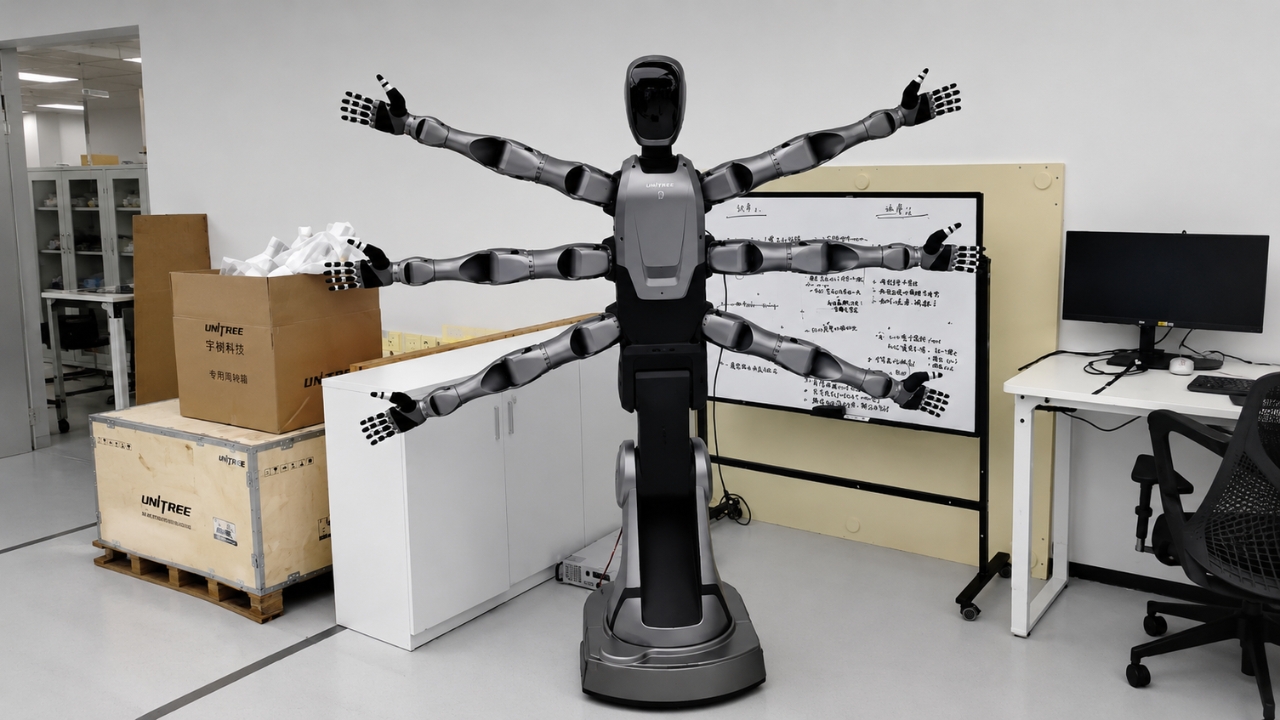
Midea introduced the MIRO U as a new bet in Chinese industrial robotics, combining six arms, a mobile base, and interchangeable tools to reduce downtime in line adjustments and make appliance production more flexible.
The factory gained six arms.
Midea introduced in China the MIRO U, an industrial humanoid robot with six arms designed to work inside factories. The equipment was designed to change tools, carry heavy parts, rotate 360 degrees, and perform simultaneous tasks on production lines.
The noteworthy detail is not just the machine’s unusual appearance. According to Midea itself, the robot will be used in a washing machine factory in Wuxi, Jiangsu province, with an expectation to increase efficiency in line adjustments and changes by about 30%.
-
Engineers Uncover Rain’s Role in Airflow Mystery at Brazilian Underground Facility

-
Brazilian Engineers Lead $200 Million Project to Bring Water from São Francisco River to Transform Supply in Northeastern Cities

-
Brazilian University Tests Recycled Plastic Component for Homes, Aiming for More Sustainable Single-Family Housing Construction
-
Apple, Samsung, and Sony Warn: Wet Bluetooth Earbuds Can Be Damaged if Stored Before Fully Drying


Six-arm robot was presented as Midea’s industrial bet
The MIRO U was publicly revealed in December 2025, during the 2025 Greater Bay Area New Economy Forum, also linked to the 21st Century Technology Annual Conference, in Guangzhou.
The presentation was made by Wei Chang, vice president and CTO of Midea Group. According to the company, the equipment is part of the third generation of the MIRO family, a line aimed at industrial applications.
The difference lies in the concept. Instead of merely copying the human form, the MIRO U was designed to overcome some limitations of the human body in production environments. Therefore, it combines a mobile base with wheels, six mechanical arms, and interchangeable tool modules.
Midea wants to use the MIRO U in a washing machine factory in Wuxi
The most important application mentioned by the company is in Midea’s high-end washing machine factory in Wuxi. The company stated that the robot would enter the plant at the end of December 2025, and the company’s annual report already treats the use as a pilot application.
This detail changes the weight of the news. It’s not just a prototype displayed at a technology fair. The MIRO U was presented as part of an attempt to place industrial humanoids in real factory tasks, where downtime, model changes, and line reorganization can directly affect productivity.
According to Midea, the robot can increase adjustment and line change efficiency by 30%. The number does not mean that the entire factory will produce 30% more, but it indicates an important promise in a sensitive stage of production.
Six arms, 360-degree rotation, and interchangeable tools
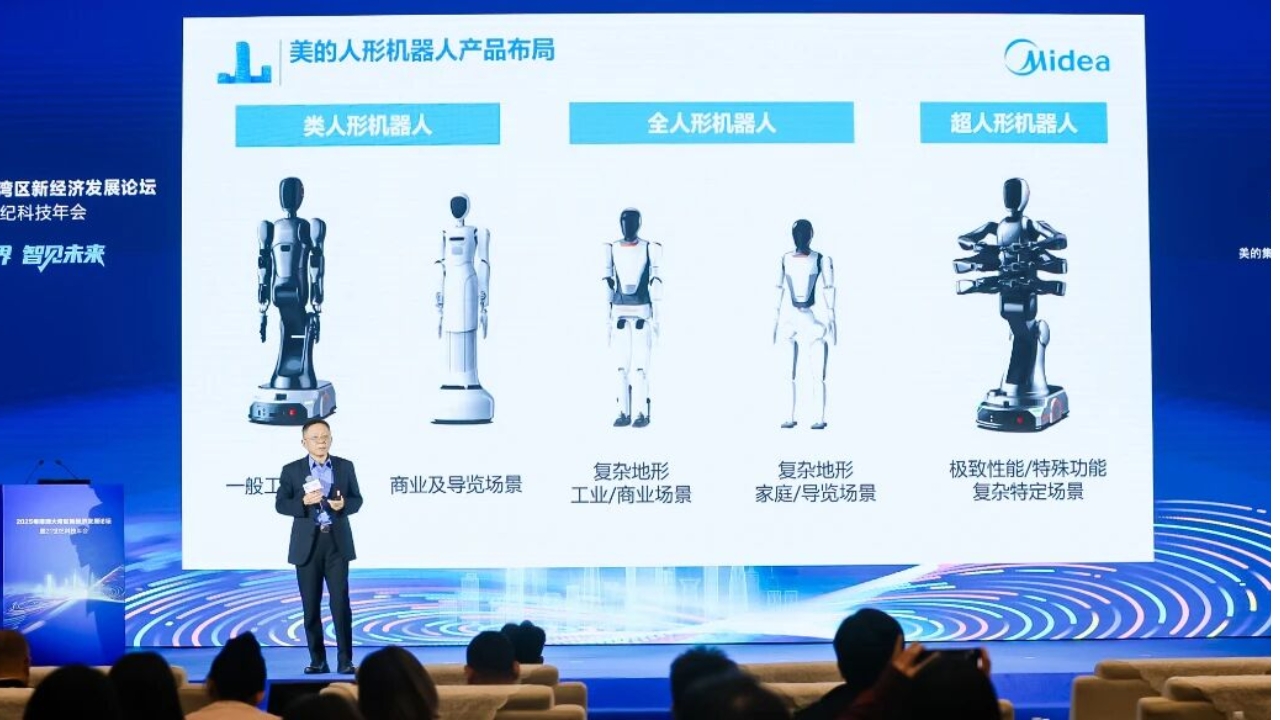
Midea’s annual report provides technical details that help understand why the MIRO U draws attention. The machine has a waist module with 3 degrees of freedom, six arms with 6 high-precision drive joints, and different types of end effectors.
Among these modules, the company mentions skillful hands, vacuum suction cups, and other interchangeable accessories. In practice, this allows the robot to be adapted for different tasks within the same line.
Midea also claims that the equipment can move up and down stably, as well as rotate 360 degrees on its own axis. This combination increases the machine’s operating area without requiring a traditional fixed structure.
Interesting Engineering highlighted three tasks at the same time
Interesting Engineering’s coverage reinforced the more visual aspect of the novelty. According to the site, the robot can perform three tasks at the same time, move heavy components with the lower part, and use the upper arms for finer work, such as assembly and fastening.
This is the point that turns the MIRO U into a topic with strength for the general public. A robot with six arms inside a washing machine factory seems like a science fiction image but is connected to a very concrete industry problem: making flexible lines switch tasks with less downtime.
The South China Morning Post also recorded the robot’s presentation and the implementation plan in Wuxi, reinforcing Midea’s focus on industrial efficiency.
Humanoid robots enter first where the environment is controlled


Midea’s strategy helps explain why the first major use appears in a factory, not in homes. The company summarizes its route as industry first, commerce later, and home still under exploration.
Factories are more predictable environments. There are defined routes, standardized parts, repetitive tasks, and processes that can be measured. For a humanoid robot, this reduces risks and facilitates validation.
Midea states that it started its robotics research structure in 2014 and reinforced this area in 2017, after completing the acquisition of the German company Kuka, one of the most well-known brands in industrial robotics. In 2024, the company created an innovation center for humanoids and, in 2025, developed three generations and five models.
The impact goes beyond a curious machine
The MIRO U does not yet have all public data disclosed. There is no reliable open information about price, battery autonomy, maximum load per arm, number of pilot units, or sensors used.
Even so, the case shows an important turning point. Humanoid robotics is beginning to move from the demonstration stage to a sector where every minute of downtime costs money. If the promise of 30% more efficiency in line change is confirmed, Midea’s six-arm robot could mark a new step in the automation of home appliance factories.