






 Portuguese
  Spanish


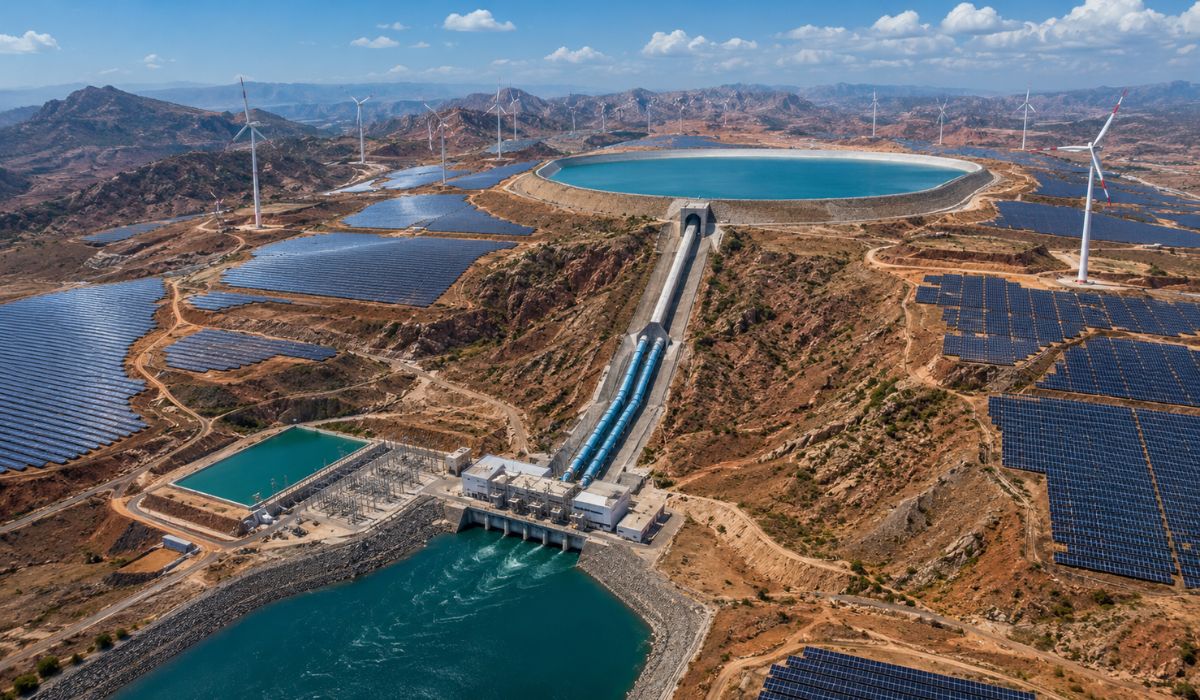


Project in India combines artificial reservoirs, solar energy, wind, and reused water to store electricity on a large scale, in a solution that transforms a dry landscape into renewable infrastructure.
A dry and rocky area in the Kurnool district, in the state of Andhra Pradesh, southern India, has become home to the Pinnapuram Integrated Renewable Energy Project, a Greenko facility that combines solar energy, wind energy, and pumped-hydro storage.
The project uses two artificial reservoirs to store electricity in the form of water’s potential energy, in a model described by the Indian government as a large-scale integrated renewable energy structure.
Its operation is based on a logic well-known in hydroelectric engineering.
-
Trump Signs Orders to Develop Quantum Computer and Bolster U.S. Systems Against Encryption-Breaking Attacks

-
Breakthrough in Clean Energy: Scientists Develop Battery-Free Artificial Photosynthesis Using Only Sunlight to Generate Chemical Energy
-
Revive Old Photos: Gemini’s Little-Known Feature Uses AI to Restore Damaged Images in Seconds with a Professional Six-Step Recovery Process

-
Young Brazilian Inventor Develops Microplastic Filter, Wins Scholarship to Study in China, and Implements Solution to Improve Water Quality in Southern Brazil


During periods of higher solar and wind generation, surplus energy powers pumps that move water from a lower reservoir to another, situated at a higher level.
When there is a need for electricity in the grid, this water returns through tunnels and passes through turbines, generating energy in a controlled manner.
The facility is called a “green battery” because it stores energy without relying on chemical batteries.
In this case, water, gravity, and the height difference between the reservoirs fulfill the role of storing the surplus produced by variable renewable sources.
How the green water battery works in India
The project was planned to combine 4,000 MW of solar energy, 1,000 MW of wind energy, and 1,680 MW of pumped-hydro storage.
According to the Press Information Bureau, an official body of the Indian government, the undertaking has an estimated investment of US$ 4.2 billion and a storage capacity of 10,080 MWh per day in one cycle.
In operation, the energy produced during periods of higher solar incidence or favorable winds is used to pump water to the upper reservoir.
At another time, when renewable generation decreases or demand increases, the flow is reversed, and the water moves turbines before returning to the lower reservoir.
This type of technology is known as a reversible power plant, pumped storage, or pumped storage.
Although already used in different countries, the model gained relevance with the expansion of solar and wind energy, sources whose production varies according to climatic conditions and time of day.
In Pinnapuram, Greenko reports that the system was designed as a closed circuit.
According to the company, the two reservoirs are set apart from natural watercourses and are intended to reuse the same water throughout operation, with replenishment mainly for losses due to evaporation.
Why renewable energy storage is necessary
Variable renewable generation poses a technical challenge to electricity grids.
Solar panels stop producing at night and reduce generation on cloudy days, while wind turbines depend on the intensity and regularity of winds.
This fluctuation requires mechanisms capable of storing surpluses and releasing energy during peak demand.
In this context, large-scale storage projects help reduce the gap between when electricity is generated and when it is consumed.
In systems like Pinnapuram’s, storage does not occur in electrochemical cells, but in the movement of water between two levels.
Speaking to The Times of India, Maurya Pydah, Greenko’s Chief Operating Officer, stated that the company moved to the pumped storage model after studies on the intermittency of renewable sources.
According to him, solar generation depends on light availability, and wind generation only occurs when wind speed is adequate.
In the same interview, Pydah compared the system to a “giant natural battery”, for storing surplus solar and wind energy and releasing it when the grid needs electricity.
The statement indicates how the company presents the project: a way to transform variable sources into programmable supply.


Two artificial reservoirs in a dry region
Pinnapuram is located in a dry climate area around Kurnool, in Andhra Pradesh.
The region offers relevant characteristics for renewable projects, such as high solar incidence and available areas for large-scale infrastructure, in addition to access to existing transmission systems and reservoirs.
The hydroelectric storage component was structured with two artificial reservoirs.
Indian environmental documents report that the project underwent technical re-evaluations and had changes in capacity and area throughout the analysis process.
In the records of the Expert Appraisal Committee, the proposal appears associated with adjustments in the storage system’s capacity and an area of 785.58 hectares for the analyzed component.
The documentation also mentions a revision in the water requirement to 1.30 TMC, in the context of the changes examined by the committee.
This information shows that the closed-loop model does not eliminate the need for environmental licensing and monitoring.
The implementation involves excavations, earthmoving, construction of reservoirs, tunnels, powerhouses, substations, and transmission lines.
Solar, wind, and pumped-hydro energy in a single system
The central aspect of the project is the integration between generation and storage.
Instead of operating solar, wind, and pumped-hydro energy as isolated structures, the proposal is to combine them into a platform aimed at delivering electricity at defined times.
The Indian government states that the facility can serve sectors such as green steel, green aluminum, and green hydrogen, activities that demand large volumes of energy and greater predictability in supply.
Greenko also presents Pinnapuram as part of a model to be replicated in other Indian states.
According to statements published by The Times of India, the company plans pumped-hydro storage projects in Madhya Pradesh, Karnataka, Rajasthan, and Uttar Pradesh.
In the electricity sector, pumped-hydro storage is analyzed as an alternative for large volumes of energy and prolonged discharge periods.
The technology does not replace all forms of storage but can complement chemical batteries, transmission lines, and other grid balancing solutions.

What Pinnapuram shows about the electricity grid
The Pinnapuram experience illustrates one of the central points of the energy transition: expanding renewable generation is not enough when production varies throughout the day.
System stability also depends on ways to store surpluses, avoid generation curtailments, and meet peak consumption.
In the Indian case, water is pumped uphill when renewable energy is available and returns to generate electricity when the grid needs reinforcement.
The operation transforms a dry land into part of an infrastructure aimed at large-scale energy storage.
The image of two artificial reservoirs in an arid region draws attention due to the visual contrast, but the most relevant technical data lies in the use of gravity as a storage mechanism.
While part of the global debate focuses on chemical batteries and critical minerals, Pinnapuram shows an application of hydraulic engineering adapted to the expansion of renewable sources.
In an economy with growing electricity demand, projects of this type indicate how grid reliability can depend on the combination of clean generation and storage.




I prefer Greenko’s 1140MW Pumped Hydro Project at the Gandhisagar Site in MP. This is because it shares only a small portion of the EXISTING Hydro Reservoir. This Eliminates the need of a Reservoir as well as a Water Source too…. the latter is in short supply at this arid area of the Telengana Site.
The Gandhisagar Pumped Hydro Project Costs about USD 1 Billion… this Project is USD 4 Billion…. much higher…. as it may contain the cost of PV Panels & Wid Turbines.
Talking about PV Panels, here again, if they use “virgin land” of any kind, it is a waste of hard-to-find Natural Resources. Use of AgriVoltaics (AV) that shares Grazing/Farmland ensures the latter is used “twice”…. by Grazing or Farming below and Generation of Pollution Free Electricity above…. at the same time… on the same land….
This kind of reverse pumping system of generating power is already exists in Tamil Nadu as a part of Parambikulam- Aliyaru project which is one of it’s kind exists in India.
This project was planned , executed and serving to the nation for more than 60 years
The power house, called Kadamparai power house , it self is built inside a huge tunnel.