Portuguese
  Spanish


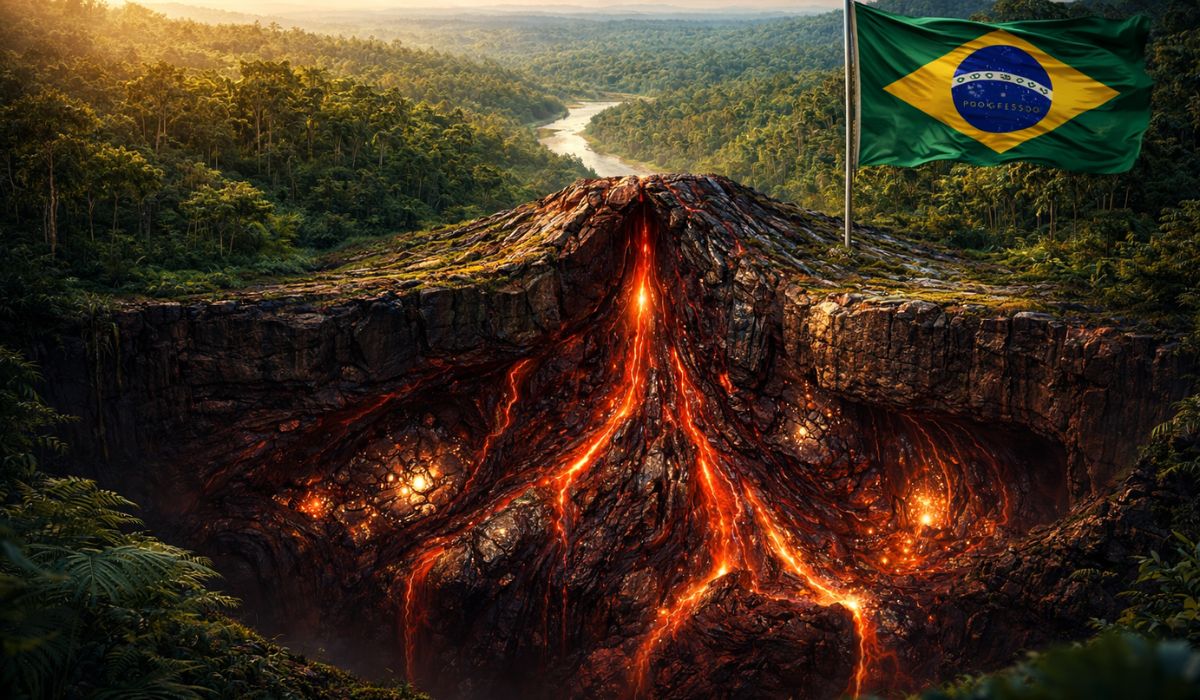


An ancient geological record in southern Pará puts the Amazon back at the center of research on remote volcanism, rock preservation, and mineral formation, in a discovery that mobilizes studies and expands scientific interest.
In southern Pará, in the region of São Félix do Xingu, a set of rocks preserves records of volcanism dating back about 1.88 billion years, associated with the so-called Uatumã magmatic event.
In promotional texts, this material is often described as a “fossilized volcano.”
In academic studies, however, the area appears as a paleoproterozoic volcanic complex preserved in the Amazonic craton, one of the oldest portions of the continental crust.
-
Archaeologists Discover 1,500-Year-Old Byzantine Mosaic with Greek Biblical Inscription in Israel, Uncover Ruins of 10 Buildings Near Kiryat Gat

-
Ohio Carpenter Finds 308-Gram Meteorite the Size of a Baseball After Dreaming of Its Location

-
Chinese Student Builds Humanoid Robot for $2,100 at Age 20, Now Leads Robotics Startup in China
-
Sumatran Rhino: The Rare “Prehistoric Survivor” with Fewer Than 50 Left and a Fascinating Natural History


Research indicates that the material does not pose any current risk and serves as a source of data on eruptions, magma circulation, and rock transformation during a remote period in Earth’s history.
The topic has resurfaced outside the academic community in reports, social media posts, and scientific outreach videos.
Among these contents, there is a video published on YouTube by the channel Prof. Rogerdautry.


One of the reference works was published in 2010 in the Journal of Volcanology and Geothermal Research, by researchers affiliated with USP and UFPA, and was later echoed by Pesquisa FAPESP.
Where the record was identified
The relevance of the case is partly linked to the location where these rocks were mapped.
The Amazonic craton is known in geology for bringing together very old terrains and for having remained tectonically stable over long intervals.
Still, researchers identified volcanic features in this area that are slightly metamorphosed, with preserved textures and structures.
In a report by Pesquisa FAPESP, geologist Caetano Juliani used the expression “the hell on Earth” to describe, in comparative terms, the intensity of the eruptions that would have marked that landscape nearly 2 billion years ago.
The current landscape does not preserve a visible volcanic cone like those observed in recent systems.
Over geological time, erosion has altered the relief and removed part of the surface structures.
What remains, according to studies, are ignimbrites, tuffs, lava flows, rhyolitic dikes, domes, and granite intrusions associated with the system.
In technical language, part of these outcrops corresponds to internal segments of the ancient volcanic apparatus, which allows for the reconstruction of stages of its functioning even without the preservation of the original crater.
What studies show about the rocks
The characterization of this record was not based on a single element.
The researchers combined field observations, petrographic analysis, and interpretation of satellite images, digital radar from the R99B/SIPAM project, and SRTM data to recognize structures, geological contacts, and distribution patterns of rock units.
Subsequently, the samples were subjected to laboratory analyses to determine mineralogy, texture, composition, and age.
According to the authors, this set of procedures was essential to distinguish ancient volcanic rocks in an area marked by extensive vegetation cover and intense weathering.
The available datings place the main activity around 1.88 billion years.
In the material cited by the authors, ages of 1884 ± 1.7 million years for ash tuff from the Santa Rosa Formation and 1879 ± 2 million years for rhyolite from the same unit appear, both obtained from zircon grains.
There are also nearby records, such as 1880 ± 6 million years for dacite from the Sobreiro Formation.
Thus, the studies offer a more precise chronological cut than the generic formulation of “1.9 billion years,” frequently used in outreach texts.
The works also indicate that the region went through more than one eruptive phase.
The Sobreiro Formation mainly comprises andesitic and dacitic lavas with associated volcanoclastic deposits.
On the other hand, the Santa Rosa Formation records explosive and effusive episodes of rhyolitic affinity, with voluminous ignimbrites, fall tuffs, crystal tuffs, lapilli-tuffs, coignimbrite breccias, dikes, and domes.
The interpretation proposed by the authors is that reactivated fractures allowed the ascent of magma, followed by explosive eruptions, outpouring of more viscous lavas, and then the intrusion of granitic porphyries and other late magmatic bodies.
Relation with ancient mineralization
The rock set is also studied for its potential economic interest.
In the most altered areas, researchers recorded potassium hydrothermal zones, propylitic, sericitic, and argillic zones, in addition to silicification and breccias with anomalous gold content.
The 2010 study mentions metallogenic potential for gold and tin in São Félix do Xingu.
Meanwhile, Pesquisa FAPESP reported, in another research front on the Amazon craton, the characterization of deposits related to gold and copper.
These data do not, by themselves, confirm exploitable reserves, but indicate an association between ancient volcanism and the circulation of mineralizing fluids.
In addition to economic interest, the case has value for reconstructing the geological history of the Amazon.
The preservation of these rocks allows for a more detailed examination of processes related to Paleoproterozoic magmatism and the evolution of ancient volcanic provinces.
For researchers, this type of record helps to understand how certain systems were formed, how they were distributed in the terrain, and how they were preserved over billions of years.
Why the structure remained off the radar for so long
The preservation of the complex is still treated with caution by the authors.
In the reference article, they state that the reasons for this degree of conservation are not fully understood.
As a working hypothesis supported by the study, the researchers suggest that the relatively rapid covering by fine sedimentary units and the thermo-tectonic stability of the Amazon craton since the Paleoproterozoic may have contributed to maintaining little-altered volcanic features.
Therefore, the same geological stability that for a long time diminished the expectation of finding this type of record may also have favored its conservation.
Another factor that helps explain the delay in identification is the inherent difficulty of mapping ancient outcrops in large areas of the Amazon.
The vegetation cover, the action of weathering, and the absence of classic volcanic forms on the surface hinder direct reading of the terrain.
In this context, the advancement of remote sensing and the refinement of petrographic and geochronological analyses have expanded the capacity to recognize ancient structures that could go unnoticed to the naked eye.
In an interview with Pesquisa FAPESP, Juliani reported that colleagues abroad showed interest in the degree of preservation of these rocks.
The emphasis given to the case, according to studies and academic repercussions, lies less in an image of a preserved crater and more in the possibility of reconstructing eruptive styles, mechanisms of volcanic material transport, and episodes of crustal extension in a remote interval of Earth’s history.
It is, therefore, a relevant record for research on the evolution of the Amazon craton and on the association between ancient volcanism and mineralized hydrothermal systems.
Although promotional texts sometimes present this type of finding as a clue to predict the emergence of new geological faults, the localized studies do not make this assertion directly.
What is documented is the scientific value of the material for understanding the dynamics of Uatumã magmatism and the formation of ancient volcanic provinces in the territory now occupied by Brazil.