Portuguese
  Spanish


Behind the promise of a domestic do-it-all is a clever move: the company wants to use real homes as a training ground for the robot’s artificial intelligence. The detail is that it moves on wheels, not legs, and much of what has been seen so far is in demonstration videos, not in proven use.
Chopping vegetables, frying eggs, doing laundry, and assisting the elderly are the tasks that the Chinese humanoid robot SeeLight S1 promises to perform on its own inside the house. Developed by the startup GigaAI, the robot is described as China’s first general-purpose domestic humanoid and will be tested in 100 real homes in the city of Wuhan, with the goal of reaching stores at a price of around R$ 75,000 by 2027.
The model was presented on May 21, 2026, and gained worldwide attention for the ambition of the project. Before the excitement, however, a caveat is worth mentioning: much of the tasks attributed to the robot were shown in demonstration videos released by the company itself, and not proven in independent domestic use. GigaAI, recently founded and having among its investors the financial arm of the giant Huawei, developed the S1 in partnership with robotics centers supported by the government of Hubei province.
What the Chinese humanoid robot promises to do

In the demonstration videos published by GigaAI on the social network WeChat, the Chinese humanoid robot appears chopping vegetables, frying eggs, putting clothes in the washing machine, hanging them, making the bed, and opening curtains, all supposedly autonomously.
-
In Andradina, in the interior of SP, a tannery transformed tilapia skin that slaughterhouses used to throw away into exotic leather for bags, shoes, and even wedding dresses, producing about 2,000 pieces per month and exporting to seven countries, proving that fish waste has become high-value fashion.

-
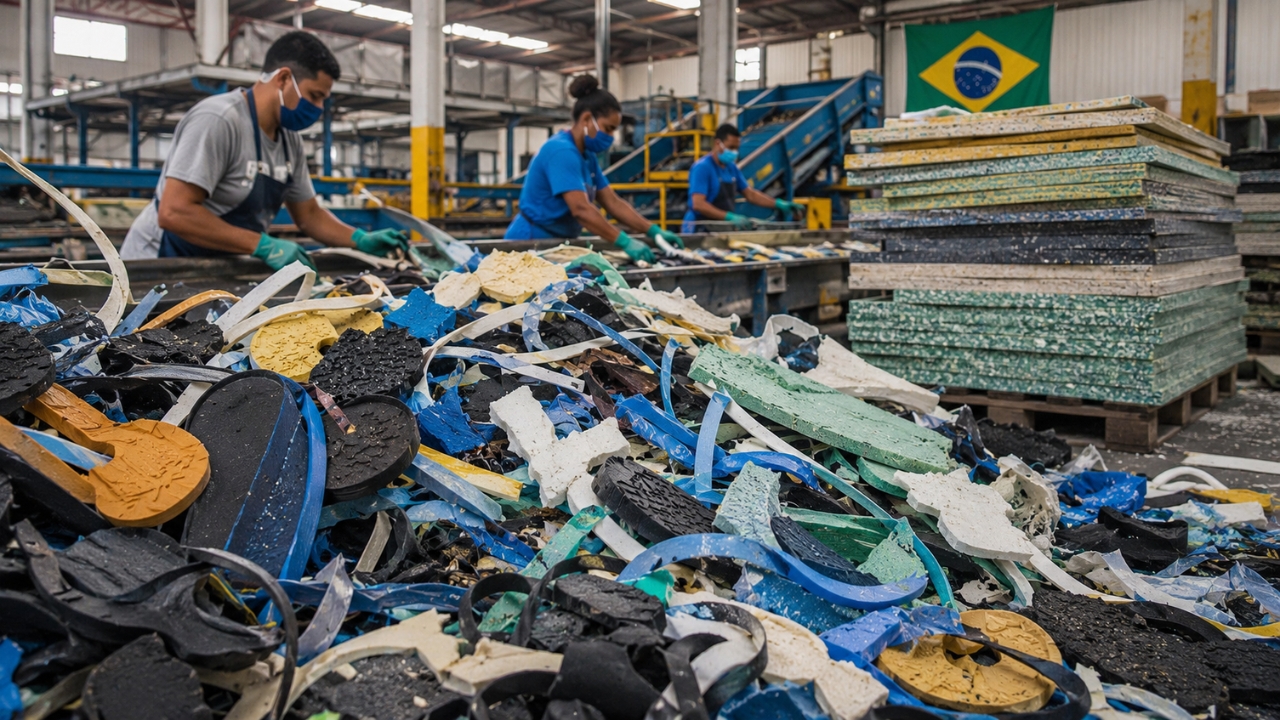
The industrial waste that even recyclers didn’t want has gained value in the interior of Bahia: two entrepreneurs invested R$ 2.8 million to transform 350 tons per year of foam, rubber, and plastic into boards that can replace wood and MDF.

-
What is a red flashlight used for, after all? See why it is so commonly used at night.

-
He has never read a line of code, but he already knows how to work: the French company UMA presented in Paris the Northstar, its first AI-powered humanoid robot designed for factories and warehouses, capable of copying tasks just by observing an employee in action.



The SeeLight S1 features two functional arms and an articulated torso capable of manipulating objects. It is worth noting, however, that demonstrations of this type need to be viewed with caution, as it is common for robots in promotional videos to be teleoperated or perform tasks in controlled conditions. The real test will come precisely with trials in real homes, where the environment is unpredictable and changes every day.
The robot that moves on wheels
A technical detail differentiates the S1 from the most famous humanoids. Instead of legs, the robot moves on wheels, which technically classifies it as a hybrid humanoid and prevents it from climbing stairs, unlike models from Boston Dynamics or Tesla. It may seem like a limitation, but it is a strategic choice by the company.
By giving up more complex and expensive legs, GigaAI can reduce the robot’s cost and bring it to market before competitors. The bet is that for most single-floor household tasks, wheels get the job done. It’s a way to anticipate market entry and start collecting real-world data as soon as possible, which, as we will see, is the true goal behind the project.
The plan for testing in real homes
The great differentiator of the SeeLight S1 is not the technology itself, but the concrete plan to place it in real homes. A first batch of 100 units began being distributed for internal testing in the homes of technology sector employees in Wuhan, and the next phase, scheduled for the first half of 2027, plans for the free distribution of robots to families in the city, prioritizing homes with the elderly, children, or pets.
To ensure safety, the robot is equipped with sensors that immediately stop its movements upon detecting contact with a child or an animal. The idea is to test the equipment in real and complex domestic environments, collecting data to improve its artificial intelligence and validate large-scale commercial viability. According to the company, the launch in stores is scheduled for June 2027, at an estimated price of around $15,000, a price GigaAI intends to halve by then.
The true goal: data from the physical world
Behind the domestic all-rounder, there is a deeper strategy linked to the future of artificial intelligence. The biggest bottleneck in robotics today is not in the hardware, which is already advanced, but in the lack of data from the physical world, and this is exactly what the Chinese humanoid robot intends to collect inside homes. The system uses so-called embedded AI, where the digital brain is connected to a body that learns by interacting with the environment.
The logic is simple: for a robot to learn to pick up a glass without dropping it or an egg without breaking it, it’s not enough to see millions of photos. It needs to feel the weight, resistance, and angle in practice, and these data only exist in real interaction. Therefore, each robot installed in a real home is worth more to the company than a thousand laboratory simulations. The household tasks are, in fact, a means to train an AI capable of operating in the physical world.
Why China is betting so much on this
The project is not just an isolated commercial initiative. Caring for the elderly, assisting families, and automating domestic work are declared goals of the Beijing government, concerned with the demographic crisis and the rapid aging of the Chinese population, which will have fewer and fewer young people to care for a growing number of elderly.
In light of this scenario, China has been encouraging the development of robots and embedded artificial intelligence as part of a state policy. The SeeLight S1 is one of the responses to this challenge, and its success or failure will be closely monitored as a test of the viability of domestic robots on a large scale. Experts in the sector, however, caution that the domestic environment is much more difficult than the industrial one, as it is unpredictable and non-standardized, making the timeline ambitious.
A mirror for Brazil and the world
Although distant, the topic resonates with realities that also reach Brazil. Population aging is a global trend, and Brazil is also moving towards having an increasingly larger proportion of elderly, making the debate on care and automation increasingly relevant here in the coming decades.
Moreover, the race for humanoid robots involves giants like Tesla, Boston Dynamics, and Figure AI, in a technological competition that will shape the future of work, industry, and care for people. Observing how China attempts to lead with an affordable domestic robot helps to understand where this technology is heading, which one day may also reach Brazilian homes, even though the current price is far beyond the reach of most families.
The SeeLight S1 is undoubtedly one of the most ambitious domestic robotics projects ever announced, with a concrete plan to place humanoids in real homes and a price that, although high, is much lower than that of competitors. But it is prudent to separate promise from reality: for now, what exists are demonstration videos and a testing plan, and only day-to-day use will reveal if the robot delivers on its promises. If successful, it could mark the beginning of a new era in home automation. If not, it will be just another chapter in the long history of robots that promised too much.
And you, would you place a Chinese humanoid robot like the SeeLight S1 in your home to cook, do laundry, and help with chores? Would you trust it with the care of an elderly family member? Leave your comment, tell us if you would pay for such technology, and share the article with those interested in robotics, artificial intelligence, and the future of technology.