






 Portuguese
  Spanish


Samsung is building one of the planet’s largest chip factories in Texas, with an investment exceeding US$40 billion and 2-nanometer technology that could redefine the global race for semiconductors
In November 2021, Samsung announced it would build a new semiconductor factory in Taylor, Texas, with an initial investment of US$17 billion.
Since then, the project has grown impressively.
Samsung’s total investment in the Texas factory already exceeds US$40 billion, with reports pointing to up to US$44 billion, making it one of the largest greenfield foreign investments in United States history.
-
A fossil kept for years in a small museum in Montreal concealed 450-million-year-old soft tissue, a discovery that has only happened once before in history.

-
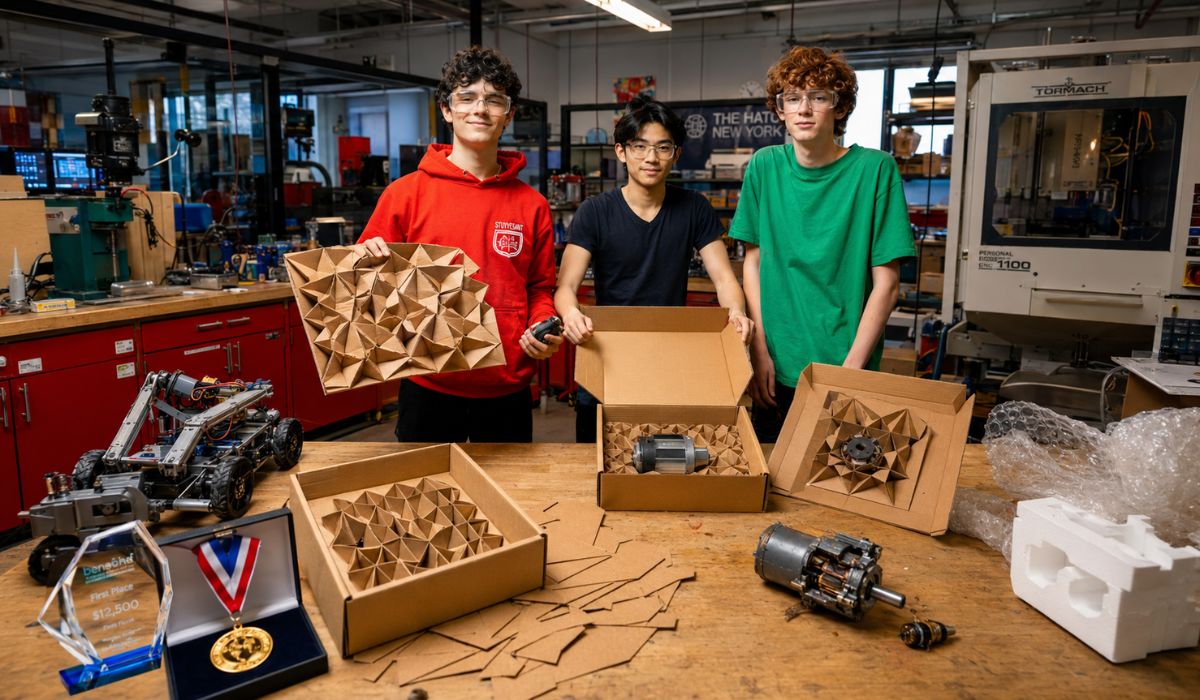
Three teenagers transform cut cardboard into Japanese origami-style packaging that promises to retire styrofoam and bubble wrap, win a $12,500 prize, and target giants like Amazon, FedEx, and Home Depot after a robot motor arrived broken.

-
They exchanged the idea of a large house for a 35 m² warehouse, spent US$ 12,000 on the structure, and created a tiny house in Colorado with space to live and work.

-
The large jar blender has a rival: Oster Ultra Power bets on 1,000 W, six stainless steel blades, and two portable cups with leak-proof lids.




The complex includes two advanced logic fabs, a research and development unit, and an advanced packaging facility.
Additionally, the American government allocated US$6.4 billion in direct funding from the CHIPS and Science Act to enable the project.
The Samsung Texas factory will produce 2-nanometer chips to power artificial intelligence, 5G, and supercomputers
The factory’s technological strategy has changed significantly since the original announcement.
Initially, production was set to begin with 4-nanometer chips in late 2024.
However, Samsung decided to jump directly to 2-nanometer technology.
2nm chips are smaller, faster, and consume less power — essential characteristics for artificial intelligence and high-performance computing applications.
The first factory will produce components for mobile devices, 5G networks, high-performance computing, and AI systems.

From small town to tech hub: Taylor, Texas, expects 20,000 new jobs with Samsung’s arrival
The project’s impact on Taylor extends far beyond the factory itself.
Samsung projects to create over 2,000 high-tech jobs directly in the operation.
During construction, at least 6,500 jobs were generated.
In total, the complete investment of over US$40 billion is expected to generate approximately 20,000 jobs in the region.
John Carter, Texas Representative in the House of Representatives, stated that the investment is “welcome news for the Central Texas community and the Texas economy as a whole.”
Just like futuristic automated factories that transform entire regions, the Samsung project promises to permanently change Taylor’s economic profile.
- Direct jobs: over 2,000 high-tech positions
- Construction: minimum 6,500 jobs
- Estimated total: ~20,000 jobs with full investment
- Suppliers: attraction of manufacturers seeking proximity to Samsung

The CHIPS Act funded US$6.4 billion to bring Samsung to Texas and strengthen American semiconductor production
The CHIPS and Science Act is federal legislation in the United States aimed at strengthening domestic semiconductor manufacturing capacity.
Samsung was designated as one of the program’s main beneficiaries.
Gina Raimondo, U.S. Secretary of Commerce, participated in an event in April 2024 at the Taylor facility to announce the US$6.4 billion in direct funding.
This contribution spurred an even greater commitment from Samsung, raising the total investment to over US$40 billion in the coming years.
The project is part of a global race for independence in chip production, especially after supply crises caused by the pandemic.
Other mega-infrastructure projects, such as urban transformations in Barcelona, show that billion-dollar projects can reshape entire regions when executed with a long-term vision.

The challenge Samsung still needs to overcome: finding customers for its Texas factory
Despite its impressive scale, the project faces real obstacles.
Recent reports indicate that Samsung is delaying the factory’s launch due to difficulties in securing customers for its production.
Competition with TSMC, which already produces 3-nanometer chips for Nvidia, is intense.
The decision to jump to 2nm was, in part, an attempt to differentiate its offering and attract large AI customers.
However, the speed of market adoption for artificial intelligence will determine if the gamble pays off.
Samsung is actively hiring, with 178 open positions across 146 different roles for the Taylor facility.
Still, the lack of confirmed contracts raises questions about the inauguration timeline in 2026.
As with many global mega-projects, the distance between announcement and actual production is often measured in years, not months.
According to American Progress, the complex represents a milestone for American reindustrialization in semiconductors.
Tom’s Hardware details the market challenges Samsung faces to make the operation viable.


