






 Portuguese
  Spanish


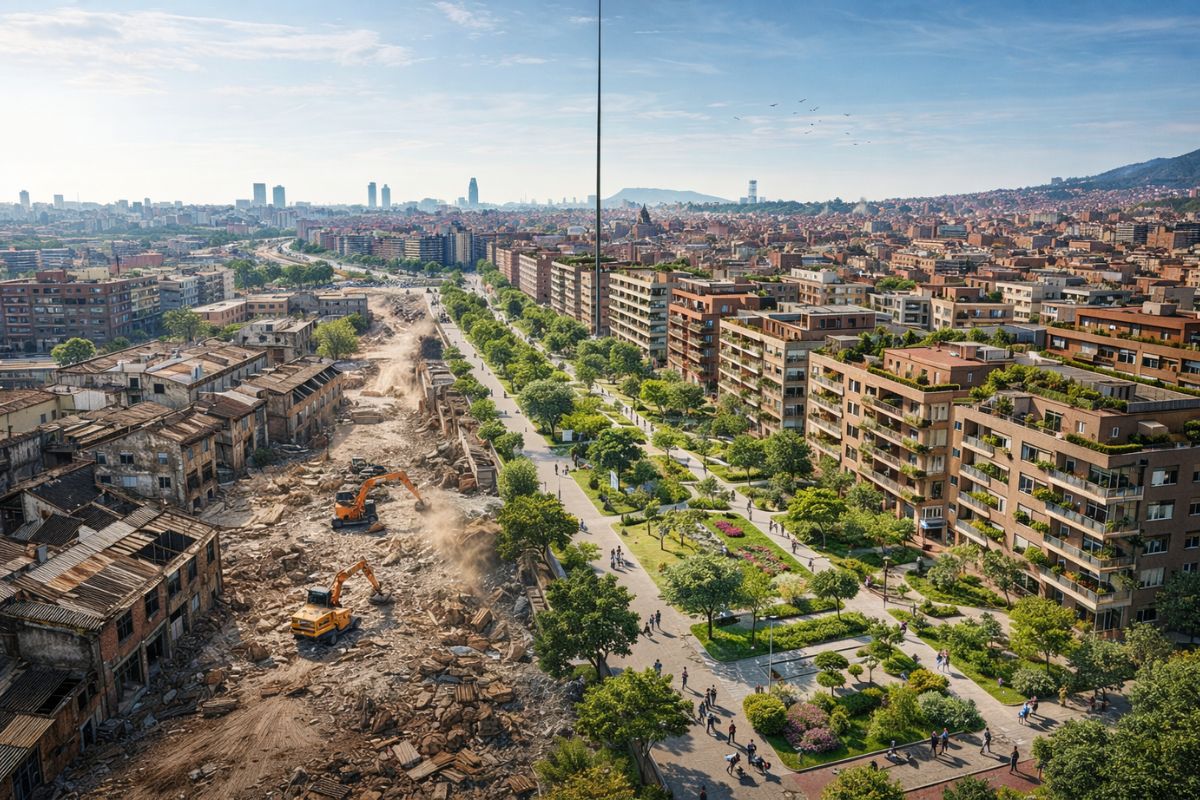

Barcelona prepares to demolish more than 30 industrial buildings on 19 hectares to erect a macro-neighborhood with 3,360 housing units, car-free streets, and abundant vegetation. Of the planned houses, 1,884 will be subsidized. The investment exceeds 85 million euros, with works scheduled between 2028 and 2029.
Barcelona is about to experience one of the largest urban transformations of recent decades. The Spanish city will demolish more than 30 industrial buildings, workshops, and garages occupying 56,814 square meters in a degraded area to make way for a residential macro-neighborhood with 3,360 housing units. The project, managed by the public company Barcelona Sagrera Alta Velocitat (BSAV), is a direct response to the housing crisis that the city is facing, combining subsidized housing and private developments in an environment that prioritizes pedestrians, vegetation, and restrictions on vehicle traffic.
The structures to be demolished are concentrated on streets such as Santander, Rambla Prim, Via Trajana, and Bonaventura Gispert, and will begin to disappear from mid-2027. The technical projects for the demolitions are already underway, with special protocols due to the possible presence of asbestos in the roofs, which may increase estimated costs by about 5.15 million euros. Compensation for the relocation of businesses and constructions amounts to approximately 30 million euros. Barcelona is not just building houses; it is redesigning an entire part of the city that has been forgotten for decades.
What Barcelona plans to build in place of the industrial buildings
The macro-neighborhood that will replace the abandoned warehouses and workshops is not a conventional housing complex. Barcelona designed the space as a “new city balcony towards the Besòs River”, prioritizing vegetation, ample public spaces, exclusively pedestrian streets, and severe restrictions on road traffic. The 19-hectare land will be transformed into a mixed neighborhood that integrates housing, commerce, services, and green areas in an urban design that reflects the latest trends in sustainable planning.
-
Scientists warn that melting ice is triggering an alarming chemical transformation in preserved areas, and the first signs are already concerning researchers worldwide.

-
China placed 198 robotic legs under a 7,600-ton school and made the building walk 62 meters in 18 days, rotating the historic structure as if a concrete structure had gained feet to escape demolition.

-
Distributor confirms the premiere of ‘Dark Horse’, Bolsonaro’s film, in 650 cinemas with 99% of copies dubbed.
-
9-year-old boy who could only hold a plank for 6 minutes in physical education class trained alone for 6 months, without needing encouragement from his parents, until he broke the world children’s record with 61 minutes and 5 seconds.


Of the 3,360 planned houses, the distribution is strategic: 1,884 units will be officially protected, many owned by the municipality, aiming to alleviate the demand for affordable housing in Barcelona. The other 1,476 will correspond to private developments. This balance between social housing and the free market aims to create a socially diverse neighborhood, avoiding the gentrification that often accompanies large urban renewal projects. Barcelona has learned from past mistakes and is trying this time to include the population that needs it most.
Why Barcelona took decades to start this transformation
The area where the macro-neighborhood will be built carries the weight of a historical railway gap that divided Barcelona for decades. The presence of train lines, industrial warehouses, and obsolete logistics infrastructure prevented the region from developing as a residential neighborhood, even though it is located in a strategic position in the city. The lands remained stuck between decaying industrial use and the impossibility of renewal until the railway issue was resolved.
What unlocked the project was the construction of the future La Sagrera station, which is expected to be completed in about six years. With the high-speed station under construction, Barcelona can finally integrate the area into the urban fabric of the city, connecting the new neighborhood to the Sant Martí ring road and other transport infrastructures. The total investment in urban development exceeds 85 million euros, a figure that reflects both the scale of the transformation and the commitment to rectify an urban divide that has penalized residents of the region for generations.
How the timeline of works in Barcelona will be
According to the portal Cronista, the plan follows a defined sequence. Contracts for the technical demolition projects were awarded in March 2026, with completion of the plans expected by September of the same year. The demolition of the more than 30 industrial buildings is set to begin from mid-2027, after the completion of safety protocols that include the removal of potentially toxic materials such as asbestos. Barcelona does not want to repeat the mistakes of previous works that ignored environmental risks.
As soon as the land is cleared, urbanization and construction works will begin between 2028 and 2029. The estimated timeline for the completion of all urbanization, construction, and marketing of the houses is approximately 10 years, meaning that the macro-neighborhood will only be fully inhabited around 2038. Elements such as the Salvador Seguí Institute, the rural house Can Riera, and the retaining wall of the Horta stream will be preserved during the works, minimizing impacts on the educational area and local heritage.
What the macro-neighborhood of Barcelona means for the housing crisis

image: BSAV
Barcelona is facing one of the most acute housing crises in Europe, with rental prices skyrocketing over the last decade and a supply of affordable housing that does not keep pace with demand. The macro-neighborhood with 1,884 subsidized units represents the largest block of protected housing that the city will put on the market in a single project, a volume that could alleviate some of the pressure on families being pushed out of central neighborhoods by prices.
The project also aims to revitalize the surrounding area of Sant Andreu, positioning the region as a new attractive and modern residential hub in Barcelona. The connection with the La Sagrera station will ensure quick access to the city center and other locations in Spain by high-speed train, which tends to increase the neighborhood’s value and attract residents who are currently forced to live in distant peripheries due to a lack of affordable options. Barcelona is betting that this macro-neighborhood can be both a housing solution and a driver of urban transformation.
The urban model that Barcelona is following with this project
The macro-neighborhood fits into a broader trend in Barcelona to rethink urban space in favor of people. The city is already a global reference with the superblock model (superilles), which restricts vehicle traffic in residential areas and returns streets to pedestrians. The new neighborhood takes this concept to the extreme: car-free streets, abundant vegetation, and public spaces designed for community, not for motorized circulation.
This approach reflects a paradigm shift that Barcelona has been implementing for years. Instead of designing cities for cars and adapting what is left for people, the Spanish city does the opposite: it designs for people and restricts vehicle space to the minimum necessary. The 19-hectare macro-neighborhood is the most ambitious application of this principle, and its success or failure will be observed by urban planners worldwide as a test of the viability of a model that promises to transform how European cities grow.
Barcelona will demolish industrial warehouses and build a macro-neighborhood with 3,360 houses, car-free streets, and plenty of vegetation. Do you think Brazilian cities should adopt similar projects? Do car-free streets improve or complicate urban life? Leave your opinion in the comments.


