






 Portuguese
  Spanish


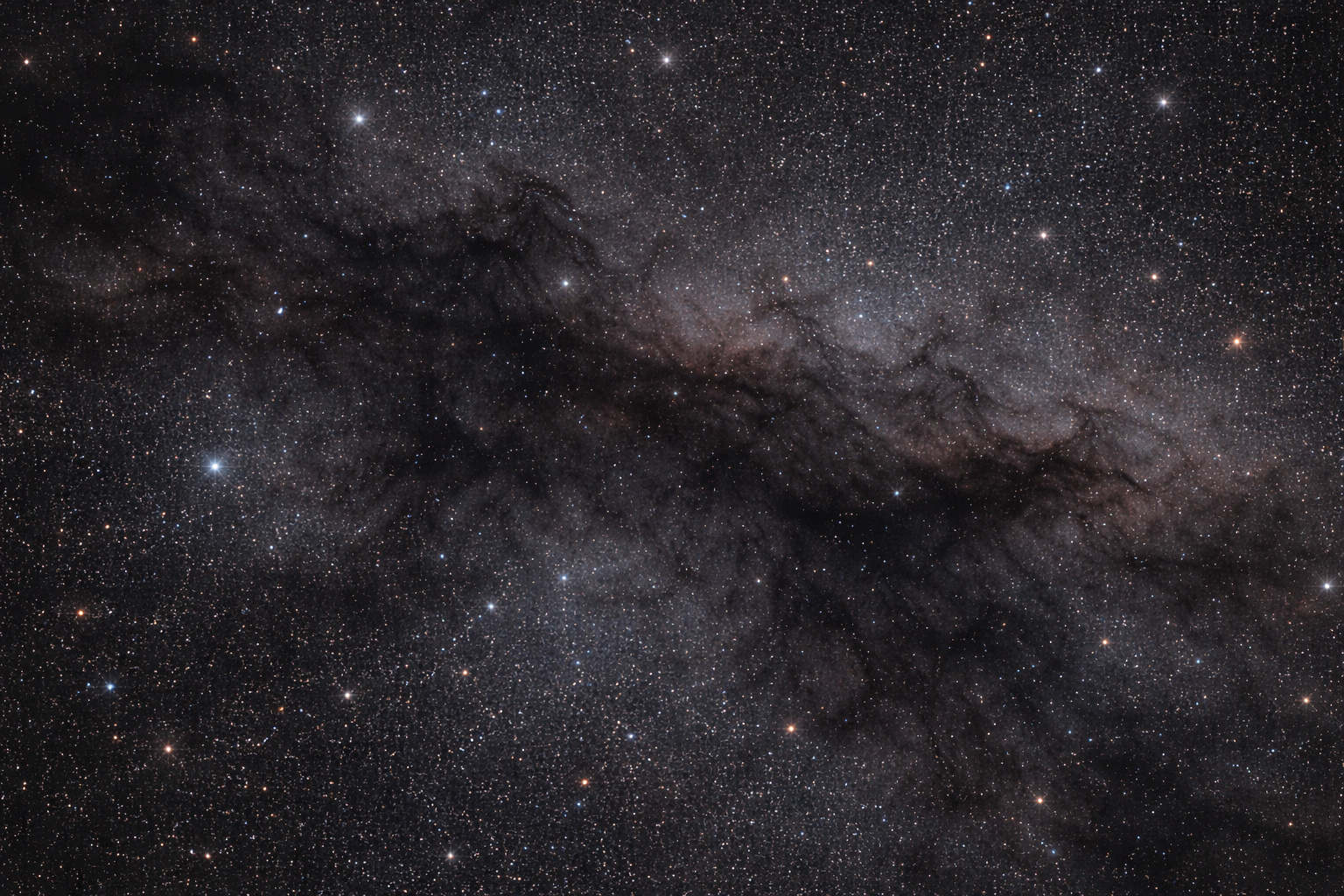
Eos molecular cloud, just 300 light-years away, reveals invisible hydrogen and could change understanding of star formation and matter in the universe.
In 2025, an international team of astronomers revealed one of the most intriguing discoveries in recent astronomy: a gigantic molecular cloud of hydrogen named Eos, located about 300 light-years from Earth, an extremely small distance in cosmic terms. The study, published in the journal Nature Astronomy and released by the University of Arizona, showed that this structure, positioned at the edge of the Local Bubble, is among the largest individual structures ever identified in the sky and has remained beyond the reach of traditional detection methods.
The cloud is not only notable for its size. Researchers estimate that Eos has about 3,400 times the mass of the Sun and extends across the sky with an apparent width equivalent to 40 full moons side by side, if it could be observed with the naked eye. The discovery also gained attention in science communication outlets such as BBC Sky at Night Magazine, which highlighted the unusual dimension of the structure and its proximity to the Solar System.
The most surprising aspect, however, is not just its scale, but the fact that this cloud has remained hidden until now not because it is distant, but because it is primarily composed of “dark” molecular hydrogen, difficult to track by conventional methods based on carbon monoxide. According to the authors, Eos was identified through fluorescent emission in the far ultraviolet of H₂, a technique that allowed revealing a structure that simply did not appear in the most commonly used surveys of the Milky Way.
-
Russia and India Lift 320-Ton Pressure Vessel into Kudankulam Nuclear Plant Reactor, Advancing Project That Has Already Prevented 112 Million Tons of CO2 Emissions

-
Brazilian Student Wins Global Science Fair in the U.S. with Sound Wave Method to Alter Alzheimer’s-Linked Genes
-
Bosch Unveils Revolutionary 2.3 kg Hub Motor for E-Bikes with 45 Nm Torque and 400 Watts Power, Eliminating Resistance Above 25 km/h in Historic Shift for German Manufacturer
-
Brazilian Engineer Develops Marine Bacteria from Ubatuba into a Mini Power Plant Generating 227 mW per Square Meter, Cleans Air by Capturing CO₂ and Releasing Oxygen


Eos cloud discovered 300 light-years away and why this surprised astronomers
In astronomy, finding giant structures close to Earth is rare. Most known large molecular clouds are located thousands of light-years away. In the case of Eos, its proximity makes the discovery even more impactful.
The cloud is situated at the edge of the so-called Local Bubble, a cavity of hot and rarefied gas that surrounds the Solar System and extends for hundreds of light-years.

This region was already considered relatively well-studied. Therefore, the existence of a completely unknown massive structure within this “mapped territory” surprised the scientific community.
The fact that something so large has gone unnoticed for decades raises a central question: how many other invisible structures may still be hidden close to us?
Why the cloud stayed invisible for so long
The main reason for the “disappearance” of Eos lies in the way astronomers traditionally detect molecular clouds.
Typically, these structures are identified through the emission of carbon monoxide (CO), which serves as an indirect “marker” of the presence of hydrogen. This is because molecular hydrogen (H₂), while being the most abundant element in the universe, does not emit easily detectable signals in many ranges of the spectrum.
In the case of Eos, the problem is even more extreme: the cloud is considered “CO-dark”, meaning it has a very low amount of carbon monoxide, making it practically invisible to conventional methods.
This means that, for decades, telescopes simply “looked through” it without realizing its existence.
Innovative technique revealed hydrogen that “glows in the dark”
The discovery was only possible thanks to a completely different approach. Instead of looking for indirect signals, scientists directly detected molecular hydrogen using emission in far-ultraviolet.
The data came from the FIMS-SPEAR instrument, installed on the South Korean satellite STSAT-1, which captured the fluorescence of hydrogen — a phenomenon where molecules emit light after being excited by radiation.
This method allowed for the observation of something that was previously invisible. According to the researchers themselves, it is the first time in history that a molecular cloud has been discovered directly through hydrogen emission, rather than through indirect markers.
This technique opens a new field of exploration, with the potential to reveal hidden structures throughout the galaxy.
A stellar nursery that may never form stars
Molecular clouds are known as the “nurseries” of the universe, as it is within them that stars are born from the gravitational collapse of gas. However, Eos exhibits unusual behavior. Studies indicate that it may not be actively forming stars and, even more surprisingly, may be dissipating before it can generate new stellar systems.
Models suggest that the cloud may disappear in about 5.7 million years, a relatively short period in astronomical terms.
This indicates that not all molecular clouds evolve to form stars — some may simply disperse, influenced by radiation and environmental processes.
What the Eos cloud reveals about the formation of stars and planets
The discovery of Eos provides a unique opportunity to study a little-observed stage of interstellar gas evolution. Most of the hydrogen present in it is primordial material, formed shortly after the Big Bang and reorganized over billions of years.
This means that the cloud functions as a “cosmic archive,” allowing analysis of how gas evolves before it transforms into stars and planets.
Furthermore, the discovery suggests that the amount of gas available in the galaxy may have been underestimated, as many similar clouds may be hidden. If there are more structures like Eos, the current model of star formation may need to be revised.
A new map of the universe may be starting to emerge
The main implication of the discovery is not just the existence of Eos, but the method used to find it.
The ultraviolet-based technique may reveal an entire population of “invisible” clouds scattered throughout the Milky Way. According to researchers, this could literally rewrite the understanding of the interstellar medium, showing that there is much more gas than previously thought.
This type of advancement changes how astronomers interpret old data and may lead to the rediscovery of regions that have already been observed but poorly understood.
Why this discovery changes what we know about our “cosmic neighborhood”
Until recently, it was believed that the space around the Solar System was relatively well-known. The discovery of Eos shows that this is not true.
Even in a region considered “mapped,” there are still gigantic structures that escape traditional observation methods. This reveals a fundamental limitation of astronomy: we only see what we know to look for.
Eos, therefore, is not just a new cloud — it is a reminder that the nearby universe still holds fundamental mysteries.
The discovery of Eos raises an inevitable question: if something so large can go unnoticed so close to us, how many other “hidden universes” are still waiting to be revealed with new technologies?







Be the first to react!