Portuguese
  Spanish


The Asteroid Worth an Impressive US$ 10 Quadrillion Is Undergoing an Unexpected Transformation. Recent Images from the JWST Show That It Is Rusting in Space.
Space always holds fascinating surprises for us, and one of them is the asteroid (16) Psyche, which has caught the attention not only of NASA but also of economists and curious individuals around the world. Valued at an impressive 10 quadrillion, Psyche was initially estimated to have such an astronomical value because it is believed to be composed mostly of precious metals, such as iron, nickel, and even gold.
This metallic composition, very different from most asteroids made of rock and ice, makes it a true floating mine in space.
With such a wealth of resources, a fraction of Psyche’s metals could, in theory, revolutionize the global economy by injecting a massive amount of valuable metals into the market.
-
16-Year-Old from Brazil’s Sertão Wins Young Scientist Award for AI Predicting Rainfall with 94.5% Accuracy to Aid Farmers

-
Netherlands Reports First Child Euthanasia Case Since Rule Expansion for Minors

-
Brazilian Innovator Survives Homemade Submarine Dive in Paraty Despite Hatch Leak and False Oxygen Alarm
-
China Develops Custom 140-Ton Electric Mining Truck with 770 kWh Swappable Battery, Deploys 290 Units in Xinjiang’s Largest Zinc Mine



However, a new piece of information about the asteroid has surprised scientists: Psyche seems to be rusting, as shown by the latest images captured by the James Webb Space Telescope (JWST).
The Scientific Value of Psyche for NASA
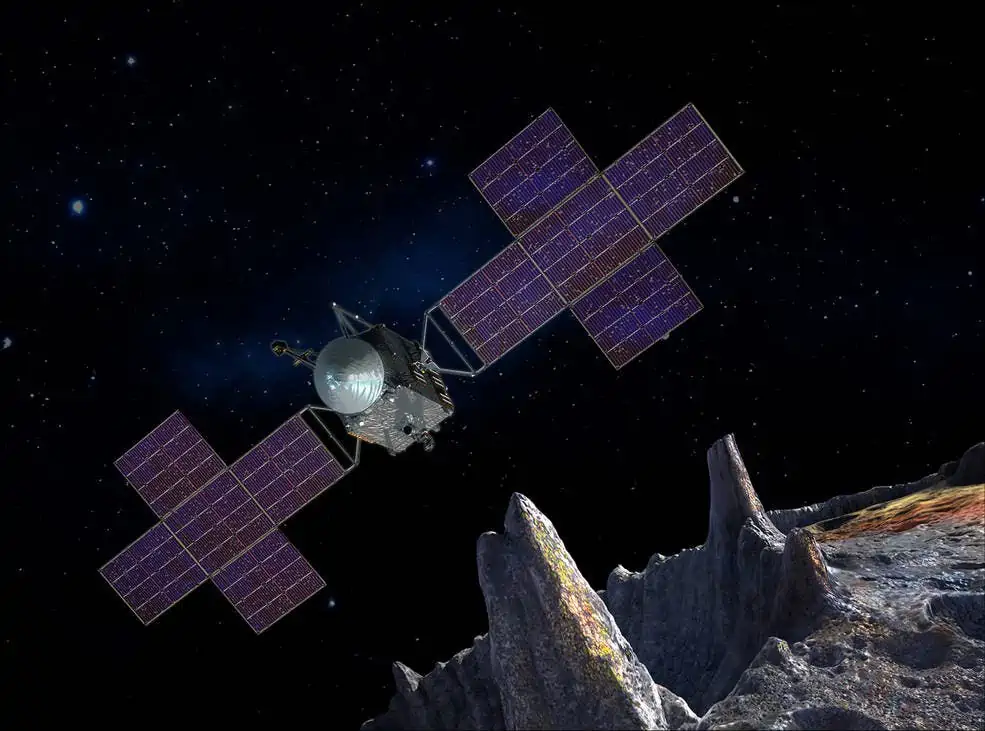
Although the monetary value of the asteroid is staggering, NASA is more interested in what Psyche can reveal about the history of our solar system.
It is believed that the asteroid is, in fact, the exposed core of a protoplanet, providing a unique opportunity to study a planetary core up close. This discovery could provide valuable insights into the early days of the solar system and how terrestrial planets, like Earth, formed.
By studying Psyche, NASA hopes to better understand the building blocks of planets. Essentially, Psyche’s metallic composition may serve as a mirror for the cores of planets like ours, making it a true window into the past of planetary formation. But there is a puzzle: the asteroid seems to be much more complex than initially thought.
New Data and Surprises: Is Psyche Not So Metallic After All?
Until recently, Psyche’s density was estimated to be extremely high, suggesting it was rich in metals. However, more recent observations reveal that its density has been revised downward. This indicates that Psyche’s composition may not be as metallic as previously thought, and that it contains a significant amount of silicates, minerals more common in rocky asteroids.
Additionally, the latest data from JWST brought an even more intriguing revelation: the presence of hydroxyl (OH) and possibly water (H2O) on the asteroid’s surface.
These molecules seem to be reacting with the asteroid’s metals, leading to rust formation. The discovery is surprising because water was not expected to be found on Psyche, raising new questions about its history and origin.
How Is Rust Forming on Psyche?
The key to this discovery lies in the different wavelengths of light absorbed by the molecules present on Psyche. Using advanced instruments such as the Near Infrared Spectrograph (NIRSpec) and the Mid-Infrared Instrument (MIRI) from JWST, scientists were able to observe the asteroid in detail.
The result was the detection of an absorption feature at 3 micrometers, which is typically associated with OH and H2O molecules. This suggests that Psyche’s surface is not purely metallic, as previously thought.
But where is this water coming from? One of the most accepted hypotheses is that Psyche may have formed beyond the solar system’s snow line, a region where it was cold enough for water to condense into ice.
If this hypothesis is true, the asteroid may have migrated to its current position in the asteroid belt, bringing traces of water with it. Another possibility is that this hydration could be the result of impacts from other water-rich asteroids that collided with Psyche.
The Future of Psyche Exploration
Although observations from JWST have revealed new information about Psyche, there are still many unanswered questions.
To better understand this enigmatic asteroid, NASA launched a spacecraft to Psyche in October 2023. The mission is expected to arrive at the asteroid by mid-2029 and promises to provide a more detailed examination of its surface, composition, and internal structure.
With the help of high-precision instruments, NASA’s mission will be able to confirm or refute many of the hypotheses raised thus far.
Asteroid mining, for now, remains a mere speculation, but the scientific data that Psyche may provide promises to be revolutionary, both for science and for the future of space exploration.