Portuguese
  Spanish


India has built a 22-kilometer bridge over the sea to connect Mumbai — and even before its inauguration, an earthquake tested the structure while workers were still on it
Inaugurated in January 2024, the Mumbai Trans Harbour Link — also called Atal Setu — is the longest sea bridge in India. According to Wikipedia, the Mumbai bridge stretches 21.8 kilometers over the Arabian Sea, connecting Mumbai to Navi Mumbai.
Furthermore, the project cost Rs 17,843 crore — equivalent to approximately US$ 2.1 billion — and reduced the travel time between the two cities from 2 hours to just 20 minutes.
Therefore, a journey that previously required facing Mumbai’s chaotic traffic for hours now takes the same time as an episode of a series — thanks to 22 kilometers of concrete and steel over the ocean.
-
Bruno Guimarães, 28, Misses Crucial Penalty Against Norway in World Cup After Replacing Vinicius Jr.

-
Two-Bedroom Home Built in a 40-Foot Shipping Container Delivered and Ready for Same-Day Living in São Paulo Countryside

-
Inspired by a school lesson on Africa’s water crisis, a young boy raised money through chores to fund a well that transformed a Ugandan community.

-
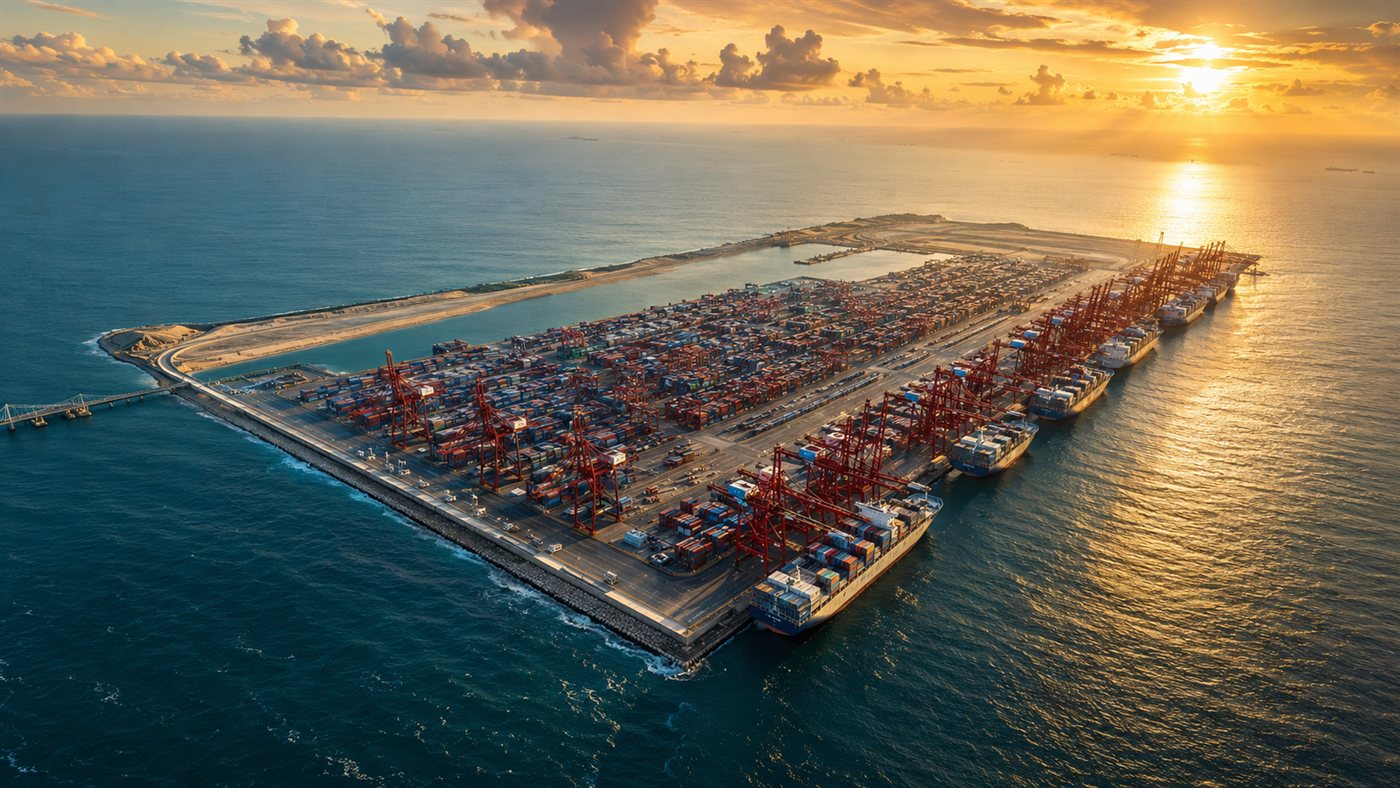
China Constructs Artificial Island 32 km Offshore for Yangshan Port, Connected to Shanghai by 32 km Bridge, Unloading 3,000 Containers in 20 Hours



The impressive numbers of the Mumbai bridge

According to project data, the Mumbai bridge consumed over 177,000 tons of steel and 504,000 cubic meters of concrete. In practice, the volume of concrete used would be enough to build over 200 20-story buildings.
Indeed, the structure is supported by 586 pillars driven into the seabed, some over 40 meters deep in the ocean floor. Consequently, the construction required commercial divers, special barges, and floating cranes operating simultaneously.
Moreover, the bridge has 6 traffic lanes and was designed to withstand winds of up to 212 km/h — a speed equivalent to a tropical cyclone in the Arabian Sea.
In comparison, the famous Rio-Niterói bridge in Brazil is 13 kilometers long — nearly 9 kilometers shorter than the Mumbai bridge.
The day an earthquake tested the Mumbai bridge before its inauguration
Especially during the final phase of construction, an earthquake of magnitude 3.5 struck the area while workers were still on the bridge. According to reports at the time, workers felt the vibration, but the structure absorbed the tremor without any visible damage.
In this sense, the Mumbai bridge is designed to withstand earthquakes of magnitude 6.5 on the Richter scale — over 100 times the energy of the earthquake that tested it prematurely.
Just like the Chenab Bridge in the Himalayas needs to deal with constant earthquakes, the Mumbai bridge operates in an active seismic zone near the western coast of India.
Still, the incident served as an involuntary validation — the structure passed the test that no engineer had planned.
From 2 hours to 20 minutes: the impact on Mumbai’s traffic

Equally transformative is the impact on mobility. Mumbai is one of the cities with the worst traffic in the world — drivers lose an average of 8 days a year stuck in congestion, according to urban mobility studies.
Thus, the Mumbai bridge created a direct route over the sea that completely eliminates the need to cross the city through the center. In practice, those living in Navi Mumbai and working at Mumbai’s international airport now make the trip in 20 minutes instead of 90.
Additionally, the government expects the bridge to reduce traffic on the expressways crossing the center of Mumbai by 20% — benefiting even those who never use the bridge directly.
On the other hand, the toll has generated controversy. To give an idea, the toll for cars is Rs 250 (approximately US$ 3) — an amount considered high for the Indian working class.
How to build 22 kilometers of bridge over the sea without stopping maritime traffic
According to project engineers, one of the biggest challenges was to build the bridge without interrupting the intense maritime traffic of the Mumbai port — one of the busiest in India.
To achieve this, teams built the bridge in prefabricated segments that were transported by barges and lifted by floating cranes. Each segment weighed up to 2,500 tons and needed to be positioned with millimeter precision.
Moreover, marine corrosion posed another challenge. The concrete of the Mumbai bridge contains special additives that resist the destructive action of salt for at least 100 years.
In comparison, Brazilian infrastructure often uses conventional concrete that begins to deteriorate in decades — a direct result of cost-cutting on material specifications.
The Mumbai bridge is just the beginning — India plans more mega bridges

According to the Ministry of Road Transport of India, the country plans to build three more transoceanic bridges in the next two decades, including a connection between the mainland and the Andaman Islands.
Despite this, analysts warn that maintaining a 22-kilometer structure over the sea is as challenging as its construction. Salt, humidity, and constant winds require regular inspections and preventive repairs that will cost billions over the decades.
The construction of the Mumbai bridge also generated environmental controversy. Environmentalists warned that the pillars driven into the seabed disturbed the local marine ecosystem, affecting populations of flamingos and other migratory birds that use the shallow areas of the Arabian Sea as habitat.
However, the Maharashtra government implemented compensatory measures, including the creation of 14 artificial mangrove islands along the bridge route to serve as alternative habitat for the birds.
According to marine biologists, flamingo populations in the region have partially recovered after the completion of the work — although long-term monitoring is still ongoing.
Equally impressive is the bridge’s lighting. In total, 22 kilometers of LED lights have been installed along the structure, making the Mumbai bridge visible from space at night — and creating one of the most spectacular night views of any bridge in the world.
The lighting system consumes energy generated by solar panels installed on the bridge’s side barriers. Therefore, the nighttime lighting of the bridge is partially powered by the sun that illuminates the structure during the day.
In comparison to the Øresund Bridge between Denmark and Sweden — which is 16 kilometers long and cost US$ 4.4 billion in 2000 — the Mumbai bridge offers 6 kilometers more at half the relative cost, adjusted for inflation.
Similarly, the Indian experience in building the bridge is being studied by engineers from Sri Lanka and Bangladesh, who plan similar bridges to connect isolated islands and coastal regions.
According to traffic data from the first months of operation, over 40,000 vehicles cross the Mumbai bridge daily — a number that is expected to rise to 70,000 when the real estate development in Navi Mumbai is complete.
Will the Mumbai bridge maintain its integrity for 100 years as designed — or will the ocean claim its price first?
Ultimately, the 22-kilometer Mumbai bridge proves that India is capable of infrastructure megaprojects that compete with the largest in the world. However, the real test is not building — it is maintaining. And the Arabian Sea, with its cyclones, earthquakes, and corrosive salt, will be the final judge.