Portuguese
  Spanish


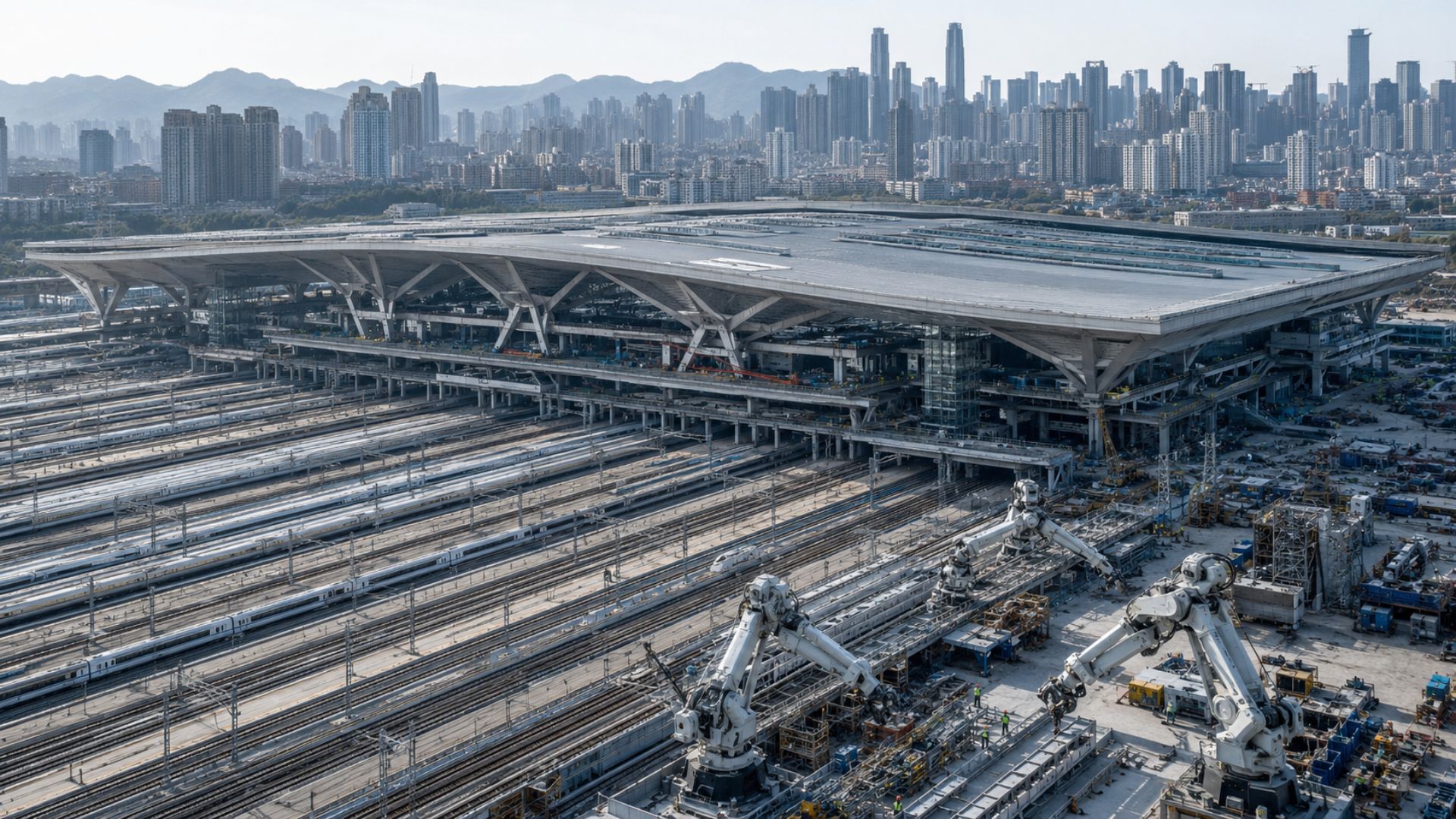


The construction advanced on a site that operated day and night, under heat exceeding 40 degrees, with laser-guided robots leveling concrete three times faster than humans. The result is a terminal of 1.22 million square meters, an area equivalent to about 170 football fields, opened in June 2025 in southwest China.
A colossal eight-story railway station with a 16,500-ton roof, Chongqing East Station was erected in just 38 months, with strong participation from construction robots, and has become one of the largest passenger terminals in the world. Located in the Nan’an district, in southwest China, the station features 15 platforms and 29 tracks, and impresses both for its scale and the speed with which it was completed.
Inaugurated on June 27, 2025, Chongqing East Station went into operation along with a new section of the high-speed railway linking Chongqing to Xiamen. The construction began following project approval in May 2022, and was completed about three years later, a timeframe considered very short for a structure of this size, now regarded as the largest high-speed railway station in western China.
The dimensions of a railway giant

The total construction area reaches 1.22 million square meters, equivalent to about 170 football fields, distributed over eight floors, with four above and four below ground level, in a vertical layout designed to maximize space.
-
Alert in Santa Catarina: the Anita Garibaldi Bridge on BR-101 is completely closed in both directions due to “structural risk,” and drivers are diverted to a 20 km/h detour that promises kilometer-long queues until July 20.

-
More than 6,000 trucks poured nearly 70,000 cubic meters of concrete without interruption for 72 hours to create the largest continuous concrete pour in history and erect a megaproject in Saudi Arabia.
-
28-meter, 156-ton titans traveled 20,000 km from China to the port of Santa Catarina: Portonave received 7 fully electric megacranes, part of a R$ 210 million package, to double container handling.
-
They exchanged the idea of a large house for a 35 m² warehouse, spent US$ 12,000 on the structure, and created a tiny house in Colorado with space to live and work.




It is important to clarify to avoid confusion with the numbers: this 1.22 million square meters refers to the total area of the entire station, not the roof. The metal roof, although gigantic, covers about 120,000 square meters and is precisely the element that weighs 16,500 tons. Even so, the scale of the roof is so large that, according to engineers, its construction was one of the greatest technical and safety challenges of the entire project.
A terminal that brings together various transports

In the same complex converge high-speed train lines, metro networks, urban buses, and taxi services, allowing passengers to switch from one mode of transport to another without having to leave the building, in a concept that China has been calling integration between stations and cities.
This multi-level organization was planned to handle enormous flows of people. The lower floors tend to concentrate urban transport, such as the metro, while the upper levels receive high-speed trains, capable of traveling up to 350 kilometers per hour. The goal is for the station to be able to move tens of millions of passengers per year smoothly, connecting Chongqing to major cities like Beijing and Shanghai.
The army of robots that raised the station


The major highlight of the project, and what caught the world’s attention the most, was the intensive use of construction robots. On a site that operated 24 hours a day, in a city where summer heat exceeds 40 degrees, autonomous machines worked alongside technicians and engineers, in a hybrid model that drastically accelerated the schedule and reduced risks for workers.
Among the equipment used were laser-guided concrete leveling robots, with technologies such as distance sensors, artificial intelligence, and 5G connection, which worked about three times faster than humans. Robots were also employed for floor laying and the installation of heavy glass facades, with panels weighing up to 800 kilograms. According to the company responsible, the approach tripled the average efficiency and reduced labor costs by around 40%.
The engineering of the colossal roof
The metallic roof is undoubtedly one of the greatest technical feats of Chongqing East Station. With its 16,500 tons, assembling it directly dozens of meters high would be risky and logistically complicated. Therefore, the engineers resorted to a special lifting technique, assembling the structure in sections at ground level before raising it.
Once ready, these sections were lifted with the aid of powerful hydraulic jacks controlled by a synchronized computerized system, which raised the roof blocks to the final height of dozens of meters. The covering combines high-strength aluminum panels with stainless steel alloys to ensure durability against corrosion and includes skylights that allow natural light to enter, reducing energy consumption with artificial lighting.
Building in a city of mountains
Another major challenge was the terrain itself. Chongqing is a metropolis known for its rugged topography, full of hills and rocky formations, which makes the construction of large flat structures a complex task. To build the station, it was necessary to prepare the terrain with excavation and containment techniques to ensure a stable base for the enormous weight of the concrete and steel structure.
Drainage and containment systems were designed to protect the complex against landslides and the heavy rains of the region, frequent in this part of China. This combination of difficult terrain, severe climate, and monumental scale helps explain why the completion of the work in 38 months was celebrated as a remarkable feat of Chinese engineering, even by the standards of a country accustomed to megaprojects.
Chongqing East Station symbolizes the rapid pace at which China has been expanding its high-speed transport network, combining monumental scale, automation, and short deadlines. More than a passenger terminal, it is a showcase of the use of robots in civil construction and the concept of integrating large stations into the urban fabric. For Brazil, which is still discussing its first high-speed train projects, examples like this show the size of the challenge and the potential of modern rail transport.
And you, what did you find most impressive about Chongqing East Station: the construction speed in just 38 months, the army of robots, or the scale of a terminal the size of 170 football fields? Do you believe Brazil should invest in high-speed railways like China? Leave your comment, tell us where you are reading from, and share the article with those interested in engineering, trains, and large constructions.