






 Portuguese
  Spanish


Geotubes installed on the seabed in Kerala attempt to contain erosion in Poonthura, where strong waves, fishing communities, and construction delays expose the challenges of coastal protection.
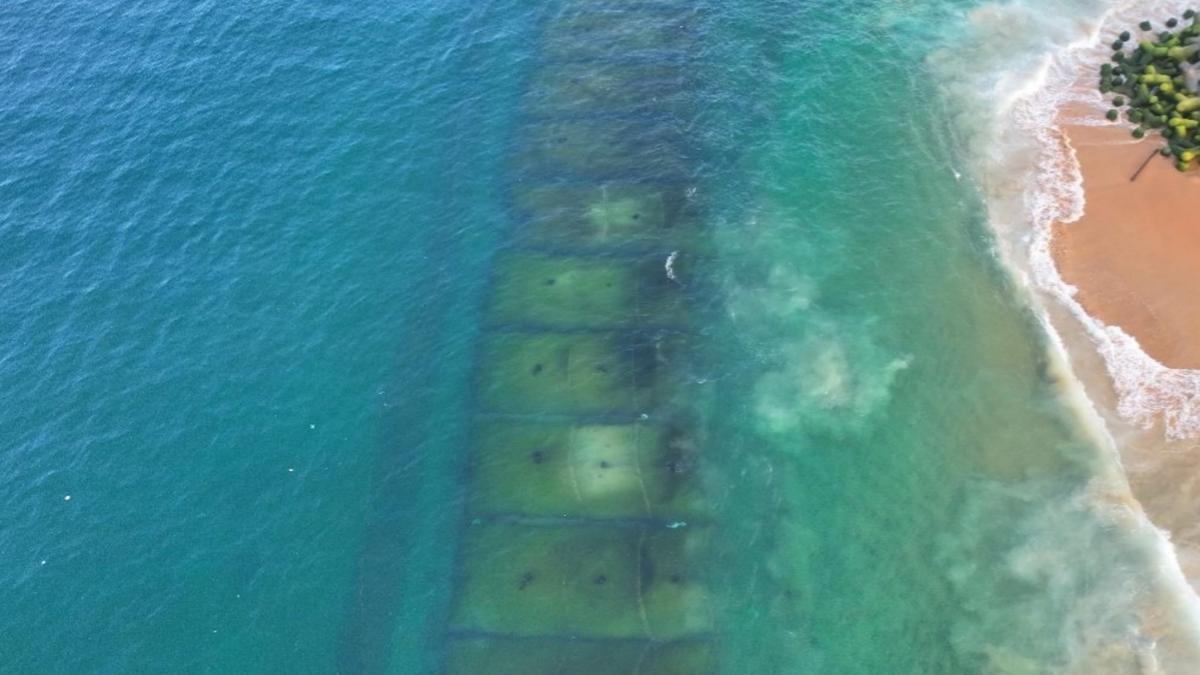
On the coast of Poonthura, in the Indian state of Kerala, giant fabric tubes filled with sand have been installed on the seabed to form a kind of submerged barrier against the force of the waves.
These structures, called geotubes, are about six meters deep and have been positioned between 80 and 120 meters from the sand strip, in a coastal stretch affected by erosion.
The barrier is considered “invisible” because it does not appear as a wall above the beach.
-
China Unveils Most Human-Like Humanoid Robot for Public Sale, Featuring Silicone Skin and 88 Joints, Priced from $17,600

-
Brazil Deploys Water-Landing Ambulance Planes in the Amazon, Cutting Travel Time from 3 Hours to 12 Minutes to Reach Isolated Communities

-
LG Unveils 635-Liter InstaView Fridge with Touch-Activated Door, Craft Ice, UVnano Purification, and Smart Features
-
Astronauts Returning from Space Show Reduced Immune Cells and Thymus Suppression, Highlighting Potential Risks for Long Mars Missions


It operates underwater, reducing the energy of the waves before they reach the coast and helping to create conditions for the gradual accumulation of sand.
The submerged breakwater project in Poonthura was considered operational in 2026, after delays caused by lack of material, import restrictions, and unfavorable sea conditions.
The work, estimated at 20 crore rupees, was planned to protect a vulnerable stretch of the state capital’s coast, Thiruvananthapuram, and reduce the impact of waves on coastal communities.
Geotubes form submerged barrier against erosion
The intervention is conducted by the Kerala State Coastal Area Development Corporation, known by the acronym KSCADC, with technical support from the National Institute of Ocean Technology, NIOT, and funding from the Kerala Infrastructure Investment Fund Board, KIIFB.
The project was presented by the state government as an alternative to traditional coastal structures, such as rock barriers, which had already been associated with environmental and operational concerns in the region.
The initial schedule planned for completion by March 2025, but the deadline was revised to April 2026 after a stoppage started on May 7, 2025.
According to information published by the Times of India, the main obstacle was the shortage of custom-made geotubes, material necessary for the continuation of the offshore installation.
Lack of material stalled the progress of the work at sea
The lack of supplies occurred after the exclusion of a Chinese supplier.
The company had supplied custom geotubes with special authorization from the central government of India, but the purchasing guideline linked to the “Make in India” policy led KSCADC to seek materials only from Indian companies.
As a result, Chinese shipments were blocked by customs, according to the report published by the Indian newspaper.
Since the work depends on parts with specific technical specifications, the change of supplier did not occur immediately.
In the first stage, KSCADC reported that it was looking for companies in Mumbai capable of producing materials compatible with the geotubes used in the already installed sections.
Later, according to updates released by the local press, the resumption of supply began to involve a company from Gujarat to meet the remaining part of the project.
How the giant sand tubes work
Geotubes are large fabric structures filled with sand and installed on the seabed.
In Poonthura, they were positioned parallel to the coast, at an approximate distance of 80 to 120 meters from the shore and about six meters deep.
The technical function of the system is to reduce the force of the waves before they reach the beach and to promote the accumulation of sand along the coastal strip.
The original design cited by KSCADC included tubes of 20, 16, and 12 meters in length, with a circumference of 15 meters, distributed in layers on the seabed.
In later descriptions of the project, the structure was presented as a set of parallel segments of submerged breakwater, installed along a stretch of the Poonthura coast and nearby areas.
Structure protects vulnerable stretches of Kerala
The initially informed area extended from Poonthura Church to Cheriya Muttam, with a broader plan to extend towards Shangumukham.
Later updates indicated that the structure was also related to the protection of stretches near Valiyathura, Beemapally, and Shankhumukham, within the state policy for areas affected by coastal erosion in Thiruvananthapuram.
The project began in February 2022, after obtaining the necessary authorizations, and was executed in partnership with DVP GCC Joint Ventures, based in Mumbai.
The work was monitored as a pilot experience to evaluate the use of geotubes in protecting coastal areas subject to wave action and progressive sand loss.
The delays, however, were already apparent before the halt in 2025.
In 2023, the project faced supply issues and restrictions related to the approaching monsoon, a period when sea conditions hinder offshore activities.
The combination of logistical limitations, dependence on specific materials, and short operational windows contributed to the revision of the schedule.
KSCADC attributed interruption to material and rough seas
According to a KSCADC employee interviewed by the Times of India, two segments installed about 100 meters from the coast had been completed as part of the pilot initiative.
The third segment, in turn, was 50% completed when work was interrupted due to lack of material and unpredictable sea conditions.
The same employee stated that the agency was seeking suppliers capable of reproducing the specifications used in previous stages.
He also said that, with the rough seas, activities were mainly limited to the morning period, which reduced the installation pace.
The completion, at that time, was projected for April 2026.
Execution offshore imposed restrictions that do not apply to conventional land-based works.
Even with mobilized teams, the installation of geotubes depended on more stable seas, operational visibility, and the availability of suitable equipment to position the structures on the ocean floor.
Therefore, the physical progress of the work varied according to the season and weather conditions.
Work was treated as operational in 2026
In April 2026, the work was described as operational by local publications, following the completion of the geotube installation the previous month.
A technical inspection by NIOT was scheduled for April 25, 2026, with the final report expected by May 15 of the same year.
The evaluation should consider, among other points, the behavior of the barrier during the monsoon period.
Monitoring during the southwest monsoon is relevant because this period usually increases wave pressure on the Kerala coastline.
For technicians and authorities involved in the project, performance at this stage helps indicate if the system can reduce erosion in the protected section and if the technology can be replicated in other coastal areas of the state.
Poonthura is a region occupied by fishing communities and frequently appears in discussions about coastal erosion in Kerala.
Local residents and fishermen had already questioned the effectiveness of the system after swells and strong waves, demanding solutions capable of protecting houses, boats, and community structures located near the sea.
Fishing communities monitor the effect of the barrier
The criticisms from fishermen show that the project also involves a social dimension.
Besides the technical result, the project needs to be observed for how it affects the routine of those who live from fishing and occupy areas more exposed to the ocean’s action.
The evaluation of the system, therefore, does not depend solely on the physical completion of the installation but also on the effects perceived in coastal communities over time.
State authorities and representatives of KSCADC, on the other hand, have presented geotubes as a solution with less environmental impact compared to some conventional barriers.
This assessment is attributed to the agency responsible for the project, which pointed out the technology as more suitable for reducing damage to the marine environment and avoiding the intensive use of rocks in coastal structures.
The first phase was announced by KSCADC in February 2025 as successful.
On that occasion, the agency reported that 400 meters out of a planned total of 750 meters had been completed.
The corporation also stated that the system could contribute to erosion control and represent a lower-cost alternative compared to other coastal protection methods.

Monitoring should measure the effect against erosion
Even so, the effectiveness of the submerged breakwater depends on continuous monitoring.
The installation of geotubes is an important stage of the project, but the results need to be measured under different sea conditions, especially during months of greater instability.
This monitoring should indicate if the structure reduces wave force and if it favors the replenishment of the sand strip in the protected section.
The experience in Poonthura has also been observed within a broader debate on coastal works in Kerala.
The state faces erosion at different points along the coast, and local governments are seeking solutions that combine community protection, technical feasibility, and controlled environmental impact.
In this context, the project funded by KIIFB serves as a reference for evaluating alternatives to more rigid structures.
The resumption after supply hurdles shows that the project’s timeline was directly linked to the availability of compatible material and the procurement rules set by the central government of India.
The exclusion of the Chinese supplier, the search for Indian manufacturers, and the need to maintain technical specifications explain part of the delay recorded between the pilot phase and the final stage of installation.
In the coastal stretch served by the project, the main expectation is that the submerged barrier will reduce the impact of waves before they reach the beach.
For the local population, however, the concrete evaluation depends on the effects on erosion, the safety of homes, and the working conditions of fishermen.

The performance of the system during periods of stronger seas should guide the state government’s next decisions on expanding the technology.
In a region where the advance of the sea affects fishing routes, homes, and public structures, the Poonthura project has come to be monitored as a test for coastal protection policies in Kerala.
The technical outcome of the next evaluations should indicate whether the geotubes installed at the seabed can fulfill the intended function and whether the solution will be considered for other vulnerable stretches of the coastline.


