Portuguese
  Spanish


A report from Xataka consulted on July 5, 2026, shows that the Odeillo furnace, in Font-Romeu-Odeillo-Via, concentrates solar energy with 63 movable mirrors and a giant reflector, reaching up to 3,500 °C for research with extreme materials and solar fuels, without generating electricity on a scale like a conventional power plant.
Solar energy is usually associated with photovoltaic panels and plants that deliver electricity to the grid, but the Odeillo Solar Furnace in the French Pyrenees shows another path: using sunlight as a source of extreme heat. The facility is located in Font-Romeu-Odeillo-Via and concentrates solar radiation in a small point.
According to Xataka, the laboratory operated by PROMES-CNRS can multiply the natural intensity of light up to 10,000 times and reach temperatures between 3,300 °C and 3,500 °C. The most curious thing is that this power is not mainly used to generate electricity, but to test materials, industrial processes, and solar fuels.
Odeillo solar furnace is hidden on a slope of the Pyrenees
The Odeillo Solar Furnace is installed in a mountainous region of French Cerdanya, in the Pyrenees. The location was not chosen by chance: the area combines altitude, a large number of sunny days, and an atmosphere with good optical purity, important conditions to reduce radiation losses.
-
DNA Analysis Reveals How Five Cattle Survived Over 130 Years on a Deserted Brazilian Island

-
Private Spacecraft Intercepts Another for First Time in History During U.S. Space Force Mission Completed 11 Hours Early with Rocket Launched in Record 16 Hours

-
Scientists Predict Earth’s Habitable Lifespan: 1.8 Billion Years Before Oceans Evaporate and Sun Forces Planet Out of Life Zone
-
LG Unveils XBOOM Stage 501 Portable Speaker with 25-Hour Battery, AI Karaoke, and Sound by will.i.am in Brazil


This choice helps explain why the facility has become a reference in concentrated solar energy. Instead of occupying a plain with photovoltaic panels, Odeillo uses geography and direct sunlight as part of its own engineering, transforming the mountain into a high-intensity thermal research setting.
Mirrors concentrate the light in a point of just 40 centimeters
The system uses two main optical sets. The first is a field with 63 motorized flat mirrors, capable of following the sun’s movement and continuously reflecting light towards the large fixed parabolic reflector.
Then, this light converges to a focal tower about 40 centimeters in diameter. It is at this concentrated point that solar energy stops seeming gentle and starts behaving like an industrial heat source, reaching temperatures capable of melting resistant materials.
Temperature can reach 3,500 °C without burning fuel
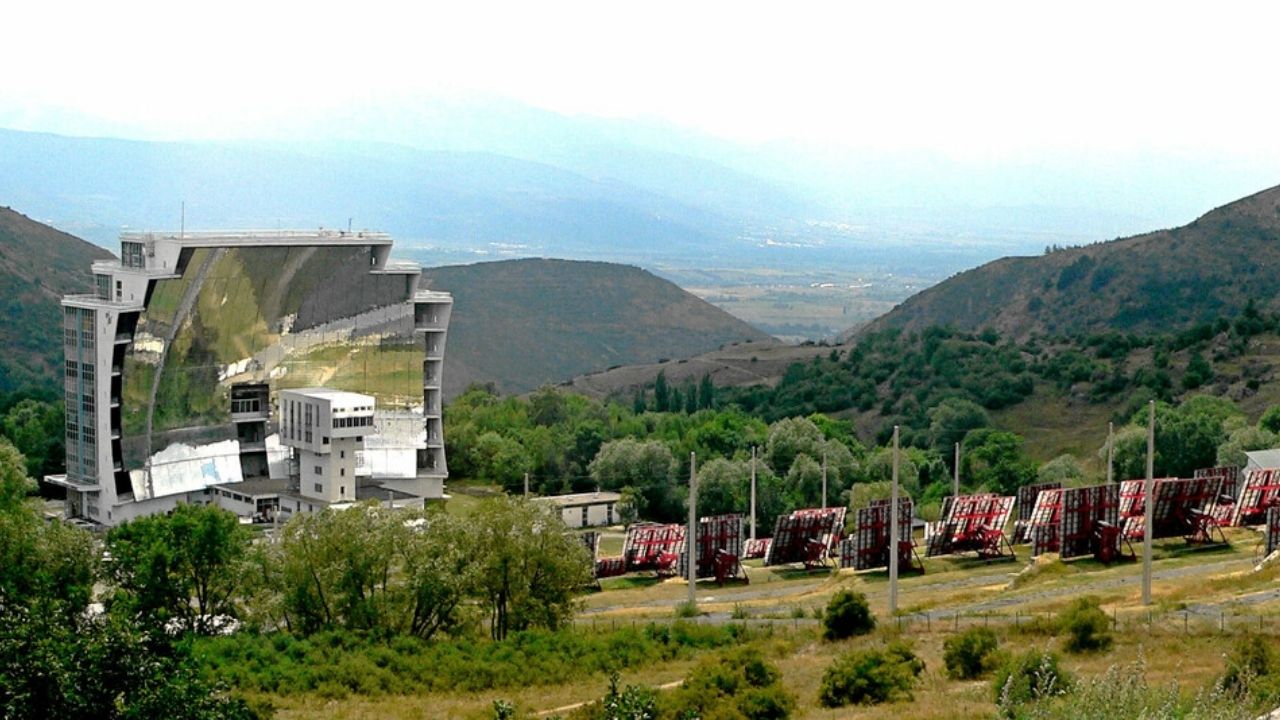
According to data cited by Xataka, the furnace can reach between 3,300 °C and 3,500 °C. This range surpasses the temperature of many conventional industrial processes and shows that the sun, when precisely concentrated, can be used as an extreme thermal tool.
The installation has a nominal thermal power of 1 megawatt. The essential difference is that this solar energy is not primarily converted into electricity, but applied as direct heat to investigate reactions, materials, and technologies that require very severe conditions.
Structure was born before the modern solar energy boom
The origins of the project date back to the 1940s, when chemist Félix Trombe used a repurposed anti-aircraft mirror to concentrate sunlight in experiments. In 1949, a first prototype was built in the citadel of Mont-Louis, just over 10 kilometers from Odeillo.
The current furnace was built between 1962 and 1968 and began operation in 1969. This means that Odeillo was exploring solar energy on an experimental scale long before modern solar plants became common, functioning as a kind of predecessor to solar concentration technologies.
It is not a power plant, and this detail changes everything
Despite the power and impressive appearance, the Odeillo Solar Furnace should not be confused with an electricity generation plant. The source itself highlights that it does not produce electricity significantly nor integrates into the current renewable matrix as a conventional plant.
This difference is important to avoid exaggerated interpretations. The value of the furnace lies in research, not in delivering energy to homes or businesses, which places the installation closer to an industrial laboratory than a commercial solar energy plant.
Extreme materials are tested with concentrated solar heat
One of the current applications of the furnace is in the study and manufacture of materials resistant to extreme conditions. This type of research may interest areas such as the aerospace industry, high-temperature processes, and the development of materials capable of withstanding aggressive environments.
By using concentrated solar energy, researchers can subject samples to intense heat without directly relying on conventional combustion at the focal point. This opens up opportunities to investigate materials under conditions difficult to reproduce with common methods, especially when the goal is to understand resistance, stability, and thermal performance.
Solar fuels also enter the research path
Another field mentioned by the source is the development of solar fuels. The example mentioned is the Sunfuel project, which uses the heat of a solar furnace to heat metal oxides and generate gases later converted into clean fuels.
This type of research still belongs to the technological and experimental field, not a ready commercial solution to replace fossil fuels on a large scale. Even so, it shows why solar energy can go beyond panels: it can also serve as process heat to manufacture future inputs.
Odeillo competes for prominence with installation in Uzbekistan
Xataka compares Odeillo to the solar furnace in Parkent, Uzbekistan, pointing out that both are among the largest and most powerful installations of their kind in the world. The difference lies in the usable power: according to SolarPACES cited by the source, Odeillo reaches 1,000 kW, while Parkent is limited to about 700 kW.
The explanation involves altitude. Odeillo is around 1,600 meters, while Parkent is approximately 1,050 meters, which reduces the solar intensity available at the Uzbek installation. In practice, the comparison reinforces the role of the Pyrenees as part of the performance of the French laboratory.
What Odeillo reveals about the future of solar energy
The Odeillo Solar Furnace shows that solar energy does not need to be thought of only as electricity coming from panels or solar towers. It can also be concentrated heat, a laboratory tool, a source for testing materials, and a path for researching fuels less dependent on carbon.
The question that remains is whether such technologies should receive more attention in the energy transition, even without generating electricity on a large scale. Do you think the solar energy of the future will be more in city panels or in laboratories capable of manufacturing materials and fuels with extreme heat? Leave your opinion in the comments.