Portuguese
  Spanish


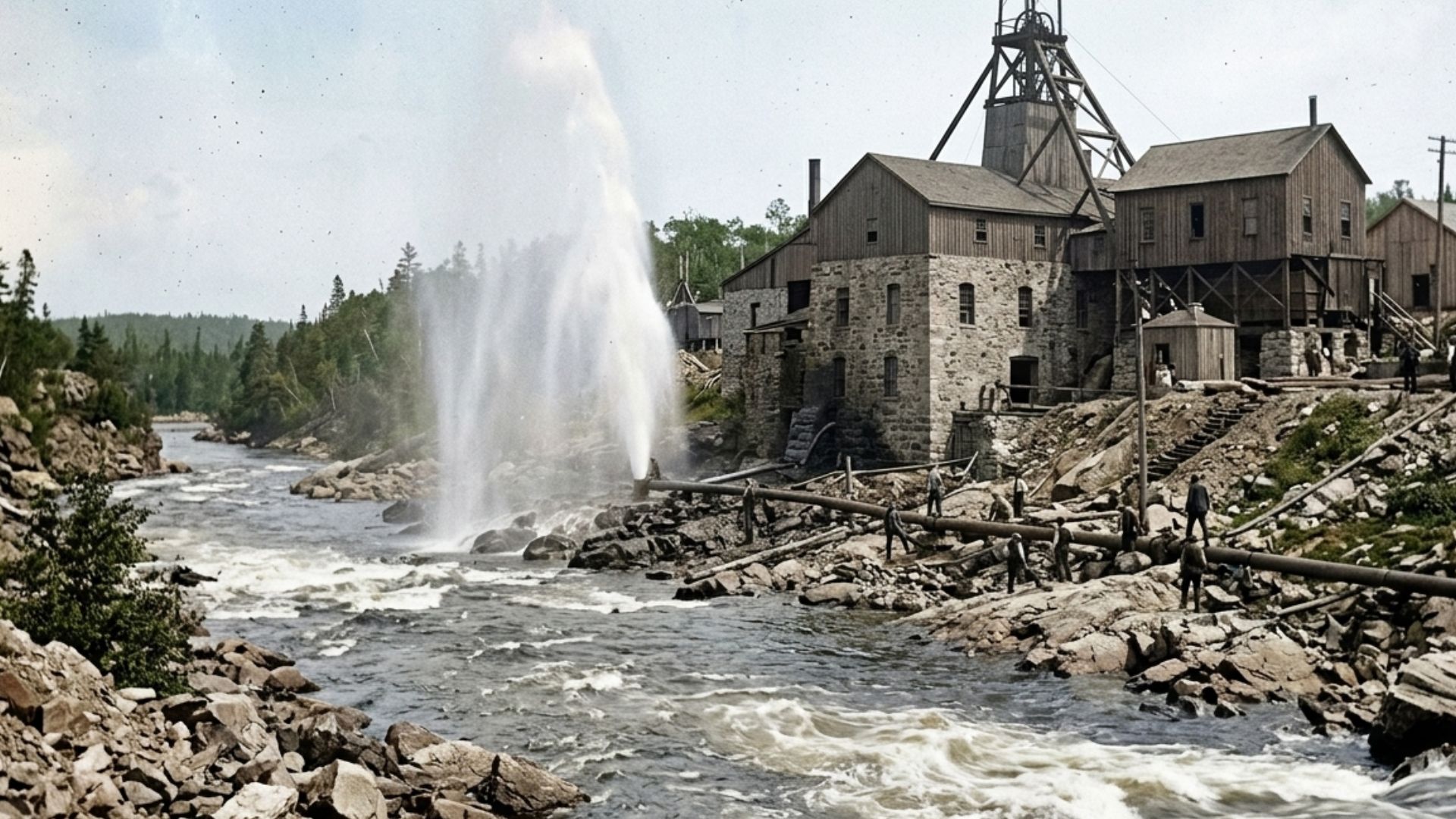

Hydraulic compressor of Ragged Chutes, in Canada, generated compressed air for decades using water and gravity, without engines or electricity.
In the early 20th century, when industrial electrification was still advancing unevenly, engineers in Canada put into operation a facility that even today seems unlikely. In Ragged Chutes, on the Montreal River, in Ontario, the system began generating large volumes of compressed air without engines, without electricity, and without the mechanical compressors that would dominate the industry in the following decades.
The project went into service in 1910 to supply the silver mining community of Cobalt and became one of the most impressive examples of hydraulic engineering applied to mining. Its operation relied solely on running water, gravity, and the intelligent design of wells, chambers, and underground pipelines.
How the hydraulic compressor of Ragged Chutes transformed water into compressed air
The installation was a type of hydraulic air compressor, a technology also known as trompe. The principle consisted of making water descend with air dragged into the system, naturally compressing this air as the liquid column increased pressure in depth.
-
Berries, Strawberries, and Blueberries Could Transform Agriculture in Northeastern Brazil, New Tests Reveal

-
Danish Resident Discovers Six Viking Gold Bracelets Weighing 762.5 Grams, Third Largest Gold Treasure in Denmark

-
Over 200 Cities in Southern Brazil on Storm Alert as Cyclone Near Uruguay Brings Heavy Rain, Hail, and Winds Up to 100 km/h

-
Archaeologists Discover 2,300-Year-Old Beer in Sealed Bronze Vessel from Ancient Chinese Tomb





In Ragged Chutes, river water was channeled into the descent wells, carrying air bubbles into the flow. At the bottom, a chamber separated water and air, allowing the compressed air to be sent through pipelines to power industrial equipment and mining operations.
The most extraordinary aspect was the simplicity of the process. According to modern technical descriptions of the system, the compressor operated without moving parts and without direct external energy input for compression, because gravity itself did the work that would normally be performed by mechanical machines.
Deep wells, underground chamber, and network of pipes formed the machine
The most cited historical descriptions for Ragged Chutes show that the system was anything but small. One of the technical surveys on the installation points to wells about 341 feet deep, something close to 104 meters, while the IESO summarizes the concept by stating that the plant launched the water and air mixture to a depth of 107 meters in a run-of-river type system.
In addition to the wells, there was a large underground chamber for separating air and water. The compressed air then traveled through an extensive network of pipes to the mines in the Cobalt region, where it was used in pneumatic tools and other processes related to mining activity.

This scale helps explain why Ragged Chutes entered the history of Canadian mining. It was not a laboratory experiment, but a real energy supply infrastructure for an important mineral hub at the beginning of the 20th century.
Compressor without electricity operated for about 70 years and became a reference for efficiency
One of the most remarkable features of the project was its longevity. Technical sources linked to the modern study of hydraulic compressors describe Ragged Chutes as an installation that provided compressed air over an operational life of about 70 years, something unusual for high-demand industrial equipment.
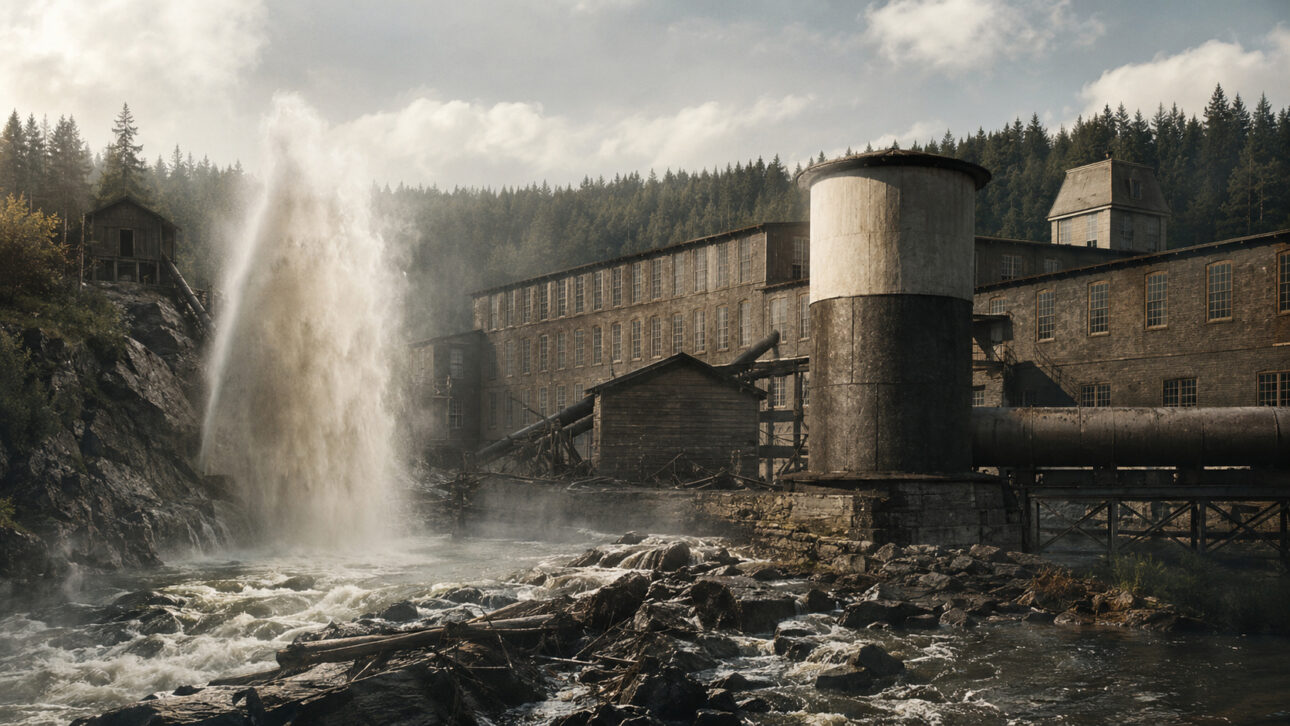
Another important point was the very nature of the compression. As the air was compressed in contact with water, the process approached isothermal compression, a condition considered more efficient than conventional mechanical compression, which heats the gas more during the process.
This also helped deliver cooler and cleaner air. In modern evaluations of the technology, versions of the concept are described as capable of providing cooled and oil-free air, with relevant operational advantages for industrial and underground environments.
Why the technology was abandoned even though it was so ingenious
Despite the technical success, the technology lost ground throughout the 20th century. The advancement of electricity and mechanized compressors made energy distribution more versatile and easier to adapt to different types of industrial installations.

IESO itself summarizes this shift by pointing out that, by the 1970s, air compression in run of river systems like Ragged Chutes had been replaced by mechanized solutions.
In practice, the new electrical infrastructure offered more flexibility than large hydraulic systems dependent on very specific geography.
This does not mean that the principle has been surpassed from a thermodynamic point of view. What occurred was a change in industrial, logistical, and economic convenience in favor of technologies easier to install in a wide variety of locations.
Ragged Chutes once again inspired efficient mining projects in the 21st century
Decades later, the idea once again caught the attention of researchers and engineers in Ontario. The IESO reports that Dean Millar, from Laurentian University and Electrale Innovation, revisited the concept to develop modern versions of hydraulic air compression aimed at the current needs of deep mining.
According to the organization, the modern proposal seeks to reduce energy consumption and operational costs compared to traditional mechanical compressors.
In the evaluation presented in the project, the adoption of the principle could generate energy savings of around 13%, as well as increase durability due to the much smaller number of components subject to wear.
This is why Ragged Chutes remains so fascinating more than a century later. The installation showed that it was possible to produce compressed air with water and gravity, without engines or gears, and still serves as a reference for research in sustainable mining, energy efficiency, and long-lasting industrial systems.